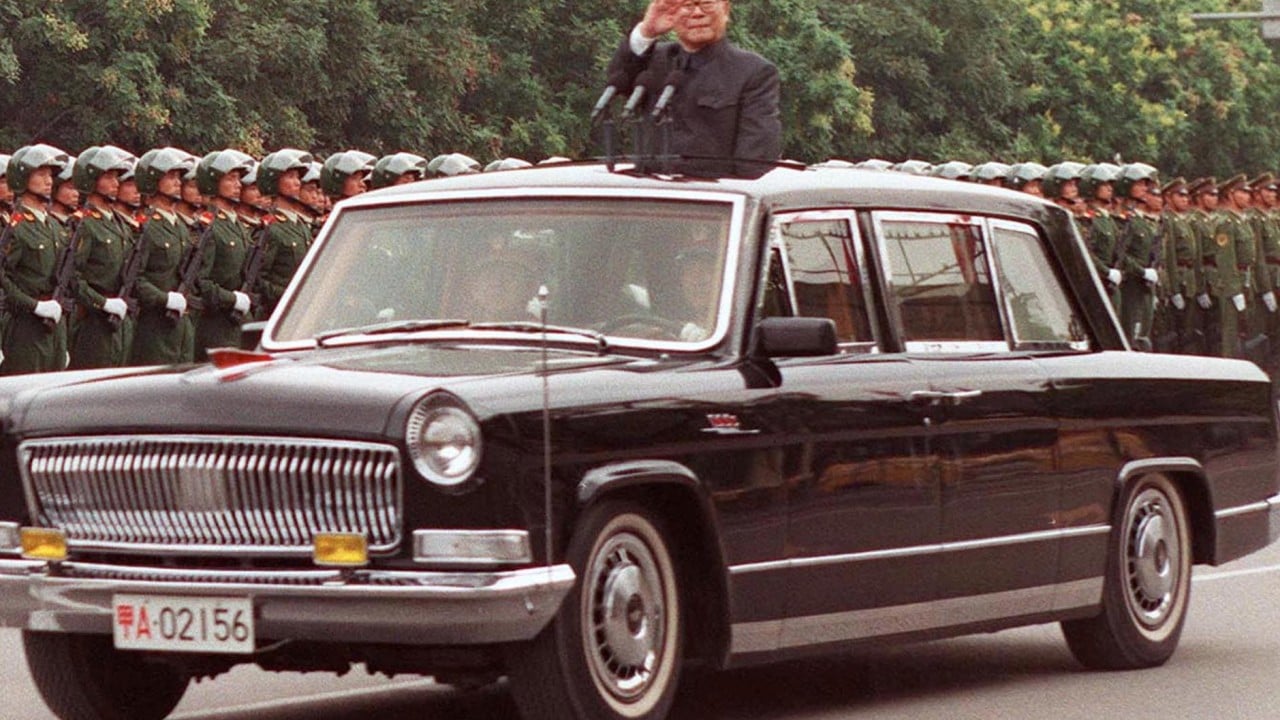
The wind off the Bohai Sea does not care about doctrine. It sweeps down the gray concrete of military academies, rattles the barbed wire of border outposts, and bites at the ears of nineteen-year-old conscripts who are trying very hard not to blink during inspection.
Stand on a parade ground in northern China on a freezing morning, and you can smell the machine oil and scorched coal. You can hear the rhythmic, thunderous stamp of twenty thousand boots hitting the earth as one. It sounds like a heartbeat. But whose?
That is the question hanging over every barracks, every briefing room, and every quiet command bunker from Beijing to the Taiwan Strait. When a top military official stands beneath the portraits of past architects to speak about obedience, he is not just reciting history. He is summoning a ghost. And that ghost still holds the reins.
Loyalty.
It is a word that sounds clean and sharp on paper, like a bayonet fresh from the grindstone. In practice, it is messy, complicated, and soaked in the blood of internal politics.
Consider what happens when a massive state machine tries to modernize. You give a twenty-two-year-old lieutenant a tablet computer that links directly to satellite feeds. You hand him the keys to a hypersonic missile battery that can strike targets a thousand miles away with terrifying precision. You teach him calculus, cyber defense, and orbital mechanics. You transform him into a digital warrior.
Then you ask yourself the terrifying question that keeps generals awake at midnight: When the screen lights up with an order that contradicts his conscience, his family's safety, or his own survival instincts, what stops him from walking away?
Technology does not answer that. Silicon chips do not inspire self-sacrifice. Satellites do not demand devotion.
So the leadership looks backward to look forward.
They channel the specter of Jiang Zemin. Not necessarily as a nostalgic nod to the economic boom years of the late nineties and early noughties, but as the iron-willed architect who pulled a fractured military back from the brink of institutional chaos.
Let us step back for a moment. Picture the Chinese military in the mid-1990s. It was a sprawling, mercantile behemoth. Soldiers were running commercial enterprises, from pig farms to hotels, to fund their own operations. Generals were distracted by profit margins. The force was bloated, corrupt, and dangerously undisciplined. It was an army that knew how to do business, but it was an open question whether it knew how to fight.
Then came the mandate. The directive was simple, brutal, and absolute: The military must stop doing business. It must return to its core function. It must pledge absolute, unyielding political obedience to the Party.
That turnaround required an iron fist wrapped in velvet diplomacy. It required cementing the idea that the gun must always obey the command, never the wallet.
When modern leaders invoke that era today, they are issuing a stark warning. The corruption purges that have rattled the upper echelons of the People's Liberation Army over the past decade are not administrative housekeeping. They are existential surgery.
I remember talking with a retired defense analyst in a smoky teahouse in Chengdu years ago. He stirred his brew with a thin bamboo stick, watching the tea leaves settle into chaotic patterns.
"An army with advanced weapons and weak loyalty is just a very expensive warehouse fire waiting to happen," he told me, his voice barely rising above the murmur of the room. "You can buy steel. You can buy microprocessors. You can copy a hull design from a satellite photo. But you cannot purchase the moment a man decides to stay at his post while the roof caves in."
That is the invisible stake in every policy speech delivered by military commissars.
When a senior general stands before an auditorium of subordinate commanders to remind them of historical legacies, he is translating a high-stakes calculus into human terms. He is saying: We have the hardware now. We have the stealth fighters, the aircraft carriers, the quantum communication links. But none of it matters if the mind at the trigger hesitates.
To understand this dynamic, you have to look past the crisp uniforms and the polished propaganda reels. You have to look at the psychological architecture of an institution designed to project absolute power outward by maintaining absolute control inward.
The modern battlefield is chaotic. It is decentralized. In past centuries, a general stood on a hill and watched the lines clash. Today, a squad leader in a contested archipelago might find himself cut off from communications, forced to make a split-second decision that could trigger a regional war.
How do you program loyalty into an autonomous unit?
You cannot. You can only instill it through a deep, cultural saturation of ideology. You bind the soldier's personal identity so tightly to the collective mission that dissent becomes psychologically unthinkable.
This is where the legacy of past leaders becomes a tactical asset. By tying modern readiness to historical survival, the leadership creates a narrative of inevitability. They frame obedience not as a burden, but as the ultimate shield against foreign encirclement and internal decay.
Critics in Western capitals often look at these speeches and dismiss them as hollow ritual. They see empty rhetoric, communist party theater, and stale ideological boilerplate.
That is a dangerous miscalculation.
Ritual matters. Symbols matter. When repeated often enough in the echoing halls of military academies, these stories shape reality. They create a shared vocabulary of duty that bridges the gap between a peasant conscript from Sichuan and a cyber-warfare officer in Shanghai.
Consider the sheer scale of the transformation. Over the past three decades, the military has shifted from a massive, low-tech infantry force into a high-tech joint command capable of dominating its regional periphery. That kind of rapid institutional evolution usually tears organizations apart from the inside. It breeds resentment among the old guard, confusion among the recruits, and anxiety among the officer corps.
How did they hold it together?
Through an unyielding insistence on political orthodoxy. Every technological leap forward has been matched by a tightening of political reins. Every new destroyer launched into the gray waters of the Pacific is christened with a heavy dose of ideological conditioning.
The message is relentless. The technology changes, but the master does not.
As we watch geopolitical tensions rise across the Indo-Pacific, the spotlight often falls on tonnage, missile ranges, and carrier groups. Analysts count warheads like baseball cards, comparing numbers on spreadsheets as if war were an actuarial exercise.
They miss the human core.
Behind every radar screen is a human being weighing the cost of obedience. Behind every launch code is a chain of command built entirely on trust, fear, and shared belief.
When a top general stands up to invoke the past, he is reaching across time to steady the hand of the modern soldier. He is reminding them that the machine only moves when the human spirit inside it stops questioning the destination.
The wind continues to howl across the parade grounds. The boots still strike the concrete in unison. And somewhere in the dark, a young officer stares at his glowing console, waiting for an order that will test every word he was ever taught.