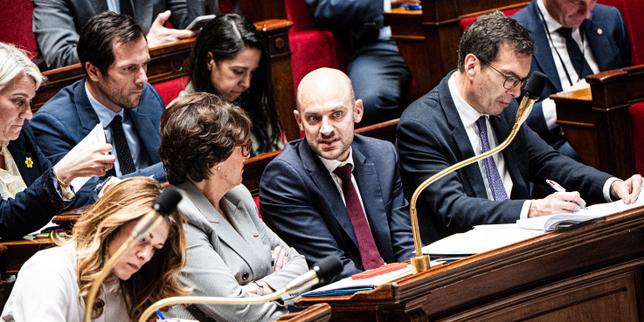
The air in the Quai d’Orsay always carries a scent of old paper and expensive cologne. It is a place where words are weighed like precious stones before being released into the world. But recently, a specific set of words fell from the lips of Jean-Noël Barrot, the French Minister for Europe and Foreign Affairs, and they didn't land with the grace of a diplomat. They landed with the thud of a ghost.
Barrot stood before an audience and dusted off a rhetorical relic. He spoke of Israel’s "moral superiority," a phrase that feels like it belongs to a black-and-white newsreel from a different century. To hear it in 2024, or projected into the uncertainties of 2026, is to witness a man trying to fix a leaking nuclear reactor with a roll of vintage scotch tape. For a different look, see: this related article.
The argument is simple, at least on the surface. It suggests that because a state is a democracy, its military actions are inherently bathed in a different light than those of its adversaries. It posits that the "purity of arms" is not just a goal, but an intrinsic state of being. But for a father sitting in the dust of a collapsed apartment block in Gaza, or a family huddled in a shelter in northern Israel waiting for the sky to fall, "moral superiority" is a ghost story told by people who have never had to wash the metallic scent of blood off their hands.
The Weight of the Invisible Scale
Imagine a woman named Sarah. She lives in a world of spreadsheets and school runs. She is a hypothetical stand-in for the millions who try to make sense of the headlines over coffee. Sarah hears the Minister speak about moral superiority and she feels a flicker of comfort. It suggests there is a "right" side, a clean side, a side where the ledger of human suffering is managed with a divine sense of accounting. Related analysis regarding this has been shared by USA Today.
Then she sees the images.
She sees the gray-white dust that coats the skin of children pulled from the rubble. She hears the statistics—tens of thousands dead, infrastructure vaporized, a generation of trauma being sown into the soil like salt. The comfort of the Minister's words begins to sour. She realizes that the "moral" argument isn’t being used to describe the reality on the ground; it is being used to bypass it.
Barrot's maneuver is not new. It is a rhetorical shield. When the civilian death toll becomes mathematically impossible to ignore, the shield is raised. It says: Our intentions are good, therefore the outcome is justified. It creates a world where a bomb dropped by a democracy is morally distinct from a rocket fired by a militia, even if the shrapnel feels exactly the same when it enters a human body.
The Problem with High-Ground Diplomacy
The danger of this language lies in its finality. Once you claim the moral high ground, you stop looking at the map. You assume that wherever you stand, the ground must be high because you are the one standing on it.
In the halls of French power, this resurgence of "moral superiority" marks a shift away from the traditional Gaullist "middle path." France used to pride itself on being the bridge-builder, the power that could speak to all sides because it refused to lean entirely into the Manichean struggle of "good versus evil." By adopting this specific vocabulary, Barrot isn’t just defending a country; he is abandoning a legacy of nuance.
Logic dictates that morality in conflict is not a static trait. It is a daily, hourly choice. It is found in the restraint shown by a sniper. It is found in the corridors of a hospital that chooses to treat the "enemy." It is not a trophy that a state wins once and keeps on a shelf forever. To suggest otherwise is to treat ethics like a membership card rather than a grueling, ongoing practice.
The Human Ledger
Let’s step away from the podiums and look at the numbers, though the numbers themselves are a form of violence. When we talk about "superiority," we are implicitly comparing. We are saying that X number of lives on one side are weighed differently because of the political system they live under.
But a heart beats at the same frequency in Tel Aviv as it does in Gaza City. Fear doesn't have a voting record. Grief doesn't care about the democratic credentials of the government that issued the order.
The Minister’s argument relies on the idea of the "unintentional" tragedy. It assumes that as long as the target was military, the civilian lives lost are mere "collateral." It is a cold, mathematical word for a warm, breathing human life. In any other context, we would call this a failure of the highest order. In the context of "moral superiority," it is framed as a tragic necessity.
The disconnect is widening. On one side, you have the sanitized language of European diplomacy, filled with caveats and historical echoes. On the other, you have the raw, unedited reality of a conflict that has become a meat grinder for human potential. Barrot is speaking to the past, hoping that the old spells still work. They don't.
The Cracks in the Narrative
We are living in an era where the "invisible stakes" have become visible. Technology has stripped away the delay between a strike and its witness. We see the consequences in high definition, often in real-time. The old arguments were designed for a time when the public only saw what the state wanted them to see. Today, the "moral shield" is being pierced by a billion smartphone lenses.
Consider the psychological cost of this rhetoric on the people it claims to defend. To tell a soldier that they are "morally superior" by birthright or by flag is to unburden them of the very thing that makes them human: the heavy, painful weight of conscience. If you are told you are inherently good, you stop questioning whether your actions are right.
This is the hidden cost of Barrot’s argument. It doesn't just dehumanize the victim; it hollows out the victor.
Beyond the Binary
The real tragedy is that this language prevents the only thing that can actually stop the bleeding: empathy. Empathy is messy. It requires admitting that your side can be cruel. It requires acknowledging that the "enemy" has a mother who will weep just as loudly as yours.
When a high-ranking official like Barrot reaches for the "moral superiority" card, he is effectively shutting down the conversation. He is saying there is nothing left to discuss because the character of the actors has already been judged. It is the diplomatic equivalent of a "get out of jail free" card, used to bypass the grueling work of international law and human rights accountability.
But the world is no longer interested in cards. It is interested in the bodies. It is interested in the children who will grow up without limbs or without parents, or both. It is interested in why, after decades of "superior" diplomacy, the region is more of a powder keg than ever.
The Silence After the Speech
After the microphones are switched off and the Minister leaves the room, the words remain hanging in the air. They don't provide food. They don't stop rockets. They don't rebuild schools. They are merely a comfort for the comfortable.
True moral authority isn't something you claim in a speech. It is something you earn through the grueling, unpopular work of peace. It is found in the courage to tell your allies "no." It is found in the strength to see the humanity in the person who hates you.
Barrot’s argument is a retreat into the familiar. It is a sign of an establishment that has run out of ideas and is falling back on the songs of its youth. But the tune is off-key. The world has moved on, and the ghosts of old arguments are no longer enough to haunt us into silence.
The dust in the air of the Quai d’Orsay eventually settles. The papers are filed away. But outside, in the heat and the wind, the reality of the human element persists. It doesn't care about superiority. It only cares about survival.
The Minister speaks of a moral shield, but the shield is made of glass, and it is already beginning to shatter under the weight of the truth.