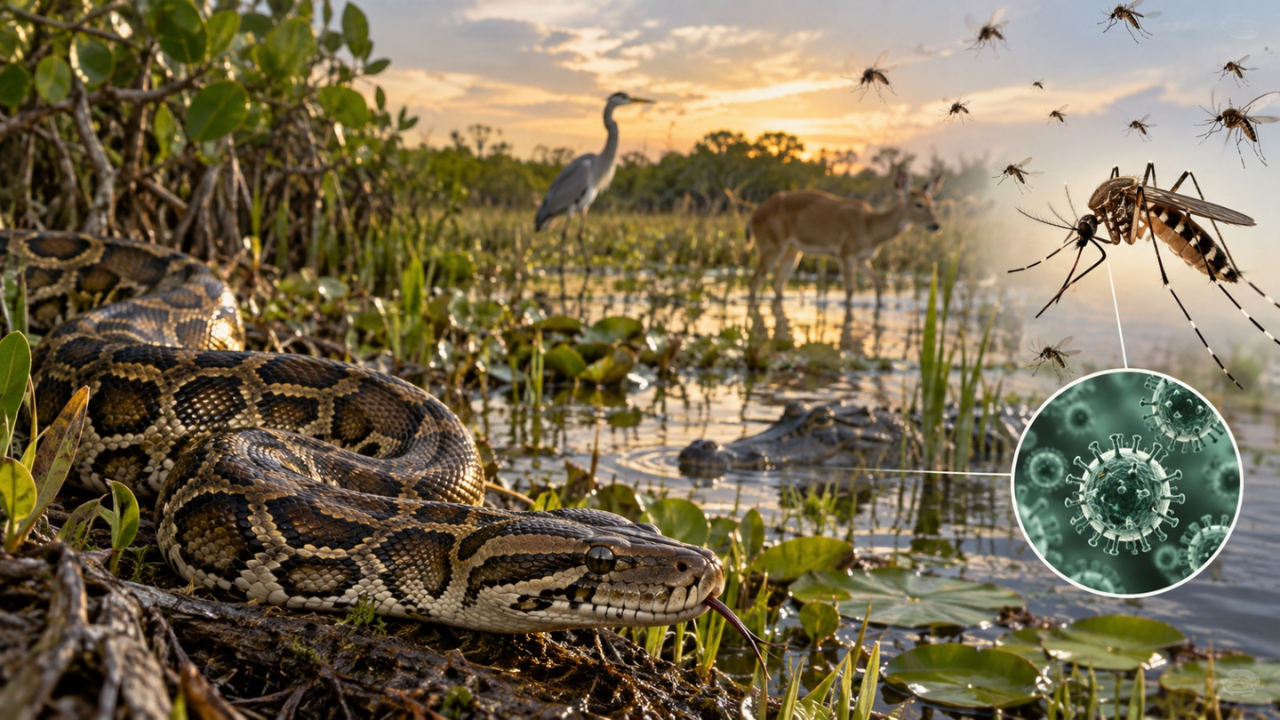
Dawn in the River of Grass does not break with a trumpet call. It seeps. First, the water turns the color of tattered pewter beneath a low, bruised sky. Then, the sawgrass rustles—not from wind, but from the sudden, heavy slide of something cold against mud.
For decades, the story of the Florida Everglades was written in broad, predictable strokes. Alligators ruled the sloughs. Wading birds painted the cypress canopies in flashes of snowy white and roseate pink. It was an ancient, brutal choreography of survival, finely tuned over millennia.
Then came the giants from the East.
They arrived in cardboard boxes, smuggled through the exotic pet trade, little ribbons of muscle and malice no longer than a pencil. When they outgrew their tanks, or when hurricanes shattered backyard cages, people dropped them into the canals. And the swamp, vast and humid and drowning in prey, said yes.
Burmese pythons didn't just adapt to the Everglades. They colonized it. Growing up to eighteen feet long with skin patterned like fractured mahogany, these apex predators became invisible ghosts. They slid beneath the dark water without a ripple. They waited in the crooks of strangler figs. And slowly, agonizingly, they began to empty the forest.
The Silence That Followed
Walk through the hammock trails of Everglades National Park today, and the absence will strike you before anything else. It is a hollow kind of quiet.
Bobcats? Gone. Raccoons? Rare. Opossums, marsh rabbits, foxes—mammal populations across vast stretches of the park plummeted by ninety percent or more in less than two decades. To understand the magnitude of this crash, imagine walking through a bustling metropolis where every ninth-floor window and sidewalk is suddenly empty. No cars. No footsteps. Just the whistling of the wind through abandoned concrete.
Scientists who spent their lives tracking these creatures found themselves staring at empty telemetry screens. The signals flatlined.
As a hypothetical field biologist standing knee-deep in tea-colored water might tell you, nature abhors a vacuum. But nature is also a master accountant. When you remove millions of pounds of warm-blooded mammals from an ecosystem, the ledger does not simply balance itself out. It violently tips.
The pythons had eaten the mammals. But in doing so, they triggered a chain reaction that nobody saw coming. A microscopic, buzzing ripple effect that would eventually reach out of the swamp and tap directly on human front doors.
The Unseen Shift
Mosquitoes do not care about pythons. Or so the logic went.
For years, research into the python invasion focused entirely on the visible carnage—the swallowed deer, the bloated snakes captured by state wranglers, the desperate scramble to protect native panther corridors. But ecosystems are intricate webs of invisible threads. Pull one thread, and the whole tapestry shudders.
Consider what happens when you remove the primary midnight snack of the local mosquito population.
In the undisturbed Everglades, mosquitoes had choices. They could bite a marsh rabbit, a raccoon, an opossum, or a wading bird. Different mosquito species developed distinct preferences. Some specialized in the fur-bearing mammals that slept in hollow logs and dense brush.
Enter the python. As the snakes systematically vacuumed up the mammals, those furry hosts vanished from the landscape. The raccoons were gone. The cotton rats were gone.
The mosquitoes were left hovering in the humid night, starving, their specialized feeding strategies suddenly useless.
So they adapted. Or rather, the species capable of adapting survived, while the others waned. The common malaria mosquito and other vectors found themselves sharing a swamp with a new kind of giant. Pythons are cold-blooded, yes, but they breathe, they radiate heat, and crucially, their scales offer exposed patches of skin and well-vascularized tissue where a hungry insect can drill.
More importantly, with the furry mammal shield gone, certain mosquito species shifted their dietary allegiance toward the remaining fauna. And in the Everglades, the remaining abundant, large-bodied animals weren't furry mammals anymore. They were wading birds. They were reptiles. And, increasingly, they were whatever happened to cross the path of a swamp encroaching on human suburbs.
The Ripple at the Screen Door
This is where the story stops being just about a strange ecological tragedy in a remote wetland and starts becoming intensely personal.
Picture a suburban kitchen in Broward County, the air-conditioning unit humming a low, rattling tune against the relentless exterior heat. A homeowner steps out onto the back porch to take out the recycling at dusk.
Slap.
It is just a mosquito bite, right? A minor annoyance of Florida living, solved by a quick swipe of the hand and a can of bug spray.
Except the biology driving that bite has been fundamentally rewired fifty miles to the west.
When pythons decimated the small mammal population, they inadvertently concentrated disease vectors. Studies examining blood meals in Everglades mosquitoes revealed a stark transformation in feeding patterns. Without raccoons and bobcats to feed on, certain mosquito populations swelled by shifting their targets, amplifying the transmission cycles of avian-borne pathogens and altering the microbial landscape of the swamp.
When an ecosystem loses its buffers, disease doesn't just disappear; it looks for a new highway. The collapse of mammalian biodiversity removed the dilution effect—a ecological principle where a diverse array of hosts helps keep pathogen transmission rates diluted and stable. With fewer species absorbing the bites, the remaining hosts carry a heavier epidemiological load.
The snake in the sawgrass is terrifying because of its bulk, its crushing coils, its alien amber eyes. But the true danger of the Burmese python invasion has always been quieter. It is microscopic. It hums in the dark.
Living in the Aftermath
To stand in the Everglades today is to witness a landscape caught between two eras.
Teams of python hunters scour the levees at night, armed with flashlights and snake hooks, hunting creatures that can lay a clutch of fifty eggs and disappear into a limestone fissure. They pull out monsters weighing over a hundred pounds, beasts that look like living fossils draped over the hoods of swamp buggies.
Yet, for every python removed, thousands remain, sliding through the water like liquid shadow.
We created this. The pet trade of the late twentieth century was casual, unregulated, and shockingly short-sighted. People bought cute baby snakes without asking what happens when a twelve-inch ribbon turns into a sixteen-foot engine of muscle. We brought them here, and when they became inconvenient, we let them go.
Nature does not forgive debts; she simply collects them in unexpected currency.
The mosquito shift is a reminder that you cannot dismantle the engine of an ancient ecosystem and expect the car to keep driving smoothly just because the headlights still work. Every mammal eaten by a python was a stitch holding the ecological fabric together. As those stitches broke, the seams frayed, letting in pests, pathogens, and imbalances that ripple outward into our neighborhoods, our health, and our future.
The sun sinks lower over the marsh, turning the water the color of old copper. A great blue heron stands frozen in the shallows, sharp-eyed and patient, hunting in a world that has grown infinitely more dangerous than it was twenty years ago. Somewhere beneath the surface, silent and heavy, a python coils in the dark, waiting for the world to notice it is there.