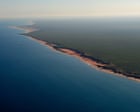
The salt air off the Kimberley coast doesn't care about geopolitics. It smells of brine and ancient stone, a scent that hasn't changed in ten thousand years. But lately, that air has carried something new. It’s the sound of an outboard motor cutting through the dawn stillness, a vessel hitting the red sand, and the frantic footsteps of people who have traveled six thousand kilometers to stand in a place they aren't supposed to be.
For decades, the Australian border conversation was dominated by a specific imagery. We talked about leaky wooden boats from Indonesia. We talked about Middle Eastern refugees. We built an entire national identity around the phrase "we will decide who comes to this country." Yet, a quiet shift has occurred. The faces appearing on the sun-bleached shores of Western Australia and the Northern Territory are increasingly from the world’s rising superpower. You might also find this related story useful: Strategic Asymmetry and the Kinetic Deconstruction of Iranian Integrated Air Defense.
Chinese nationals are arriving by boat. It is a sentence that feels like a glitch in the matrix of modern migration. Why would citizens of the world’s second-largest economy, a nation of gleaming high-speed rails and digital payment utopias, risk a perilous maritime crossing into the Australian bush?
Even more striking is the response from Canberra. When asked for the tally—the simple, raw data of how many Chinese citizens have been intercepted—the Australian government has effectively pulled a curtain across the stage. They refuse to say. Not because they don't know, but because knowing might be too expensive. As extensively documented in latest articles by The New York Times, the implications are widespread.
The Human Shadow in the Red Dust
Consider a man we will call Chen. He isn't a statistic. He is a hypothetical composite of the stories trickling out from the scrubland near Beagle Bay.
Chen didn't come from a war zone. He didn't flee a famine. He likely came from a mid-tier city where the economic miracle has started to feel like a tightening vice. Perhaps he lost his savings in a property market collapse that the state media refuses to acknowledge. Maybe he spoke a word too many on a messaging app and felt the social credit system begin to fray at his edges. He represents the "run philosophy"—a growing movement in China known as runxue, the study of how to escape.
For Chen, the journey involves a labyrinth of flights to Southeast Asia, followed by a clandestine transfer to a vessel that was never meant for the open sea. When he steps onto Australian soil, he isn't met by a welcoming committee. He is met by a vast, indifferent wilderness.
The government’s refusal to provide numbers turns Chen and those like him into ghosts. By withholding the data, the state suggests that the mere mention of these arrivals could "damage bilateral relations." It is a stunning admission. It implies that the truth is a commodity we can no longer afford to trade.
The Geopolitical Poker Game
This isn't just about border security. It’s about a delicate, high-stakes dance between two nations that need each other and distrust each other in equal measure. Australia relies on China to buy its iron ore and coal. China relies on Australia’s resources to keep its industrial heart beating. After years of trade wars and "wolf warrior" diplomacy, the relationship is currently in a state of "stabilization."
Stabilization is a polite word for walking on eggshells.
If Australia publishes a report showing a surge in Chinese boat arrivals, it sends a message to the world that people are desperate to leave the "Chinese Dream." That is a loss of face. In the currency of global diplomacy, face is often more valuable than gold. By keeping the numbers secret, the Australian government is essentially offering a gift of silence to Beijing.
But silence has a cost. It erodes the transparency that is supposedly the bedrock of a democracy. When a government decides that the public’s right to know is secondary to the comfort of a foreign power, the internal compass begins to spin.
The logic used by officials is that revealing the numbers would provide "intelligence" to people smugglers. It’s a convenient shield. It allows the state to bypass the uncomfortable reality: that the nature of migration is changing, and our old maps no longer work.
The Mechanics of the Escape
The journey usually starts on the mainland, moves through the visa-free corridors of Southeast Asia, and ends in the Timor Sea. This isn't the chaotic flight of the 1970s "boat people." This is a logistical feat.
- Step One: Securing a tourist visa to a neighboring country like Indonesia or Vietnam.
- Step Two: Connecting with "facilitators" who specialize in maritime passage.
- Step Three: The "black run"—a dash across the water to remote spots like the Dampier Peninsula.
Unlike previous waves of migration, many of these arrivals aren't hiding. They are walking into remote towns, finding the nearest police station, and asking for asylum. They are using the system’s own weight against it. They know that once they are on the mainland, the legal process to remove them is a marathon that can last a decade.
The silence from Canberra creates a vacuum. In that vacuum, fear and speculation grow. If the numbers were small, would they be so guarded? If the numbers were decreasing, wouldn't they be shouting it from the rooftops as a policy victory? The secrecy itself becomes the most damning statistic.
The Invisible Stakes
We often view border security as a matter of fences and patrol boats. We forget that it is actually a matter of stories.
The story Australia tells itself is one of "ordered migration." We like lists. We like points-based systems. We like the idea that we are in total control of the perimeter. The Chinese boat arrivals shatter that narrative. They represent a wild card—a demographic that doesn't fit the traditional refugee profile, coming from a country that we are officially "friends" with, yet cannot talk about honestly.
For the people on those boats, the stakes are everything. They are trading their life savings and their citizenship for a chance to live in the "sunburnt country." They are betting that the Australian legal system is more robust than the one they left behind.
For the Australian public, the stakes are different but no less vital. We are witnessing a moment where the "national interest" is being used to justify a lack of accountability. If we can't talk about who is arriving on our shores because it might upset a trading partner, what else can't we talk about?
Beyond the Horizon
The boats will keep coming. As long as the pressure inside the pressure cooker of the Chinese economy continues to rise, the steam will find a way to vent. Australia happens to be the closest Western democracy. We are the logical destination for the disillusioned.
The government can keep the spreadsheets locked in a vault. They can refuse the Freedom of Information requests. They can cite "bilateral sensitivities" until the ink runs dry. But the reality is written in the sand of the Kimberley. Every footprint left by a newcomer is a data point that the government cannot erase.
We are entering an era where the human impulse for a better life is colliding with the cold realities of global trade. In this collision, the truth is often the first casualty. We are told that silence is a strategy. We are told that darkness is a form of protection.
But as the sun rises over the Indian Ocean, illuminating another empty vessel drifting toward the mangroves, the silence starts to feel less like diplomacy and more like a surrender. We are watching a new chapter of our history be written in real-time, yet we are being asked to keep our eyes closed.
The man on the beach looks at the horizon. He has arrived. He is no longer a ghost to himself, even if he remains one to the state. The waves continue to roll in, indifferent to the secrets they carry, while the rest of us wait for a number that may never come.
The price of a stable relationship, it seems, is the truth itself.