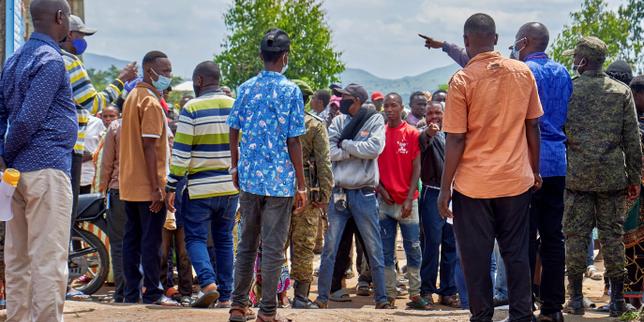
The heat in the western corner of Uganda does not just sit on your skin. It heavy-coats your lungs, thick with the scent of red earth and woodsmoke. In a small clinic near Bundibugyo, the silence is what hits you first. When a viral hemorrhage takes hold of a village, the usual chatter of children and the scraping of cassava pots evaporate. There is only the rhythmic, terrifying sound of shallow breathing behind plastic isolation sheets.
For decades, the world has treated outbreaks of hemorrhagic fevers like sudden, unpredictable lightning strikes. They hit, they devastate, the international community scrambles, and then, as the embers die down, the spotlight moves on. But for the people living along the forested borders of East Africa, the threat never truly leaves. It waits in the shadows.
We have grown accustomed to hearing about Ebola as a singular monster. It isn't. It is a family of shapeshifters. While global headlines celebrated the deployment of highly effective vaccines against the Zaire strain of the virus in recent years, a quiet, equally deadly sibling remained entirely unchecked.
Its name is Bundibugyo. And for the past two decades, the science to stop it has been frozen in time.
The Strain That Discretion Forgot
To understand why a breakthrough expected by the end of 2026 matters so deeply, you have to look at how we measure human value in global medicine.
In 2007, a new kind of sickness began whispered trickles through the Bundibugyo district. Patients presented with the classic, horrifying hallmarks of Ebola—fever, intense muscle pain, vomiting, and internal bleeding. Yet, when scientists ran the standard diagnostic tests for the known Zaire and Sudan strains, the results came back blank.
Imagine a lock where the key fits perfectly, but the door refuses to budge. That is what doctors faced. It was a completely distinct species of the virus.
By the time that specific outbreak was contained, it had claimed dozens of lives. The mortality rate hovered around thirty percent. While lower than the terrifying ninety percent killing efficiency of the Zaire strain, thirty percent still means that if you and two neighbors sit down for dinner, one of you will not survive the month.
Then came the silence.
Because the Bundibugyo strain did not explode into massive, continent-spanning crises like its Zaire cousin did in West Africa between 2014 and 2016, pharmaceutical priorities shifted. The world built a firewall against Zaire. It began aggressive testing on a Sudan vaccine. But Bundibugyo was left on the shelf, a file tucked away in a cabinet, deemed a low-probability risk.
This is the hidden calculation of global health geography. If a disease stays localized in a remote, mountainous region of Africa, the economic incentive to cure it slows to a crawl. The people of Bundibugyo became hostages to probability.
Inside the Ring of Fire
Consider how a village experiences an outbreak. It begins with a single person. A hunter returns from the forest with a profound fatigue. Within days, his family members are cleaning up fluids, holding his hand, washing his brow. They do this out of deep, instinctual love.
That love is exactly what the virus exploits.
When an outbreak occurs, medical teams utilize a strategy called ring vaccination. Think of it as a controlled burn in a forest fire. Instead of trying to vaccinate an entire nation of millions, teams locate every single person who came into contact with an infected patient, and then vaccinate them, alongside their own immediate circles. You create a human shield of immunity around the spark to keep it from becoming a wildfire.
But you cannot build a shield without wood. For the Bundibugyo strain, the shield simply did not exist. If an outbreak flared tomorrow, doctors would have nothing to offer those contacts but a prayer and supportive care.
The science behind creating these shields is incredibly intricate, yet it hinges on a basic biological trick. Most modern viral vector vaccines use a harmless, weakened virus—often a vesicular stomatitis virus or an adenovirus—and modify it to carry a tiny, harmless blueprint of the target virus's surface protein. When injected, your immune system spots this blueprint, throws up an alarm, and builds an army of antibodies.
When the real monster eventually shows up, your body recognizes the face and destroys it instantly.
Developing this specific blueprint for Bundibugyo has been a masterclass in scientific patience. Researchers cannot easily test these vaccines in traditional clinical trials because, thankfully, outbreaks are sporadic. You cannot predict when or where the virus will strike next. Instead, scientists must rely on rigorous animal models and small-scale human safety trials to prove the vaccine triggers the right defenses without causing harm. It is like building a parachute and needing to ensure every stitch is flawless before anyone ever jumps from the plane.
The 2026 Horizon
The tide is finally turning. A coordinated international push, driven by African scientists, global health coalitions, and non-profit research institutes, has pushed a candidate vaccine into advanced development. The target is clear: a viable, deployable vaccine ready for emergency use guidelines by the closing months of 2026.
This is not just a triumph of laboratory chemistry. It is a fundamental shift in how we view biological security.
For the longest time, the prevailing logic was reactive. We waited for the tragedy to write the budget. The shift toward finalizing a Bundibugyo vaccine before a massive outbreak occurs represents a proactive philosophy. It acknowledges that an obscure valley in Uganda is connected by just a few degrees of separation to international airport hubs in Entebbe, Nairobi, and London.
More importantly, it rectifies a long-standing moral asymmetry.
Health security should not be a privilege dictated by zip code. The readiness of this vaccine means that when the next inevitable spillover event occurs—when the virus jumps from a fruit bat or a non-human primate into a human community—the response will not be panic and body bags. It will be a swift, quiet deployment of science.
The Memory of the Soil
On the ground in western Uganda, the upcoming timeline is not just a statistic on a PowerPoint slide in Geneva or Washington. It represents the closing of a fearful chapter.
Local health workers still remember the frantic days of past outbreaks. They remember the heavy, suffocating weight of personal protective equipment in equatorial heat. They remember the agonizing conversations with families who could not understand why the medicine that saved lives down south against other strains was useless against the sickness in their own homes.
The true victory of the upcoming vaccine will not be celebrated with a massive parade. It will be measured in the quiet moments that do not happen.
It will be measured in the child who does not lose her mother. It will be measured in the clinic that stays open for routine births rather than being converted into a sealed isolation ward. It will be measured in the simple peace of a village where a sudden fever is just a fever, and not the arrival of an invisible executioner.
The red dust of Bundibugyo still blows across the hills, but soon, the air will carry something new. Certainty.
/i.s3.glbimg.com/v1/AUTH_5dfbcf92c1a84b20a5da5024d398ff2f/internal_photos/bs/2022/7/q/6M5eaAQBGuPVBPz0xKuQ/whatsapp-image-2022-12-24-at-17.52.03.jpeg)