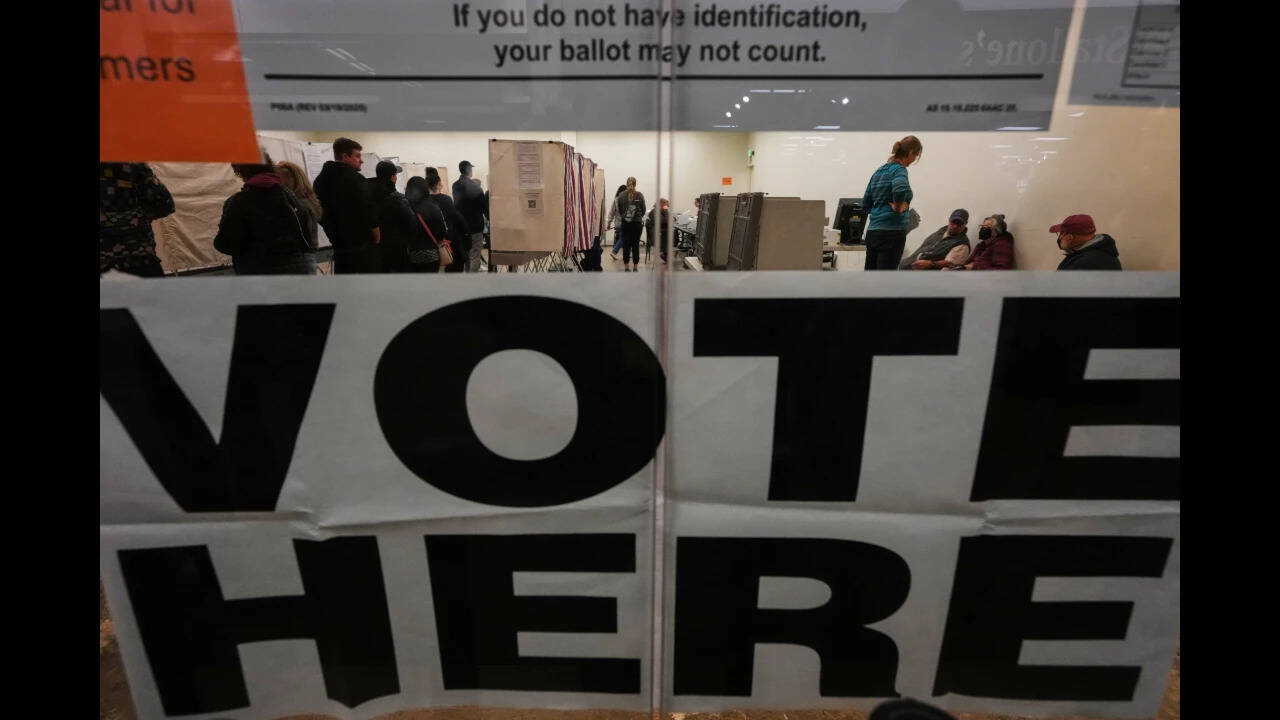
The fluorescent lights of a county registrar’s office in central California hum at a frequency that gets behind your eyes by four in the afternoon. Stacks of manila folders, heavy with decades of paper trails, sit beside humming optical scanners. Outside, the late autumn sun drops low over almond orchards and strip malls. Inside, a clerk named Elena—a hypothetical composite of the thousands of local election administrators who actually run American democracy—stares at a computer screen.
Her job is unglamorous. She cross-references birth dates, driver’s license numbers, and Social Security digits against state and federal databases. When a mismatch pops up, she flags it. When someone moves out of county, she updates the roll. When someone dies, she removes their name.
Yet, in the national imagination, Elena’s quiet office has become the scene of an alleged heist of historic proportions.
For years, Donald Trump has asserted that millions of undocumented immigrants cast ballots in California, flipping the state’s electoral outcomes and distorting the popular vote. It is a claim repeated at rallies, in interviews, and across social media with absolute conviction. Now, that political rhetoric has collided with the unforgiving rules of a courtroom. A recent legal filing has formally challenged Trump’s assertions regarding non-citizen voting in California, demanding something that rallies never require: admissible evidence.
To understand why this legal clash matters, you have to step away from the podiums and look at the machinery of how a ballot actually moves from a printing press to a certified tally.
The Anatomy of an Accusation
The dispute centers on a fundamental collision between political speech and legal proof. According to court documents filed in response to ongoing litigation over election integrity and ballot access, legal challengers argue that claims of widespread non-citizen voting in California rely on conjecture rather than documented reality.
Trump and his allies have long pointed to California’s "Motor Voter" program—officially known as the New Motor Voter Act, which automatically registers eligible citizens when they apply for or renew a driver's license at the Department of Motor Vehicles—as a primary vulnerability. The argument goes like this: because California allows undocumented residents to obtain driver's licenses under a separate law, AB 60, the boundary between legal drivers and eligible voters must be porous. Critics contend that administrative errors at the DMV inevitably spill non-citizens onto the voter rolls, creating an undetectable wave of illegal votes.
On the surface, the suspicion feels intuitive. Bureaucracies make mistakes. Anyone who has ever spent three hours in a DMV waiting room only to have their address misspelled on a registration card knows that government databases are not infallible.
Yet, when the legal filing dissects this premise, a very different picture emerges.
How the Firewall Actually Works
Think of California’s voter registration system not as an open door, but as a series of locked airlocks.
When a resident walks into a DMV office, the type of license they apply for immediately splits their digital path. An AB 60 license—the credential issued to residents who cannot provide proof of legal presence—requires different documentation and carries a distinct federal restriction notice printed right on the card. Under the Motor Voter system, applicants for AB 60 licenses are bypassed entirely from the automatic registration prompt.
Even for standard license applicants, registration is not a blind sweep. Applicants must affirmatively attest, under penalty of perjury, that they are United States citizens. That data does not immediately create an active voter. Instead, the DMV transmits the record to the California Secretary of State’s office, which runs it through the VoteCal database—a centralized system that cross-checks the applicant’s identity against state Department of Public Health records and the Social Security Administration.
Does the system ever glitch? Yes. And that nuance is crucial.
In 2018, California officials acknowledged that programming and processing errors at the DMV had mistakenly registered roughly 23,000 people—including some non-citizens—or altered party preferences incorrectly. The state immediately canceled those registrations and notified the affected individuals. Subsequent independent audits confirmed that the errors were technical failures in data transmission, not a coordinated conspiracy, and found no evidence of mass voting by ineligible residents.
That distinction—between a software bug caught by internal audits and millions of fraudulent ballots cast in secret—is the exact fault line running through the new legal filing.
The Weight of a Felony
Consider a hypothetical resident named Mateo. Mateo arrived in California fifteen years ago, works in construction, pays payroll taxes through an Individual Taxpayer Identification Number, and holds an AB 60 driver’s license so he can drive his kids to school and get to job sites legally.
Imagine Mateo receives a voter registration form by mistake, or someone hands him a clipboard outside a grocery store. What happens if he fills it out and casts a ballot?
First, under federal and state law, voting as a non-citizen is a felony punishable by prison time. Second, and far more devastating for someone in Mateo’s shoes, it triggers permanent immigration consequences. Under the Immigration and Nationality Act, falsely claiming U.S. citizenship or voting unlawfully renders a non-citizen deportable and permanently inadmissible, stripping away any future path to a green card, asylum, or naturalization—even if they are married to a U.S. citizen or have American-born children.
When election researchers and legal scholars examine claims of mass non-citizen voting, they point directly to this asymmetry of risk. To believe that millions of undocumented immigrants are voting in California, one must believe that millions of people who live carefully in the shadows—avoiding even minor traffic infractions to protect their families from deportation—are willingly committing a traceable federal felony to cast a single ballot in a state that already votes reliably Democratic by margins of four to five million votes.
Human behavior simply does not bend that way. Fear is a far stronger deterrent than a barcode.
What the Audits Show
Across the country, conservative and liberal watchdogs alike have spent years hunting for the phantom voters described in campaign speeches. The results have been remarkably consistent, regardless of who funds the search.
The Brennan Center for Justice examined 42 jurisdictions in the 2016 general election—covering 23.5 million votes—and found only about 30 incidents of suspected non-citizen voting referred for further investigation. That is 0.0001 percent of the ballots cast.
Even conservative-led state reviews have hit the same wall. In Texas, a 2019 state review initially claimed to have identified tens of thousands of non-citizens on the voter rolls, sparking national headlines. Weeks later, state officials had to walk back the numbers after discovering the list was composed almost entirely of naturalized citizens who had obtained their driver's licenses before becoming Americans. The Texas Secretary of State resigned over the debacle, and the state settled lawsuits by admitting the methodology was flawed.
In Georgia, a 2022 audit conducted by the Secretary of State’s office—led by Republican Brad Raffensperger—checked the entire voter roll of roughly 7.8 million people against federal citizenship records. They found 1,634 non-citizens who had attempted to register over a 25-year period. None of them were allowed to register, and none of them cast a ballot.
California’s own post-election audits, alongside academic studies from institutions like Stanford University and the Public Policy Institute of California, mirror these findings. While isolated cases of ineligible voting do occur—and are prosecuted when discovered—they number in the dozens across decades, not the millions required to alter a statewide race.
The Invisible Stakes of the Narrative
If the numbers are so small, why does the argument refuse to die? Because in politics, an unproven claim does not need to win in court to succeed in public.
When a leader with a massive platform insists that an election system is rigged by outsiders, the damage is not measured in overturned verdicts. It is measured in the slow erosion of civic trust. It changes how neighbors look at one another in line at the grocery store. It turns routine administrative clerks like our hypothetical Elena into targets of suspicion, harassment, and death threats. Since 2020, California and other states have seen an unprecedented exodus of seasoned local election directors—people with twenty or thirty years of institutional memory—driven out by burnout and hostility over accusations they know to be false.
At the same time, dismissiveness carries its own danger. Simply telling skeptical voters to "trust the experts" rarely works when those voters feel their concerns about border security and institutional competence are being mocked. Acknowledging that DMV errors happened in 2018, explaining exactly how they were fixed, and showing the paper trail behind every ballot is not a concession to conspiracy theories. It is the only way to disarm them.
Democracy relies on a fragile bargain: the losers agree to accept the outcome because they believe the process was fair, and the winners agree to govern within the rules because they know they will face the voters again. When the referee is accused of fixing the game without proof, the entire stadium begins to empty.
Inside the Courtroom Standard
A courtroom is a stubborn place. Unlike a television studio or a social media feed, a judge does not care how many times an assertion has been repeated or how fiercely an audience applauds it. Under the Federal Rules of Civil Procedure, claims made in legal filings must be grounded in fact and supported by evidence, or attorneys risk sanctions.
That is why the recent filing questioning Trump’s claims in California carries weight beyond the immediate legal docket. By forcing the issue into an evidentiary forum, the challengers are applying the ultimate stress test to a decade-old talking point. They are asking for names, precincts, ballot serial numbers, and audit logs.
So far, those logs tell a story that is far less cinematic than a thriller, yet far more reassuring than the alternative. Every ballot envelope arriving at a California county office is scanned, its signature compared against the voter’s historical registration record by trained reviewers. If a signature doesn't match, the ballot is held, and the voter is mailed a cure notice to verify their identity. Every provisional ballot is quarantined until the voter's eligibility is confirmed. Every tabulator is tested publicly before and after Election Day, disconnected from the internet, and audited by hand-counting random precincts to verify the machine totals.
It is slow, repetitive, deeply unsexy work. It smells like cardboard boxes, toner ink, and stale coffee.
The Verdict in the Quiet Hours
Late on election night, long after the cable news networks have projected the winners and the campaign parties have swept up the confetti, the fluorescent lights in that central California registrar’s office are still on.
Elena and her team are still there, feeding ballots through high-speed scanners, logging chain-of-custody seals, and balancing batch sheets down to the single digit. There are no shadowy vans pulling up to the loading dock. There are no millions of phantom voters hiding in the code. There is only the steady, mechanical rhythm of paper moving through rollers, one verified citizen at a time, leaving behind a trail of ink that anyone with patience and a subpoena can read.