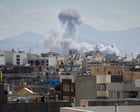
The removal of Ali Khamenei from the Iranian political apparatus via a kinetic strike represents more than a decapitation of leadership; it triggers a systemic failure in the specific structural architecture of the Velayat-e Faqih (Guardianship of the Jurist). Khamenei did not simply rule; he functioned as the primary orbital node for three competing power centers: the Islamic Revolutionary Guard Corps (IRGC), the clerical establishment in Qom, and the sprawling bonyads (charitable trusts) that control approximately 30% of Iran’s GDP. Without the central arbiter, the tension between these entities shifts from managed competition to an existential resource war.
The Tri-Node Power Structure and the Arbiter Constraint
To understand the instability following the reported airstrikes, one must define the operational mechanics of the Iranian state. Khamenei’s power was not absolute in the dictatorial sense; it was foundational. He managed the state through a system of "competitive stagnation," where no single faction could gain enough leverage to challenge the Supreme Leader.
The Military-Industrial Node (IRGC)
The IRGC is an autonomous economic and military entity. It manages Iran’s ballistic missile program, the Quds Force, and significant portions of the telecommunications and construction sectors. Its primary objective is the preservation of the revolutionary ideology, which serves as the legal shield for its commercial monopolies.
The Clerical-Legitimacy Node
The Assembly of Experts and the senior judiciary provide the theological framework that justifies the state's existence. While their physical power is inferior to the IRGC, their role in selecting the successor is the only mechanism that prevents the government from being viewed as a standard military junta.
The Shadow Economic Node (Bonyads)
These parastatal organizations operate outside the oversight of the Iranian Parliament (Majlis). They function as a patronage network, ensuring the loyalty of the lower-middle class through subsidies while simultaneously enriching the inner circle of the Office of the Supreme Leader.
The sudden extraction of the Supreme Leader creates a "decoupling" effect. The IRGC no longer requires the clerical rubber stamp to exercise force, but it lacks the theological credentials to command the loyalty of the traditionalist religious base. This creates a bottleneck in the succession process defined by Article 111 of the Iranian Constitution.
Succession Mechanics and the Article 111 Failure
The Iranian Constitution dictates that in the event of the leader's death, a provisional council consisting of the President, the head of the Judiciary, and one of the theologians of the Guardian Council shall temporarily perform the duties of the Leader. However, this legalistic view ignores the tactical reality of the IRGC’s "internal security" protocols.
The immediate risk is a preemptive securitization. The IRGC’s Intelligence Organization likely initiates a "Plan Surface," involving the grounding of all civilian aviation, the throttling of the National Information Network (intranet), and the physical isolation of high-ranking clerics who might favor a moderate successor.
The successor's profile must meet three specific criteria to maintain the current equilibrium:
- Ideological Continuity: Radical anti-Western alignment to justify the ongoing "Resistance" budget.
- Economic Passivity: A willingness to allow the IRGC to expand its control over the oil and gas sectors.
- Theological Minimum: Sufficient religious ranking to prevent a total schism with the Grand Ayatollahs of Qom.
If these criteria are not met, the transition moves from a constitutional process to a factional conflict. The lack of a clear, charismatic heir—following the death of Ebrahim Raisi in 2024—means the "Short List" is populated by figures who lack the broad-based institutional respect Khamenei spent decades cultivating.
The Regional Kinetic Feedback Loop
The elimination of the central commander of the "Axis of Resistance" disrupts the command-and-control (C2) hierarchy for non-state actors in Lebanon, Yemen, and Iraq. Khamenei’s office provided the strategic patience and financial disbursement schedules that synchronized the actions of Hezbollah and the Houthis.
The "Hydra Effect" suggests that in the absence of a central Tehran directive, these proxies may behave with increased volatility. Without a Supreme Leader to signal the "threshold of escalation," local commanders may engage in high-risk operations to secure their own regional relevance or to deter perceived Israeli opportunism. This decentralized aggression increases the probability of a miscalculation that forces a regional theater-wide conflict.
Economic Contraction and the Currency Volatility Index
The Iranian Rial (IRR) functions as a real-time barometer of regime stability. A leadership vacuum of this magnitude triggers immediate capital flight and a run on hard currency. The mechanisms of this economic shock include:
- The Velocity of Information: In the absence of state-media clarity, the "informal" market rates in Tehran’s Grand Bazaar dictate the cost of essential goods, leading to hyper-localized inflation.
- Logistical Paralysis: Major IRGC-run ports (such as Bandar Abbas) often face operational delays during periods of high-alert security, slowing the export of sanctioned crude oil and further depleting foreign exchange reserves.
- The Shadow Economy Breakdown: Patronage payments to the Basij (paramilitary volunteers) rely on a functioning banking interface. If the transition is contested, the flow of funds to these front-line enforcers may be interrupted, leading to a degradation of domestic suppression capabilities.
Technological Sovereignty and the Digital Iron Curtain
A critical component of the post-Khamenei era is the management of the "National Information Network." The regime has invested billions in ensuring that the Iranian internet can be decoupled from the global web while keeping internal government services active.
During a succession crisis, the IRGC will likely activate a total "Kill Switch." This is not merely about stopping protests; it is about controlling the narrative among the elite. By restricting communications, the security apparatus can prevent different branches of the regular army (Artesh) from coordinating a counter-coup or supporting a dissident clerical faction.
The Artesh-IRGC Duality
While the IRGC is the ideological guard, the Artesh is the traditional military. Historically, the Artesh has been sidelined, underfunded, and kept away from internal security roles. However, in a state of total structural collapse, the Artesh remains the only institution with a vestige of nationalist—rather than purely revolutionary—legitimacy. The probability of an internal "correction" depends on whether Artesh commanders believe they can secure the borders while the IRGC is preoccupied with the internal struggle for the Supreme Leader’s seat.
Strategic Reconfiguration for Global Markets
The international community must evaluate the "Post-Khamenei" environment through the lens of a High-Volatility Transition. There is no scenario where a sudden vacuum leads to immediate liberalization. Instead, the most likely outcomes involve varying degrees of military consolidation.
- Scenario Alpha: The Praetorian Guard State. The IRGC installs a figurehead cleric, effectively ending the rule of the jurist and beginning the era of the military-industrial junta. This leads to a more predictable, yet more aggressive, foreign policy focused on regional hegemony.
- Scenario Beta: The Fragmented Authority. No single leader is chosen, and a "Leadership Council" is formed. This results in policy paralysis, internal purges, and an increased risk of civil unrest as the various security services compete for turf in major urban centers.
- Scenario Gamma: The Hardliner Consolidation. A radical, younger cleric with deep ties to the security services is pushed through, doubling down on the "Resistance" ideology to distract from the internal legitimacy crisis.
The immediate strategic priority for external actors is the monitoring of the "Nuclear Threshold." In a moment of perceived existential threat to the regime's survival, the "Fatwa" against nuclear weapons—a cornerstone of Khamenei’s public-facing diplomacy—may be discarded. The technical infrastructure for breakout exists; the only remaining barrier has been the strategic decision-making of the Supreme Leader. Without his specific cautious-extremism, the transition to a nuclear-armed state becomes a tactical shortcut for any faction seeking to solidify its hold on power.
The operational focus should remain on the IRGC's "Coordination Headquarters." Watch for the movements of the 10th Sayyed al-Shohada Division around Tehran. Their deployment patterns will signal which faction has seized the physical levers of the capital before the Assembly of Experts even convenes. The transition will be decided in the barracks and the boardrooms of the bonyads, not in the mosques of Qom.