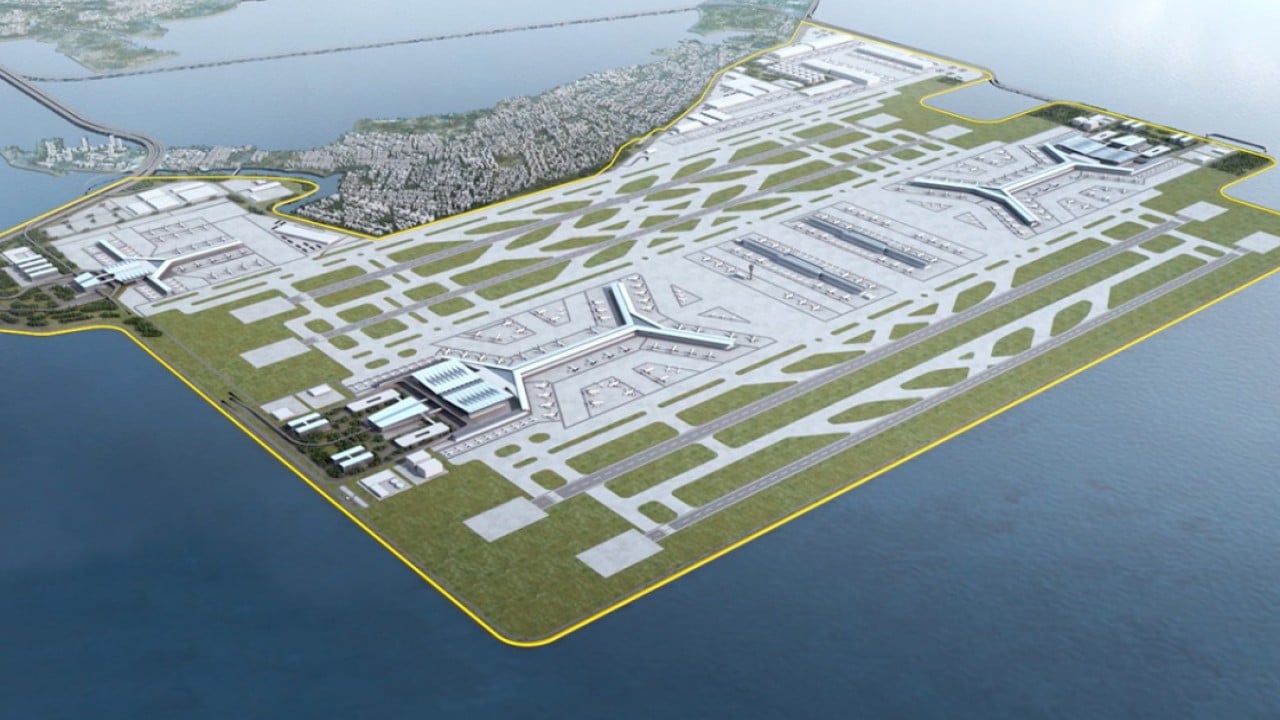
The United States government's May 2026 decision to fund the feasibility study for the Sangley Point International Airport (SPIA) represents more than a standard infrastructure grant; it is a clinical intervention in the Indo-Pacific logistics architecture. By providing technical assistance through the U.S. Trade and Development Agency (USTDA) to the Cavitex Holdings-led consortium, Washington is effectively establishing a "security-by-design" framework for a critical node in the Luzon Economic Corridor. This move solves for two primary variables: the relief of critical failure points in Metro Manila’s aviation capacity and the pre-emptive exclusion of non-allied digital and physical infrastructure from a site of immense naval significance.
The Trilateral Infrastructure Pivot
The backing of SPIA must be viewed through the lens of the PGI (Partnership for Global Infrastructure and Investment) and the specifically tailored Luzon Economic Corridor. This corridor, a joint initiative between the U.S., Japan, and the Philippines, aims to synchronize the economic output of Subic, Clark, Manila, and Batangas.
The strategy relies on three functional pillars:
- Capacity Redundancy: Ninoy Aquino International Airport (NAIA) processed approximately 52 million passengers in 2025, operating well beyond its structural equilibrium. SPIA is engineered to handle an initial 75 million passengers, scaling to 130 million via a four-runway configuration.
- Interoperable Standards: By funding the feasibility study, the USTDA ensures that the airport’s fundamental specifications—including telecommunications, air traffic management, and security screening—are built on U.S. technical standards. This creates a path of least resistance for U.S.-sourced hardware and software, effectively locking in a long-term technical ecosystem.
- Security Hegemony: The requirement for "direct flights to U.S. aviation hubs" necessitates TSA-level security protocols. This technical requirement serves as a prophylactic against the integration of high-risk vendor technologies in the airport’s sensitive data layers.
The Naval Base Legacy and Military Optionality
Sangley Point’s history as a U.S. Naval Station (closed in 1971) provides the geographical subtext for this investment. While the project is framed as a commercial aviation hub, the dual-use potential of high-capacity runways in the South China Sea theater is a factor that cannot be ignored in a data-driven risk assessment.
The site sits at the mouth of Manila Bay, approximately 8 miles from the capital. Its development into a modern international gateway provides the Philippine state—and by extension its Mutual Defense Treaty (MDT) allies—with a high-spec logistics platform capable of supporting heavy lift operations. The transition from the previously proposed China-backed consortium (canceled in 2021) to the current U.S.-supported SPIA Development Consortium (comprising Cavitex Holdings, House of Investments, and MacroAsia) represents a fundamental shift in the site’s strategic alignment.
Quantifying the Economic Multiplier
The SPIA project is structured as a private-sector-led joint venture with the Provincial Government of Cavite. The financial mechanics rely on a $11 billion capital expenditure (CAPEX) model. The USTDA’s intervention at the feasibility stage is a derisking mechanism intended to attract institutional capital by validating the project’s technical and financial viability.
The economic impact functions as follows:
- Direct Labor Demand: Construction and initial operations are projected to generate tens of thousands of high-skill jobs in civil engineering, aviation logistics, and security.
- Logistics Efficiency: By splitting cargo and passenger traffic between NAIA, SPIA, and potentially Clark, the Philippines reduces the "congestion tax" on its GDP—the lost productivity and increased fuel costs associated with Manila’s current infrastructure bottlenecks.
- Security Tech Export: The study specifically promotes the adoption of U.S. solutions in screening and telecommunications. This creates a direct export pipeline for American aerospace and cybersecurity firms.
Constraints and Execution Risks
Despite the strategic alignment, SPIA faces significant execution hurdles. The primary bottleneck is the reclamation requirement. Building a multi-runway international airport on a narrow peninsula requires massive land reclamation in Manila Bay, an endeavor that carries both high environmental compliance costs and significant engineering complexity.
Furthermore, the "Luzon Economic Corridor" is a multi-national coordination effort. Its success depends on the synchronized development of the Subic-Clark fuel pipeline and the modernization of the Philippine national railway system. If these ancillary projects lag, SPIA risks becoming a "stranded asset"—an ultra-modern airport disconnected from the broader industrial base it is meant to serve.
The U.S. strategy for Sangley Point is a template for "Integrated Deterrence." By embedding American technical standards and financial backing into the Philippines' most ambitious infrastructure project, the U.S. is securing a vital geographic position while simultaneously addressing the partner nation’s acute economic needs. This dual-purpose engagement represents the evolution of statecraft from purely military alliances to deep-tier infrastructure integration. The final strategic move for the SPIA Consortium will be the successful conversion of this USTDA-backed study into a bankable project finance structure that can withstand the capital volatility of the late 2020s.