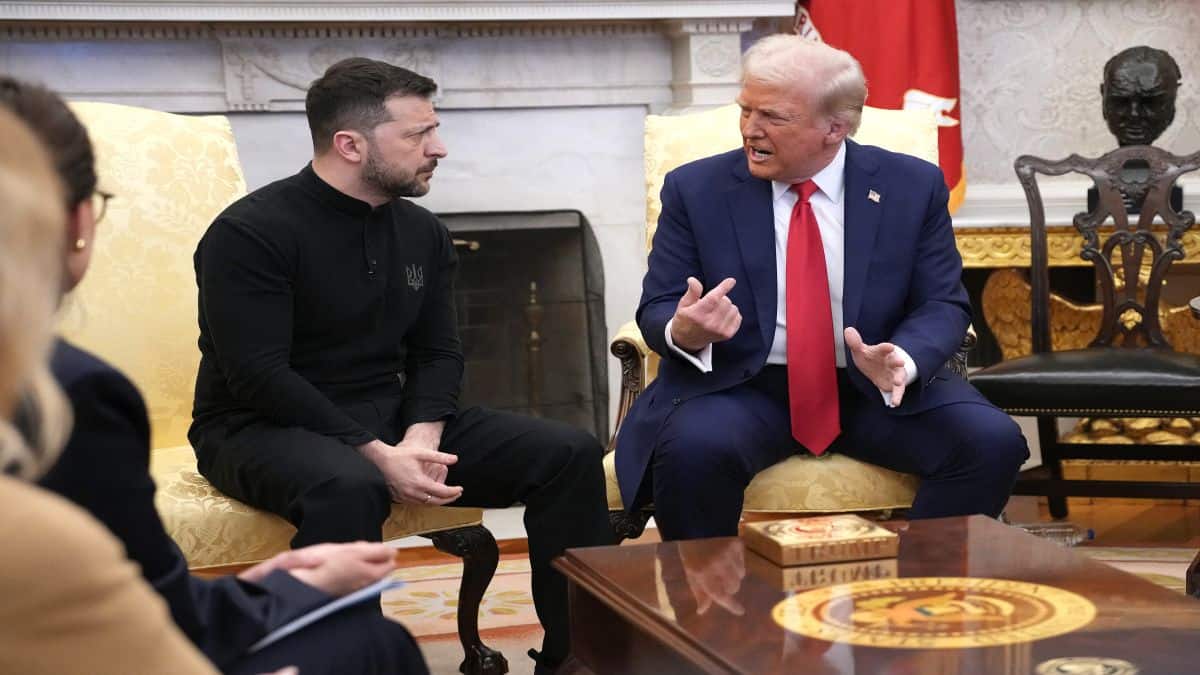
The intersection of high-stakes diplomacy and battlefield innovation just hit a wall of domestic politics. Donald Trump’s dismissal of President Volodymyr Zelensky’s offer to assist the United States with drone defense against Iranian-made threats isn't just a snub. It represents a fundamental disconnect between the current reality of modern warfare and the transactional nature of American foreign policy. While Ukraine has spent the last three years perfecting the art of intercepting Shahed-style loitering munitions, the former president is signaling that the U.S. has nothing to learn from a nation currently fighting for its survival.
This friction comes at a moment when the Pentagon is scrambled. Defense officials are quietly panicking over the cost-curve of drone defense. We are currently firing $2 million interceptor missiles at $20,000 plywood drones. It is a math problem that ends in bankruptcy or exhaustion. Zelensky’s offer was a chance to bridge that gap with combat-tested, low-cost solutions. By rebuffing it, Trump is prioritizing a specific brand of American isolationism over the immediate technical needs of the U.S. military.
The Cost of Pride in Drone Warfare
The hardware currently terrorizing global shipping lanes and Eastern European power grids is deceptively simple. The Iranian Shahed drone is little more than a lawnmower engine attached to a GPS guidance system and a shaped charge. Yet, this "low-tech" threat has consistently bypassed some of the most sophisticated air defense systems in the world.
Ukraine has built a "sensor-to-shooter" network that is arguably more advanced than anything currently deployed by NATO. They use acoustic sensors—essentially thousands of cheap microphones—to track the distinct hum of drone engines across the countryside. This data is fed into a real-time app that directs mobile fire groups. These groups don't use multimillion-dollar missiles. They use heavy machine guns and electronic jammers.
Trump’s rejection ignores this hard-earned expertise. He views the relationship through a lens of "America First," where the United States is the sole provider of security, never the recipient of it. This perspective assumes that American industrial might can always out-innovate a scrappy, desperate underdog. But in the world of autonomous systems, the underdog is often the one moving faster.
The Iranian Connection and the Global Threat
To understand why this rejection is so significant, we have to look at the adversary. Iran has exported its drone doctrine to proxies across the Middle East. The same drones being launched at Kyiv are being launched at American bases in Iraq and Syria, and at commercial tankers in the Red Sea.
The U.S. Navy is currently burning through its inventory of SM-2 and SM-6 missiles to swat down Houthi-launched drones. Each launch is a victory for the attacker. If you spend $2 million to stop a $30,000 drone, you are losing the war of attrition.
The Ukrainian Solution
What Zelensky offered was not just "help" in a vague sense. He offered the following specific technological integrations:
- Acoustic Detection Arrays: Low-cost networks that identify drone signatures before they reach radar range.
- AI-Driven Targeting: Software that allows standard machine guns to track and hit moving aerial targets with high precision.
- Electronic Warfare (EW) Recipes: Specific frequencies and protocols used to sever the link between a drone and its operator or GPS satellite.
The U.S. military is currently trying to build these things from scratch through various "Rapid Capabilities" offices. Ukraine already has them. They are being used tonight. They will be used tomorrow.
The Political Calculus of the Rebuff
Trump’s rhetoric regarding Ukraine has remained consistent: he believes the U.S. is being "taken advantage of" by its allies. By framing Zelensky as someone who has nothing to offer, Trump reinforces his narrative that aid to Ukraine is a one-way street.
However, this stance creates a dangerous blind spot. Modern defense isn't just about who has the biggest jet or the loudest tank. It’s about data. The Ukrainian military has more data on Iranian drone performance than any entity on earth. They know the flight patterns, the heat signatures, and the software vulnerabilities. To walk away from that data is to leave American soldiers more vulnerable to the same weapons.
There is also the matter of the "America First" manufacturing base. Trump likely views the adoption of foreign defense tech as a threat to American contractors like Raytheon or Lockheed Martin. These giants thrive on large, expensive programs. They are not incentivized to build a $50,000 drone interceptor because the profit margins are too thin. By blocking Ukrainian input, the political establishment protects a legacy defense industry that is currently ill-equipped for the "Small, Smart, and Cheap" era of combat.
The Intelligence Gap
When a Shahed drone is downed in Ukraine, it is immediately stripped for parts. Ukrainian engineers have found components from over a dozen Western countries inside these machines. They have mapped the supply chains. They know which specific chips are being used to bypass sanctions.
If the U.S. isn't cooperating at the highest level with the teams doing this teardown, our own sanctions regime becomes a sieve. The snub isn't just about hardware; it's about the intelligence loop. We are essentially refusing to read the manual for our enemy's most effective weapon.
The Reality of Middle East Escalation
While the political theater plays out in Washington, the threat in the Middle East is accelerating. Iran is not standing still. They are iterating on their designs based on what they see happening in the Ukrainian theater. They are learning how to swarm, how to change frequencies, and how to use fiber-optic guidance to evade electronic jamming.
The U.S. needs a solution that works now, not in five years after a lengthy procurement cycle. Ukraine’s "mobile fire groups" are the only proven counter-swarm tactic currently in existence. They are cheap, they are scalable, and they work.
Why the Military Wants the Help
Beneath the political posturing, the professional military class is desperate for this collaboration. General officers in the U.S. Army have been visiting Poland and other border regions to debrief Ukrainian tech leads. They see the writing on the wall. They know that the next conflict—whether in the Middle East or the Pacific—will be defined by thousands of autonomous systems.
The political rejection of this help creates a rift between the Commander-in-Chief’s office and the operational needs of the troops. It forces the Pentagon to work in the shadows or through back channels to acquire the very same information that was offered openly on the diplomatic stage.
The Iranian Perspective
Tehran is undoubtedly watching this exchange with interest. For Iran, the Russian theater is a giant R&D laboratory. They get to see how their drones perform against Western radar, how they respond to jamming, and how they can be refined.
If Trump is successful in decoupling the U.S. from Ukrainian drone defense, he is effectively giving Iran a clear lane to continue its experimentation. He is denying his own military the countermeasures they need to protect American assets abroad.
Strategic Cost of the Snub
The real cost of this decision won't be felt in a debate hall or on a campaign trail. It will be felt when an American destroyer is forced to expend its last interceptor missile against a swarm of cheap drones. It will be felt when a base in Iraq is breached because the "acoustic sensor" network we refused to license wasn't installed.
High-end journalism isn't about taking a side; it's about looking at the chessboard. The board currently shows a high-volume, low-cost threat moving toward American interests. Ukraine is the only player that has successfully defended against that move. Refusing their help isn't just a political choice—it’s a tactical vulnerability.
The U.S. defense establishment is currently built to fight the wars of the 20th century. We are prepared for nuclear submarines and stealth bombers. We are not prepared for a thousand plastic drones flying at 80 miles per hour, directed by a $500 flight controller. The Ukrainian experience is the only blueprint we have to survive this shift in warfare.
The choice to ignore that blueprint is a bet on American arrogance over American survival. If we lose that bet, the bill will be paid in lives, not just campaign slogans.
Moving Forward Without the Blueprint
The Pentagon will likely continue to pursue these technologies through its own "Replicator" initiative, a massive program intended to field thousands of cheap drones of our own. But without the real-world data from the Ukrainian front, we are building systems in a vacuum. We are guessing what the enemy will do next, while the Ukrainians are currently living it.
The snub is a signal to our adversaries that the U.S. is more concerned with its self-image than its situational awareness. It is a gift to Tehran and any other regime that sees the "asymmetric threat" as the ultimate equalizer. When the next swarm arrives, the soldiers in the path of it won't care about the political theater—they will care about whether or not their sensors actually work.