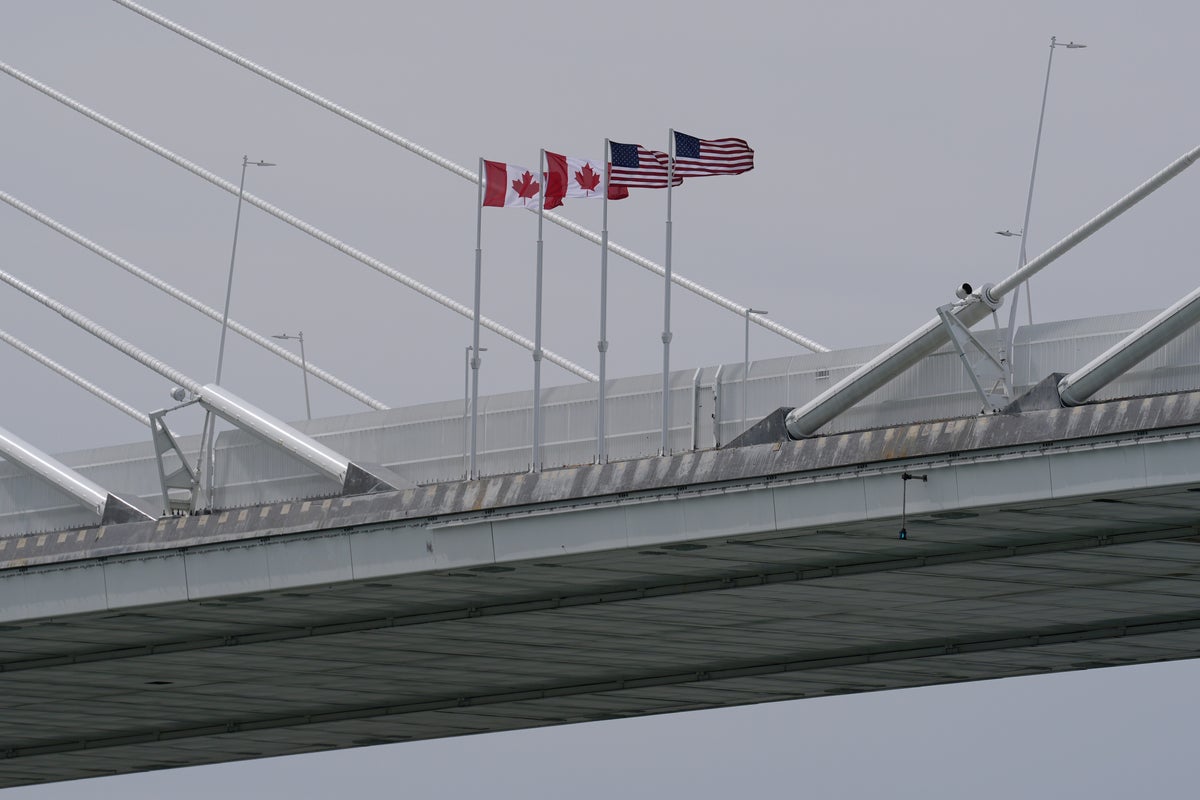
The physical completion of the Gordie Howe International Bridge exposes a structural disconnect between long-cycle infrastructure financing and short-cycle economic nationalism. While Canadian Prime Minister Mark Carney has signaled that the $6.4 billion engineering project will proceed with its formal opening, statements from the White House indicate that the underlying executive opposition remains structurally unchanged. This asset cannot be evaluated merely as a transport corridor. It represents a case study in asymmetric capital allocation, sovereign risk mispricing, and infrastructure as a lever in multi-lateral trade re-negotiations.
The Asymmetric Capital Framework of the Crossing Agreement
The institutional architecture of the Gordie Howe International Bridge is governed by the 2012 Canada-Michigan Crossing Agreement. To evaluate the strategic exposure of both nations, the financial mechanism must be broken down into its core component parts.
[Canada Underwrites 100% Capital Expenditure ($6.4B)]
                      │
                      ▼
[Windsor-Detroit Bridge Authority (Canadian Crown Corp)]
         ├── Manages Construction & Operations
         └── Collects 100% Gross Toll Revenues
                      │
                      ▼
        [Phase 1: Capital Recoupment] ──► (100% to Canadian Treasury)
                      │
                      ▼
        [Phase 2: Steady-State Return] ──► (50/50 Net Revenue Split with Michigan)
Capital Expenditure Underwriting
The Canadian federal government, via the Windsor-Detroit Bridge Authority (a Canadian Crown corporation), assumed 100% of the upfront capital risk, injecting an estimated $6.4 billion into the project. The U.S. federal government and the State of Michigan deployed zero sovereign capital for the core structural build.
Revenue Recoupment Architecture
Canada retains exclusive rights to 100% of the gross toll revenues generated by the 2.5-kilometer cable-stayed span. This capital flow is structurally dedicated to debt amortization and capital expenditure recovery.
Residual Equity Distribution
Only after Canada has fully recouped its initial capital expenditure does the contract dictate a transition to a steady-state return profile. At that point, the State of Michigan becomes eligible to receive 50% of net toll revenues. Sovereign ownership of the physical asset is split 50/50 from inception, despite the total asymmetry in capital provision.
This fiscal model provided Michigan and the broader U.S. domestic supply chain with an optimized logistical artery at zero initial public cost. The model assumed that long-term asset access was legally insulated from unrelated trade frictions. The executive pushback from Washington challenges this assumption by shifting the asset definition from a bilateral public utility to an item of transaction leverage.
Supply Chain Monopolies and the Microeconomics of the Detroit River Corridor
The economic urgency of the Gordie Howe International Bridge stems from a acute vulnerability in the North American logistics network. The Windsor-Detroit corridor acts as the primary conduit for just-in-time manufacturing between Ontario and the U.S. Midwest. Understanding the operational dynamics requires analyzing the market structure of the existing transit alternatives.
The Ambassador Bridge Monopoly Risk
Prior to the completion of the new span, the privately owned Ambassador Bridge, managed by the Detroit International Bridge Company, controlled approximately 25% of all cross-border commerce between Canada and the United States. This structural reliance creates a dangerous economic bottleneck. Industrial supply chains, particularly automotive assembly networks where components cross the border multiple times during a single production cycle, operate on minimal inventory buffers.
Redundancy Failure Economics
A localized disruption at the Ambassador Bridge—whether caused by structural degradation, labor actions, or geopolitical protests—inflicts immediate, compounding financial losses on manufacturing centers. The daily value of freight traversing this corridor exceeds $400 million. Without an alternative high-capacity route capable of handling commercial vehicle configurations, a single point of failure can force systemic shutdowns across regional assembly plants within 48 to 72 hours.
The new bridge alters this dynamic by establishing a secondary high-throughput corridor. It directly connects Ontario’s Highway 401 with Michigan’s Interstate 75. This structural bypass eliminates the municipal traffic signals and arterial bottlenecks that slow down transit via the Ambassador Bridge and the Detroit-Windsor Tunnel.
+-----------------------------------+-----------------------------------+
| Metric / Feature                  | Ambassador Bridge                 |
+-----------------------------------+-----------------------------------+
| Market Share (Historical Trade)   | ~25% of total US-Canada commerce  |
| Connectivity                       | Local arterial streets            |
| Operational Redundancy            | Single point of failure           |
+-----------------------------------+-----------------------------------+

+-----------------------------------+-----------------------------------+
| Metric / Feature                  | Gordie Howe International Bridge |
+-----------------------------------+-----------------------------------+
| Market Share (Historical Trade)   | Designed for high-volume bypass   |
| Connectivity                       | Direct Highway 401 to I-75        |
| Operational Redundancy            | Systemic risk mitigation          |
+-----------------------------------+-----------------------------------+
Geopolitical Transactionalism and the USMCA Review Window
The executive threats to delay or block the bridge opening are tied directly to the upcoming formal review of the United States-Mexico-Canada Agreement (USMCA). Washington is applying a framework of geopolitical transactionalism, treating a completed infrastructure asset as an instrument to extract concessions in broader trade negotiations.
The friction points can be categorized into three distinct policy domains:
- Tariff Alignment and Retaliation: The executive branch in Washington continues to use Section 232 tariffs on industrial goods like steel, aluminum, and lumber as a primary tool for trade enforcement. The bridge becomes a highly visible point of friction where physical access can be conditioned on Canada modifying its domestic trade defenses.
- Protection of Domestic Revenue Streams: Private lobbying efforts by the operators of the Ambassador Bridge have intersected with Washington's trade policy. By seeking federal intervention to delay or modify the operational terms of the Canadian-funded span, the incumbent private operator attempts to preserve its near-monopoly rents and protect its pricing power over cross-border freight.
- The Regulatory Sovereignty Conflict: Washington's policy demands include claims regarding the exclusion of U.S. agricultural and beverage exports from specific Canadian provincial markets, alongside anxieties over Ottawa's broader diplomatic and trade positioning toward non-aligned global economies.
By linking the operational activation of the bridge to these unrelated policy disputes, the U.S. administration aims to re-engineer the cost-benefit calculations of the 2012 Crossing Agreement. The strategy attempts to convert a settled capital project into an active variable within the USMCA renegotiation framework.
Operational Realities and Sovereign Limits of Executive Intervention
Despite the aggressive rhetoric from the executive branch, the actual mechanism for blocking an international bridge reveals significant structural limits to unilateral executive power. A sovereign state cannot easily close a major international border point without incurring deep domestic economic self-injury and triggering legal challenges.
The Department of Homeland Security and U.S. Customs and Border Protection have already allocated personnel and finalized technical installations at the U.S. Port of Entry. The operational readiness of these federal agencies means that any executive directive to withhold border processing services would require an explicit command to deliberately suppress domestic economic activity.
Because Michigan is a critical swing state with an economy tied directly to automotive and industrial manufacturing, an artificial restriction on a major trade route harms domestic firms just as much as Canadian exporters. Regional political leaders and industrial groups provide a strong domestic counterweight to prolonged border interference.
The legal reality of the Crossing Agreement also creates exposure. Because Canada funded the infrastructure with the explicit contract that it would recoup its capital through toll collection, any state action that artificially stops that revenue stream would constitute a material breach of a bilateral compact. This would open the door to immediate international arbitration and retaliatory trade measures under existing North American legal frameworks.
Strategic Forecast
The opening ceremonies and initial traffic flows will proceed, driven by the sheer economic momentum of regional supply chains and the advance deployment of customs personnel. However, the asset will remain a focal point for political leverage throughout the upcoming USMCA review cycle.
Rather than executing a permanent physical closure, Washington is highly likely to use the threat of targeted administrative slows, enhanced inspections, or selective regulatory delays at the U.S. Port of Entry. This tactical friction allows the U.S. to maintain pressure on Ottawa during trade talks without triggering an immediate legal breach or causing a self-inflicted halt to Midwestern manufacturing.
For corporate supply chains and infrastructure investors, the lesson is clear: in an era of geopolitical transactionalism, even a fully funded, legally sound, and physically complete public asset remains vulnerable to macro-level political maneuvering.



:max_bytes(150000):strip_icc():focal(665x0:667x2)/gettyimages-50733149-2000-8b129a2475974982a915418ce92a73d8.jpg)