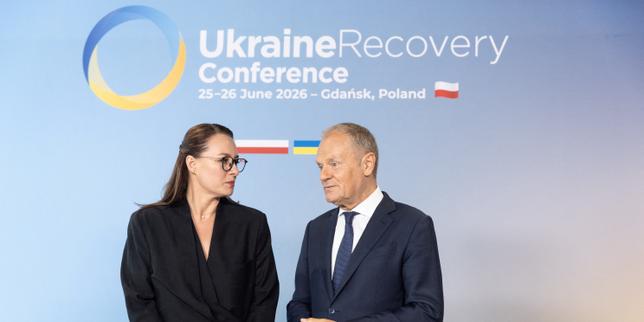
The Friction Bottleneck in Cross-Border Reconstruction
The Ukraine Reconstruction Conference highlights a fundamental mismatch: vast capital reserves and corporate willingness are paralyzed by unresolved diplomatic friction. While macroeconomic pledges suggest a frictionless flow of development capital, the microeconomic reality for Polish enterprises reveals a high-risk environment. The core barrier to entry for private capital in high-risk reconstruction zones is not a lack of liquidity, but the absence of bilateral political stability. When diplomatic relations between a primary transit hub and a recipient nation degrade, the risk premium spikes, making project financing mathematically unviable for private operators.
Private sector engagement in post-conflict reconstruction follows a strict sequence: legal security, logistical predictability, and capital protection. Diplomatic disputes regarding trade quotas, border management, or historical narratives break this sequence. This analysis breaks down the economic realities facing Polish businesses, uses structural frameworks to analyze the cross-border logistics bottleneck, and establishes the exact risk-mitigation strategies required to unlock private capital deployment. Meanwhile, you can read related stories here: Why Iraq Wants Out of the Saudi Oil Script.
The Tri-Lateral Risk Framework for Cross-Border Capital
Evaluating a corporation's capacity to operate within a reconstruction framework requires analyzing three distinct risk vectors.
                  [ RISK VECTORS ]
                         │
         ┌───────────────┼───────────────┐
         ▼               ▼               ▼
   [Logistical]    [Regulatory]    [Sovereign]
   Chokepoints     Protectionism    Guarantees
1. Logistical Chokepoint Risk
Polish enterprises operate as the physical gateway to Western Ukrainian infrastructure. Any diplomatic escalation that manifests as border protests, slow customs processing, or regulatory audits acts as an artificial supply-chain constraint. For a contractor managing civil engineering projects in Western Ukraine, a 48-hour delay at the Medyka or Korczowa border crossings creates a compounding cost penalty. Equipment depreciation continues, labor costs accrue while idle, and contractual penalties for project delays trigger automatically. To explore the full picture, check out the excellent report by Bloomberg.
2. Regulatory Protectionism and Non-Tariff Barriers
Diplomatic cooling frequently leads to regulatory retaliation disguised as compliance. This includes:
- Sudden shifts in technical certification requirements for construction materials.
- Arbitrary changes to corporate tax residency interpretations.
- Preferential treatment for domestic firms during public procurement processes.
These non-tariff barriers alter the cost function of foreign bids, destroying the margin safety buffer that firms build into high-risk proposals.
3. Sovereign Guarantee and Insurance Deficits
Private insurers refuse to underwrite asset degradation, expropriation, or political violence risks in active conflict zones without sovereign or multilateral backing. When bilateral relations strain, national export credit agencies—such as Poland's KUKE—face political pressure or capital constraints that limit their underwriting capacity for that specific corridor. Without these guarantees, commercial banks reject project finance applications, restricting reconstruction efforts to cash-rich conglomerates or state-owned enterprises.
The Cost Function of Diplomatic Delay
To understand why Polish entrepreneurs are calling for immediate diplomatic de-escalation, one must evaluate the total cost of capital deployment ($C_t$) under conditions of political volatility. The financial model can be mapped through four variables:
$$C_t = C_b + R_p + L_f + \Delta V_c$$
Where:
- $C_b$ represents the baseline operational cost of the project under stable conditions.
- $R_p$ is the political risk premium added by financial institutions to debt financing.
- $L_f$ is the logistical friction coefficient, measuring real-time border and transport delays.
- $\Delta V_c$ is the currency volatility premium caused by macroeconomic instability in the recipient nation.
When diplomats engage in public disputes, $R_p$ and $L_f$ rise simultaneously. A 1% increase in the political risk premium can invalidate the net present value (NPV) of a long-term infrastructure project. Polish small and medium enterprises (SMEs), which lack the balance sheets to absorb prolonged capital lockups, are hit hardest. Large multinationals can diversify across geographic regions, but local Polish contractors face concentrated exposure along the direct bilateral corridor.
Structural Asymmetry in Border State Economics
The economic interdependence between Poland and Ukraine during this reconstruction phase is structurally asymmetric. Poland possesses the logistical infrastructure, proximity, and European Union regulatory alignment required to serve as the primary consolidation hub for global aid and materials. Ukraine possesses the demand for capital, infrastructure development, and industrial rehabilitation.
This asymmetry creates a strategic paradox. If Polish firms withdraw or slow down investment due to diplomatic volatility, the vacuum will not remain unfilled. Western European, American, and East Asian conglomerates will establish direct logistical corridors, bypassing Polish intermediaries by utilizing alternative, albeit less efficient, transit routes through Romania or Slovakia. Polish entrepreneurs recognize that diplomatic friction does not just pause operations; it permanently re-routes global supply chains away from Polish infrastructure.
The loss of first-mover advantage is irreversible in long-term infrastructure contracts. The entities that lay the foundation stones, establish the local joint ventures, and navigate the initial regulatory hurdles secure structural advantages that persist for decades.
De-Risking the Reconstruction Corridor
Unlocking private capital requires removing bilateral political sentiment from the economic mechanism. Relying on political goodwill is an unstable strategy for corporate governance. Instead, corporate actors and trade associations must construct structural mitigations that insulate commercial operations from diplomatic cycles.
       [ STRUCTURAL MITIGATION STRATEGIES ]
                        │
      ┌─────────────────┴─────────────────┐
      ▼                                   ▼
[Multilateralization]             [Joint-Venture]
Reduce Bilateral Risk            Local Integration
Multilateralization of Project Financing
Firms must actively transition away from purely bilateral funding models. By routing project capital through multilateral institutions like the European Bank for Reconstruction and Development (EBRD), the International Finance Corporation (IFC), or European Investment Bank (EIB) frameworks, corporations insulate themselves from bilateral political disputes. A host country is significantly less likely to impose non-tariff barriers or regulatory hurdles on a project directly co-financed by a major global institution, as doing so jeopardizes broader macroeconomic credit lines.
Decentralized Joint-Venture Architectures
To mitigate regulatory protectionism, Polish enterprises should avoid operating as pure foreign entities. Creating deeply integrated joint ventures with Ukrainian domestic firms shifts the political calculus. The project is no longer viewed through a nationalistic lens as a foreign corporate extraction mechanism, but rather as a domestic economic asset employing local labor and paying local taxes. This structural integration aligns the incentives of local political regulators with the foreign capital provider, ensuring project continuity even during diplomatic standoffs.
Private Legal and Arbitration Isolation
Contractual frameworks must strictly avoid local jurisdiction clauses that could be compromised by politicized judiciaries during periods of state tension. All supply-chain, construction, and financing contracts should mandate dispute resolution through established international arbitration courts, such as the London Court of International Arbitration (LCIA) or the International Chamber of Commerce (ICC) in Paris. This creates a legally binding wall between corporate execution and state-level diplomacy.
Operational Strategy for Capital Protection
Corporate leadership must treat diplomatic volatility as a permanent, fluctuating market variable rather than a temporary anomaly. The strategic play requires shifting from reactive lobbying to structural diversification.
Convert Liquid Exposure to Fixed Assets with Sovereign Backing: Ensure that any capital deployed on the ground is explicitly tied to multilateral insurance facilities. If a project lacks World Bank MIGA (Multilateral Investment Guarantee Agency) or equivalent underwriting, freeze capital deployment at the procurement phase. Do not cross the physical border with high-value capital assets until the risk is off the corporate balance sheet.
Establish Redundant Supply Chains: Polish logistics providers must build operational redundancy by establishing secondary transshipment hubs in Romania and Slovakia. While this increases the baseline transport cost ($C_b$), it caps the maximum logistical friction coefficient ($L_f$) by preventing a single border chokepoint from gridlocking the entire corporate supply chain.
💡 You might also like: The Real Reason the US India Trade Deal is StallingInstitutionalize Cross-Border Corporate Coalitions: Trade organizations must bypass state-level diplomatic channels by forming direct, binding corporate alliances between Polish and Ukrainian business chambers. These coalitions must present unified economic data to both governments, clearly demonstrating the mutual financial loss caused by border delays and trade restrictions. By quantifying the exact damage to GDP, employment figures, and tax revenues, corporate blocks can force pragmatic economic realities back into the political discourse.
The corporate entities that thrive in this reconstruction phase will not be those that wait for a perfect diplomatic climate, but those that design their operations to withstand political instability. Operational resilience, structural legal protections, and diversified logistics are the only dependable safeguards for private capital in a volatile geopolitical environment.