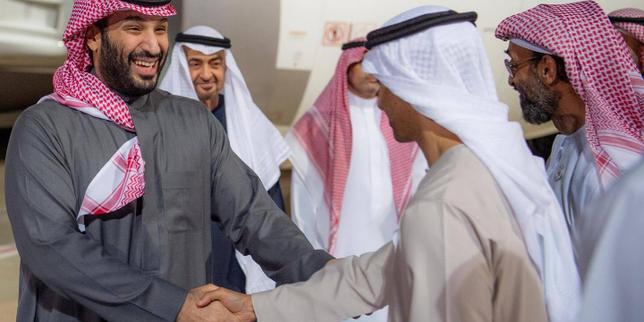
The superficial "truce" between Saudi Arabia and the United Arab Emirates (UAE) masks a structural divergence in national survival strategies. While media narratives often focus on personal friction between leadership, the reality is a zero-sum competition for regional capital, logistical dominance, and post-hydrocarbon relevance. This competition is governed by three specific friction points: the struggle for the regional headquarters (RHQ) mandate, the divergence in OPEC+ production quotas, and the conflicting visions for Yemen’s maritime geography.
The bilateral relationship has shifted from a security-first alliance to a cannibalistic economic rivalry. This is not a temporary spat; it is the natural outcome of two identical economic models—Rentier 2.0—competing for a finite pool of global foreign direct investment (FDI). Don't miss our earlier article on this related article.
The Logic of Re-Export and the Saudi Protectionist Pivot
For decades, the UAE, specifically Dubai, served as the primary gateway to the Saudi market. Under the previous regional equilibrium, the UAE managed the logistics, banking, and lifestyle infrastructure, while Saudi Arabia provided the raw consumer demand. Riyadh has now identified this arrangement as a leak in its national accounts.
The Saudi Program Headquarters initiative is the primary mechanism for plugging this leak. By mandating that any multinational seeking government contracts must establish its regional base in Riyadh by 2024, Saudi Arabia is attempting to forcibly relocate the high-value services sector from Dubai. This move targets the Multiplier Effect: To read more about the history of this, USA Today provides an in-depth summary.
- Tax Base Capture: Moving payroll and corporate tax liability to Saudi soil.
- Human Capital Density: Forcing C-suite executives and specialized talent to reside in the Kingdom, thereby driving domestic consumption.
- Knowledge Transfer: Ensuring that the "soft" skills of global finance and tech are practiced by Saudis, not outsourced to expatriates in a neighboring state.
The UAE’s response has been a radical liberalization of its social and legal codes, including the transition to a Monday-Friday workweek and the introduction of "Golden Visas." This creates a Regulatory Arbitrage situation where the UAE bets on lifestyle and legal predictability while Saudi Arabia bets on the sheer scale of its sovereign wealth fund (PIF) and procurement budget.
The Production Function of Oil and the OPEC+ Ceiling
The most visible point of failure in the alliance occurs within the OPEC+ framework. The tension here is a direct result of differing Reserve Life Expectancies.
Saudi Arabia, possessing massive reserves and a longer production horizon, prioritizes price stability to fund its multi-decade Vision 2030 projects. It acts as the "swing producer," often absorbing voluntary cuts to maintain a price floor. Conversely, the UAE has invested billions into expanding its production capacity to 5 million barrels per day (mb/d) by 2027.
The Emirati logic is driven by the Stranded Asset Risk:
- Monetization Velocity: The UAE believes the window for high oil demand is closing due to the global energy transition. It wants to pump as much as possible, as fast as possible, to maximize returns before the asset loses value.
- Capacity Utilization: Holding idle capacity is a capital inefficiency. The UAE views Saudi-imposed quotas as an external constraint on its Return on Invested Capital (ROIC).
This creates a structural instability in the cartel. Whenever the UAE demands a higher baseline, it is not merely a request for more revenue; it is a fundamental rejection of Saudi Arabia's long-term market management strategy. The UAE is signaling that it will no longer subsidize Saudi Arabia’s fiscal breakeven price at the expense of its own market share.
Maritime Sovereignty and the Yemeni Buffer Zone
The divergence in Yemen is often mischaracterized as a disagreement over military tactics. In reality, it is a conflict over the Red Sea-Aden Geopolitical Corridor.
Saudi Arabia’s primary objective in Yemen is a secure southern border and a stable government in Sana’a that prevents Iranian-backed encirclement. This is a traditional land-power security concern.
The UAE, however, operates as a maritime power. Its strategy focuses on a "string of pearls" of ports and naval bases stretching from the Horn of Africa to the Bab el-Mandeb strait. This explains their support for the Southern Transitional Council (STC). By controlling or influencing the ports of Aden, Mukalla, and the island of Socotra, the UAE secures:
- Trade Route Hegemony: Ensuring that the logistics routes feeding the Jebel Ali port remain unimpeded.
- Alternative Energy Routes: Potential pipeline exits that bypass the Strait of Hormuz.
When Saudi Arabia supports the internationally recognized government of Yemen to maintain a unified state, it directly clashes with the Emirati preference for a fragmented or autonomous South that is more amenable to maritime partnerships. The result is a fractured coalition where the two primary sponsors are backing local proxies with diametrically opposed end-states.
The FDI Bottleneck and the Vision 2030 Gravity Well
Saudi Arabia’s Vision 2030 requires approximately $3 trillion in investment. The Kingdom cannot self-fund this entirely through the PIF; it requires massive inflows of private global capital. This creates an immediate threat to the UAE’s status as the regional financial hub.
We are seeing the emergence of Negative Sum Competition in the following areas:
- Aviation: The launch of Riyadh Air is a direct strike at the hub-and-spoke dominance of Emirates and Etihad. Saudi Arabia is leveraging its geography to capture transit traffic that previously flowed through Dubai.
- Tourism: Projects like NEOM and the Red Sea Global are designed to capture the high-end luxury market that the UAE currently monopolizes.
- Special Economic Zones (SEZs): Saudi Arabia is rolling out zones with 0% corporate tax for 50 years, directly mimicking the Jebel Ali Free Zone (JAFZ) model but at a larger scale.
The UAE’s competitive advantage lies in its "First Mover" status and its deeply integrated ecosystem of legal, financial, and logistical services. However, Saudi Arabia is utilizing "Market Power" (its status as the G20’s fastest-growing economy) to force a migration of that ecosystem.
Strategic Forecast: The Shift to Transactionalism
The relationship will not result in an open break or military confrontation, as the cost of a total rupture is prohibitively high for both. Instead, the "Brotherly" rhetoric will be replaced by a Hard-Nosed Transactionalism.
Observers should expect:
- Institutional Divergence: Increasing instances of the UAE and Saudi Arabia voting on opposite sides of regional forums or pursuing separate trade agreements (e.g., Comprehensive Economic Partnership Agreements) with third parties like India or Israel.
- The Rise of Bilateralism: A decline in the importance of the GCC as a unified bloc, replaced by a web of bilateral deals where each state tries to out-maneuver the other for preferential access to Western and Asian markets.
- Industrial Redundancy: A period of overcapacity in the region as both nations build identical infrastructure (ports, airports, hydrogen plants), leading to a future "price war" in services and logistics.
The equilibrium of the Middle East is no longer defined by a unified "Sunni Block" led by Riyadh with Abu Dhabi as the junior partner. It is now defined by two competing corporate-states vying for the same seat at the table of global powers. The friction is not a glitch in the system; it is the system itself.
Strategic entities operating in the region must stop treating "The Gulf" as a monolithic market. Success now requires a dual-track strategy that navigates the increasingly protectionist barriers being erected between Riyadh and Abu Dhabi. Companies must prepare for a landscape where being "local" in one capital may soon count as being "foreign" in the other.