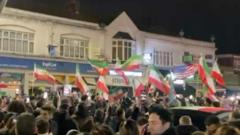
The images began flooding encrypted messaging apps minutes after the first reports of explosions near Isfahan and Karaj. Videos showed groups in various regional capitals—and even within certain Iranian provinces—handing out sweets and setting off fireworks. While mainstream headlines characterize these scenes as a spontaneous global celebration, a closer look at the ground reality reveals a much more dangerous and calculated phenomenon. These public displays are not just emotional outbursts; they are weaponized psychological markers in a conflict that has moved far beyond traditional borders.
For those watching from the outside, a firework over a city square looks like victory. For the intelligence agencies and local militias operating in the shadows, these celebrations serve as a real-time heat map of dissent and loyalty. The "celebrations" reported by Western outlets are often concentrated in specific enclaves—areas where the grip of the Islamic Revolutionary Guard Corps (IRGC) is either being tested or where rival proxy interests have established a foothold. To view this purely as a human-interest story is to miss the strategic intelligence being gathered through every viral clip.
The Mechanics of Organized Joy
Spontaneity is a rare commodity in highly surveilled states. In many instances, the distribution of confectionaries and the synchronized chanting seen on camera are the result of deep-seated underground networks. These groups utilize the chaos of a military strike to signal their presence to foreign backers. It is a high-stakes gamble. By identifying themselves through celebration, these dissidents are effectively burning their cover in exchange for a moment of international visibility.
Security forces in Tehran do not see a party. They see a target list. Historically, the aftermath of regional strikes is followed by a quiet, brutal domestic crackdown. The "celebration" becomes the justification for the next wave of internal purges. We have seen this cycle repeat in 2020, 2022, and again in the current window of 2026. The strike provides the physical damage, but the reaction to the strike provides the map for the regime’s next internal security operation.
Why Regional Rivals Are Moving Toward Quiet Satisfaction
While the streets might see outward displays of glee, the corridors of power in Riyadh, Abu Dhabi, and Amman are practicing a different kind of restraint. The celebratory narrative pushed by some media outlets suggests a monolithic front against Iranian influence. The truth is far more fragmented. Governments in the region are terrified of "blowback" from an Iranian leadership that feels increasingly backed into a corner.
Diplomats in these capitals have spent years trying to de-escalate through backchannels. A strike on Iranian soil, followed by visible celebrations within their own borders, threatens to undo years of delicate "quiet diplomacy." When a crowd in a neighboring country cheers for a strike on Iran, the IRGC interprets that cheer as a state-sanctioned act of aggression. This shifts the retaliation target from the military actor who launched the strike to the neighbor who allowed the party.
The Diaspora Disconnect
A significant portion of the footage used to support the "world is celebrating" narrative actually originates from diaspora communities in London, Los Angeles, and Paris. There is a profound disconnect between the celebratory tone of those in the safety of the West and the grim reality of those living under the flight paths of incoming drones.
For the diaspora, the strikes represent a flickering hope for regime change. For the person on the ground in Shiraz or Tabriz, the strikes represent the potential for infrastructure collapse, the loss of civilian life, and the inevitable tightening of the digital iron curtain. The disconnect is not just geographic; it is existential. The celebration in a London square does not account for the fact that every strike strengthens the hardliners' argument that the country is under an external existential threat, allowing them to marginalize the moderate voices that still remain.
The Intelligence Value of the Viral Clip
Modern warfare is as much about data as it is about ballistics. When a video of a celebration goes viral, it provides metadata that is invaluable to state security apparatuses. Facial recognition software, now a standard tool for the IRGC’s Cyber Defense Command, is used to cross-reference these "celebrants" with known activists.
- Identification: Matching faces to national ID databases.
- Network Mapping: Analyzing who is standing next to whom to identify local cells.
- Geofencing: Determining which specific neighborhoods are showing the most resistance.
The celebration is, in many ways, a trap. It coaxes the opposition out into the open at a moment when the regime is at its most paranoid and reactive. Those who analyze these events from a purely emotional perspective fail to understand that in the Middle East, a party is often a precursor to a prison sentence.
Infrastructure and the Illusion of Precision
The strikes are frequently described as "surgical." This term is a favorite of military PR departments, but it rarely reflects the aftermath on the ground. When power grids are hit or communication hubs are disrupted, the "celebration" quickly turns into a scramble for resources.
In the most recent rounds of strikes, the focus has shifted toward dual-use infrastructure. These are facilities that serve both the military and the civilian population. When these are degraded, the immediate reaction of the youth might be one of defiance, but the long-term result is a crippled economy that disproportionately affects the very people who were cheering. The economic fallout of these strikes—inflation, currency devaluation, and the scarcity of basic goods—acts as a secondary strike that lasts months after the smoke clears.
The Role of State-Sponsored Counter-Narratives
Tehran is not a passive observer in the information war. For every video of a celebration, the state media apparatus produces ten videos of "spontaneous" mourning or pro-government rallies. The battle for the "vibe" of the country is fought on TikTok and Telegram.
Observers often fall into the trap of confirmation bias. If you want to see a collapsing regime, you will find the videos of fireworks. If you want to see a defiant nation, you will find the videos of the funeral processions. The reality is a country deeply divided, where the "celebration" is a minority act of extreme bravery—or extreme recklessness—rather than a consensus.
The Shift in Proxy Warfare Dynamics
The strikes on Iran have fundamentally changed the "rules of the game" for proxies like Hezbollah and the Houthis. Previously, there was a clear line of escalation. Now, that line is blurred. The celebrations seen in places like Idlib, Syria, or parts of Iraq are a direct taunt to the Iranian-backed militias that have dominated those regions for a decade.
This creates a volatile "mini-conflict" within these countries. When sunni factions in Lebanon celebrate a strike on Iranian assets, it triggers a localized friction with Hezbollah. We are seeing a decentralization of the conflict, where the original strike acts as a catalyst for a dozen smaller, localized civil brawls across the Levant.
The Brutal Reality of the Day After
The "why" behind the strikes is often lost in the "how" of the execution. These operations are designed to delay nuclear progress or degrade drone manufacturing capabilities. They are technical solutions to political problems. The celebrations are a byproduct that the military planners don't necessarily want.
A celebrated strike is a strike that requires a response. If an attack occurs and is met with silence, the regime can choose to downplay it to save face. If an attack occurs and the world—and more importantly, the Iranian people—celebrates it, the regime is forced to react to maintain its image of strength. The very act of cheering makes a wider, more devastating war more likely.
The focus must shift from the spectacle of the fireworks to the silent movements of the security forces in the hours that follow. The true story isn't the man handing out sweets in the street; it's the empty chair at the dinner table three days later when the secret police have finished their work.
Every firework launched in celebration of a missile strike is a signal. To the West, it’s a signal of hope. To the regime, it’s a signal of a target. To the regional neighbors, it’s a signal of impending instability. Understanding this conflict requires looking past the glare of the explosions and the cheering crowds to see the cold, calculated repositioning of power that occurs in the dark.
Demand a more rigorous analysis of these events. Stop looking at the celebration and start looking at the surveillance. The next phase of this conflict will not be fought with missiles, but with the data harvested from the very people who thought they were finally seeing the beginning of the end. Identify the specific actors funding these "spontaneous" displays and track the arrests that follow. That is where the real story lives.