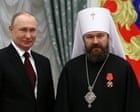
The brief detention and rapid release of Metropolitan Hilarion (secular name Grigory Alfeyev) by Czech law enforcement on a highway between Karlovy Vary and Prague exposes the mechanism of modern asymmetric operations: the strategic convergence of state law enforcement, ecclesiastical internal politics, and hybrid warfare. While initial reporting framed the event as a routine drug interdiction prompted by an anonymous tip, the structural variables surrounding the target, the operational geography, and the immediate state-level reactions indicate a highly calculated, multi-layered operation.
Analyzing this event requires moving beyond the surface narrative of criminal suspicion. Instead, evaluating the incident through a rigorous, tripartite strategic framework reveals how low-threshold criminal allegations are deployed as high-impact tools of geopolitical friction.
[State Intelligence/Informant Networks] ---> Anonymous Tip-Off
                                                    │
                                                    ▼
[Czech National Drug Headquarters]     ---> Tactical Vehicle Interdiction
                                                    │
                                                    ▼
[Geopolitical / Ecclesiastical Shock]   ---> Mutual Plausible Deniability
The Strategic Architecture of Interdiction
The operational execution of the traffic stop by the Czech National Drug Headquarters relies on a fundamental tension in domestic law enforcement: the asymmetry of anonymous intelligence. According to formal agency statements, tactical units intercepted Hilarion’s vehicle based on a targeted, anonymous tip-off alleging the transit of narcotic and psychotropic substances.
This specific vector of input creates a precise legal trigger. European law enforcement frameworks mandate immediate intervention when actionable intelligence points to trans-border narcotic transit, leaving the state with virtually zero choice but to execute an interdiction. The mechanical components of this operation highlight distinct tactical inconsistencies that support the hypothesis of a pre-planned setup rather than a routine check:
- Pre-positioned Assets: Defense statements note that multiple patrol units were pre-staged along the highway corridor, indicating a high-confidence location vector provided by the informant network.
- Procedural Exclusion: Law enforcement isolated Hilarion from the vehicle during the physical search of the boot, preventing verification of custody chain integrity.
- The Forensic Gap: Field testing confirmed the presence of a banned narcotic substance within four distinct containers. However, the quantitative mass and specific chemical composition remained undisclosed prior to his unconditional release by the court.
The structural vulnerability exposed here is the ease with which state security apparatuses can be manipulated by external intelligence actors. By feeding verified tracking data and a fabricated criminal payload into a domestic drug enforcement pipeline, an adversary can leverage a sovereign nation’s own judicial protocols to execute a highly public disruption.
The Tri-Front Vulnerability Matrix
To understand why Metropolitan Hilarion was selected as the node for this friction point, his position must be mapped across three distinct, overlapping vulnerability profiles: geopolitical exile, internal ecclesiastical fracturing, and personal reputational degradation.
1. The Geopolitical Friction Vector
Karlovy Vary represents a unique geographic anomaly within Central Europe. Historically functioning as a primary hub for the Russian diaspora, the spa town serves as an ideal theater for proxy signaling. Hilarion’s position as the head of the local Russian Orthodox congregation placed him at the immediate intersection of local Czech security scrutiny and expatriate politics. Following the installation of a new Czech administration six months prior, which shifted the state's overt posture toward Ukraine, the local Russian Orthodox infrastructure became an intuitive focal point for domestic counter-intelligence monitoring.
2. Ecclesiastical Marginalization
Hilarion’s career trajectory illustrates a steady degradation of institutional power within the Moscow Patriarchate. For thirteen years, he operated effectively as the foreign minister of the Russian Orthodox Church, leading the Department for External Church Relations. He was widely positioned as the primary successor to Patriarch Kirill.
His failure to align with the institutional consensus following the February 2022 invasion of Ukraine triggered a systematic purge. Unlike senior clergy who integrated state military objectives into religious dogma, Hilarion maintained public silence. The cost of this ideological non-compliance was immediate demotion and reassignment to the Budapest-Hungarian diocese.
3. The Compromat Loop
The third vulnerability is the accumulation of personal liability, which provided the ideal psychological substrate for a public discrediting campaign. In December 2024, the Holy Synod stripped Hilarion of his administrative duties in Hungary and forced him into nominal retirement following public allegations of financial extravagance and sexual harassment.
 ideological non-compliance (2022) ---> demotion to budapest
                                              │
                                              ▼
 financial/personal scandal (2024)   ---> exile to karlovy vary
                                              │
                                              ▼
 anonymous narcotics tip-off (2026)  ---> absolute systemic vulnerability
This sequence demonstrates that by May 2026, Hilarion possessed no functional institutional shield from Moscow, while simultaneously acting as an active target for western security agencies looking to pressure assets linked to the Russian state.
The Mechanics of Diplomatic Escalation
The immediate post-detention phase reveals the true utility of the operation. The find of a "white powder" in a vehicle trunk does not yield significant strategic value; the value is generated by the predictable, automated escalation protocols of state diplomatic apparatuses.
The Russian Foreign Ministry executed a rapid, high-visibility counter-offensive. Spokesperson Maria Zakharova labeled the incident a "deliberate, orchestrated provocation," and the ministry immediately summoned Jan Ondřejka, the Czech Chargé d’Affaires in Moscow, to deliver a formal protest.
This response highlights a specific calculation:
| Actor | Action Taken | Strategic Yield |
|---|---|---|
| Russian State | Immediate diplomatic escalation and summoning of Czech envoys. | Reinforces the domestic narrative of an aggressive, Russophobic European security apparatus targeting innocent cultural/religious figures. |
| Czech Judiciary | Unconditional release without charges within 48 hours. | Preserves legal integrity based on insufficient evidence of intent, while demonstrating domestic judicial independence. |
| The Target (Hilarion) | Public declaration of innocence via secure Telegram channels. | Re-establishes defensive narrative, emphasizing procedural violations and an ongoing campaign of anonymous threats. |
The structural bottleneck for the Czech authorities was the legal threshold of possession versus intent. While the forensic discovery of a banned substance satisfies the criteria for an initial traffic stop and short-term detention, establishing criminal liability requires proof of knowledge or control. In an environment where a vehicle can be accessed by multiple actors, and where the target has been subjected to documented, long-term harassment campaigns, the prosecution's case faces a high probability of collapse. The court's decision to release Hilarion without restrictive measures reflects a calculated risk mitigation strategy to prevent further diplomatic escalation over a legally unsustainable charge.
The Strategic Play
For international policy analysts and security consultants operating within European borderlands, the Hilarion incident provides a highly transferable case study in the weaponization of domestic legal frameworks. The operational reality of this case dictates a specific strategic playbook for handling cross-border incidents involving politically exposed persons from non-aligned states.
First, security teams must treat anonymous tips to domestic law enforcement as potential vectors of state-sponsored disruption. When an asset occupies a sensitive geopolitical position, their operational security protocols must extend to physical asset monitoring—such as continuous, tamper-evident surveillance of transport infrastructure—to neutralize the insertion of illicit materials.
Second, the immediate diplomatic decoupling seen in this case should be formalized as standard operating procedure. By quickly releasing the asset when direct intent cannot be proven, the host nation minimizes the adversary’s ability to construct a prolonged counter-narrative of state-sponsored persecution. Strategic communication teams must decouple the criminal investigation from geopolitical rhetoric, keeping the public focus strictly on objective evidentiary standards and established chain-of-custody protocols. This neutralization of the informational payload denies external state actors the leverage required to convert a simple local police action into a broader diplomatic crisis.