The standard media script for a residential fire is entirely predictable. A blaze breaks out, residents stand on the sidewalk surveying the ash, and local reporters rush in to ask how this tragedy could have been prevented. We blame old wiring, delayed emergency responses, or landlord negligence. We treat every fire like an isolated failure of execution rather than a systemic symptom of economic reality.
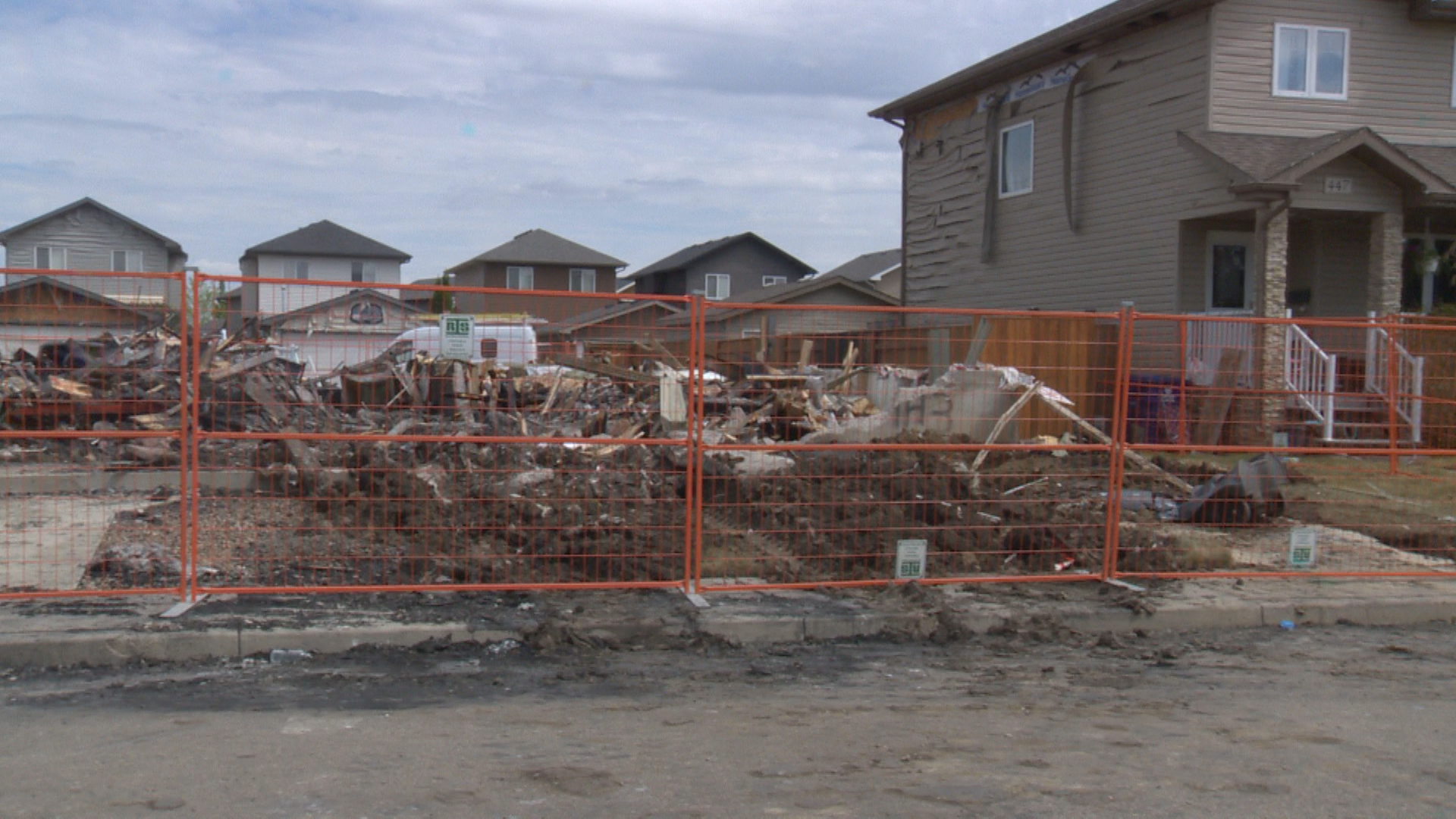
The recent Friday blaze at Geary Crescent is a textbook example of this collective blindness.
Mainstream coverage looks at the charred remains and demands stricter regulations, immediate government intervention, and endless oversight. They want to turn every apartment complex into an impenetrable fortress. It sounds compassionate. It makes for a comforting headline.
It is also completely wrong.
The hyper-focus on eliminating 100% of physical risk in aging residential infrastructure is a luxury belief that ultimately harms the exact people it claims to protect. When we over-regulate urban housing in the wake of localized crises, we inevitably drive up compliance costs, shrink the affordable housing supply, and price vulnerable tenants right out of the neighborhood.
Safety is not an absolute metric. It is a financial trade-off. Until we admit that, we are just engineering the next housing crisis under the guise of public safety.
The Compliance Trap That Suffocates Cities
Every time a localized disaster hits the news cycle, municipal governments face immense pressure to do something. That "something" is almost always a new layer of bureaucratic red tape.
I have spent fifteen years analyzing urban development patterns and municipal risk management. I have watched city councils pass sweeping retrofitting mandates after a single headline-making event.
Here is what actually happens next:
- The Cost Shift: Landlords do not absorb the cost of upgrading decades-old electrical grids or installing industrial-grade fire suppression systems. They pass it directly to the tenants through rent hikes.
- The Shadow Inventory: Small-scale property owners who cannot afford a sudden $50,000 compliance bill do not upgrade. They simply take their units off the market, turning perfectly functional housing into dead capital.
- The Institutional Takeover: Compliance burdens act as a massive barrier to entry for local landlords. Only massive private equity firms have the liquid capital to absorb these regulatory shocks. They buy up the devalued properties, perform the legally mandated upgrades, and instantly gentrify the building.
The Geary Crescent fire is undeniable evidence of aging infrastructure challenges, yes. But demanding an immediate, top-down regulatory overhaul of every similar structure in the zone ignores basic microeconomics. You cannot legislate away the physical degradation of matter without paying for it. If the state forces the upgrade, the resident pays the price or gets evicted.
Dismantling the Myth of Absolute Structural Safety
Let us address the uncomfortable truth that public officials refuse to voice: perfect structural safety is a myth.
Buildings age. Materials degrade. Human error exists. To build a completely fireproof residential structure requires specialized concrete poured with strict reinforcement, commercial-grade containment zones, and redundant mechanical ventilation systems. In short, it requires building a prison.
"If you maximize for zero risk, you minimize for human utility."
When we look at structural integrity through a purely emotional lens, we ignore the concept of tolerable risk. We accept a baseline level of danger when we drive a car, board an airplane, or cross the street. Yet, we demand that our housing stock be entirely immune to the laws of physics and time, regardless of the age or economic bracket of the neighborhood.
Consider the data on urban blazes. The National Fire Protection Association (NFPA) consistently points out that the vast majority of residential fires stem from cooking equipment, heating units, or electrical distribution failures. These are behavioral and maintenance issues, not structural sins. Forcing a building owner to invest in expensive architectural overhauls does nothing to stop a tenant from overloading an extension cord or leaving a stove unattended.
Common Fire Causes vs. Regulatory Focus
┌───────────────────────────────────────┬───────────────────────────────────────┐
│ Actual Primary Drivers (Behavioral)   │ Where Regulations Focus (Structural)  │
├───────────────────────────────────────┼───────────────────────────────────────┤
│ Cooking mishaps                       │ Expensive structural retrofits        │
│ Overloaded extension cords            │ Complete rewiring mandates            │
│ Space heater placement                │ Exterior cladding overhauls           │
└───────────────────────────────────────┴───────────────────────────────────────┘
The competitor narrative wants you to look at the ash on Geary Crescent and see a villain—a negligent system, an absent landlord, a failure of the state. The harsher reality is that older, affordable housing carries inherent risks. If you eliminate those risks by legislative fiat, you eliminate the affordability along with it.
The Perverse Incentives of Municipal Panic
When a neighborhood suffers a visible loss, the immediate impulse is to question the local inspection regime. Why was this building allowed to stand in this condition? Why did inspectors sign off on it?
This line of questioning assumes that code enforcement is an objective, flawless science. It isn't. Code enforcement is highly political, chronically underfunded, and subject to intense human bias.
When you increase the strictness of building codes in response to a tragedy, you don't magically get better enforcement. You get selective enforcement. Inspectors focus their limited energy on the easiest targets—usually smaller, independent property owners who lack the legal teams to contest citations—while corporate landlords negotiate backroom variances.
The downside to my contrarian view is obvious: it sounds cold. It sounds like an endorsement of corporate apathy or a disregard for human life. It is neither. It is an acknowledgment that resources are finite. Every dollar spent chasing the illusion of zero-risk infrastructure is a dollar pulled away from municipal services, tenant education, and rapid emergency response networks.
If we want to protect residents in high-density areas, we need to stop focusing on the walls and start focusing on the margins.
Stop Regulating the Brick; Empower the Resident
The solution to urban property risk is not a heavier regulatory hammer. It is decentralization and targeted mitigation.
Instead of forcing a multi-million dollar structural overhaul that bankrupts a community's housing stock, cities should focus on low-cost, high-impact interventions that do not distort the rental market.
- Direct Subsidy of Basic Safety Tech: Instead of mandating complex, integrated alarm systems linked to city grids, distribute high-quality, long-life lithium battery smoke detectors directly to tenants, bypassing landlords entirely.
- Liability Reform for Minor Violations: Give property owners a clear, penalty-free grace period to fix self-reported maintenance issues. The current system punishes transparency, forcing owners to hide structural flaws from city inspectors out of fear of catastrophic fines.
- Localized Emergency Infrastructure: If an area consists of older, high-density wood-frame or brick-and-joist construction, don't try to rebuild the neighborhood. Increase the staffing, equipment, and water pressure capabilities of the local fire station. Fight the hazard at the response level, not the architectural level.
The onlookers standing on Geary Crescent looking at the smoke are asking the wrong question. They are asking, "How do we guarantee this never happens again?"
The correct, brutal question we must ask is: "What level of risk are we willing to accept to ensure that the people living on this block can afford to stay here next month?"
We have spent decades pretending that safety has no cost. The charred frame of a Friday fire is a tragedy, but the economic displacement caused by the subsequent regulatory panic is a slow-motion disaster that ruins far more lives than a localized flame ever could. Stop trying to engineer a risk-free world with other people's rent money.