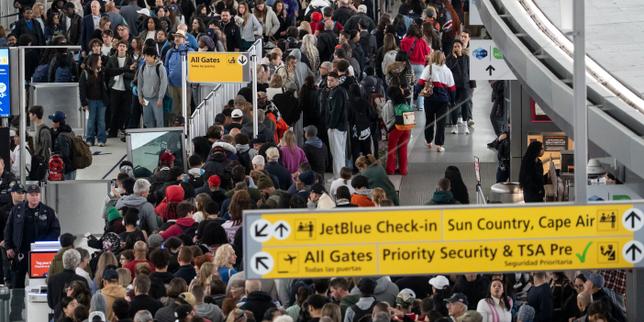
The air in an international arrivals hall has a specific, nervous weight. It is the scent of recycled oxygen, expensive duty-free perfume, and the quiet, vibrating anxiety of five hundred people waiting for a stamp that says they belong. For decades, this space—the "sterile zone"—was a predictable gauntlet of Customs and Border Protection (CBP) officers. You showed your passport, you declared your snacks, and you moved toward the sliding glass doors where life waited.
That predictable rhythm is changing.
In a shift that turns the airport terminal into a primary front of domestic immigration enforcement, the Trump administration is deploying Immigration and Customs Enforcement (ICE) agents to major U.S. airports. This is not a subtle adjustment of logistics. It is a fundamental reconfiguration of what it means to land on American soil. While CBP has always managed the "door," ICE is the agency tasked with "removal." Their presence inside the terminal changes the atmosphere from a checkpoint into a dragnet.
Consider a traveler we will call Elena. She is not a statistic, but she represents the demographic reality of this policy. Elena has lived in Chicago for twelve years. She has a Social Security number, a car payment, and a daughter who just started middle school. She traveled abroad to bury her mother. As she stands in the terminal, clutching a valid travel document, she sees a uniform she recognizes from news clips of neighborhood raids.
The officer isn't looking at her luggage. He is looking at her.
The New Architecture of the Border
For the average vacationer, the difference between a CBP officer and an ICE agent might seem academic. Both wear badges. Both carry the authority of the federal government. But the legal distinction is a chasm.
CBP is focused on the border itself—preventing illegal entry and intercepting contraband. They are the inspectors. ICE, specifically the Enforcement and Removal Operations (ERO) wing, is the machinery of deportation. By placing ICE agents directly in the path of arriving passengers, the administration is bypassing the traditional "buffer zone" between international arrival and domestic life.
The logic behind the deployment is rooted in a "maximum pressure" philosophy of immigration enforcement. The administration argues that airports are high-traffic funnels where individuals with outstanding deportation orders or expired visas can be caught with surgical precision.
It is efficient. It is cold. It is, for many, terrifying.
This move utilizes the "border search exception," a legal doctrine that grants the government broad powers to search people and property at the border without a warrant. Normally, if ICE wanted to pick someone up at their home or workplace, they might face legal hurdles or local "sanctuary" policies that limit cooperation with police. In an airport, those hurdles vanish. The terminal is a legal vacuum where the Fourth Amendment’s protection against unreasonable searches is significantly thinned.
The Invisible Net
What does this look like in practice? It looks like "roving teams."
Instead of sitting behind a plexiglass booth, these agents move through the crowds. They may monitor baggage carousels or stand near the gates of flights arriving from specific regions. Their presence serves a dual purpose: identification and deterrence.
When an agent pulls someone aside based on a database flag, the transition from "traveler" to "detainee" happens in seconds. There is no ride home. There is no stopping at the apartment to pack a bag or kiss a spouse. The logistics of the airport facilitate a rapid pipeline to detention centers.
The stakes are invisible to the businessman rushing to a meeting or the family heading to Disney World, but they are total for the person being questioned. One minute you are worrying about the length of the taxi line; the next, you are being processed for a flight out of the country.
This isn't just about those with criminal records. The administration has made it clear that the priority is "all-encompassing." If you are in the country without documentation, you are a target. Period. The nuance of a life built over decades—the taxes paid, the children raised, the community ties—is secondary to the status of the paperwork.
The Ripple Effect on the Tarmac
The presence of ICE in airports creates a psychological perimeter that extends far beyond the physical building. It changes how people travel.
We are seeing a phenomenon where legal permanent residents—green card holders—are becoming hesitant to leave the country for fear of "secondary inspection" or shifted protocols. The "chilling effect" is a real, measurable force. When the gateway to a country becomes a site of aggressive enforcement, the very nature of international exchange begins to wither.
Airlines, too, are caught in the gears. While they are private entities, they operate at the whim of federal regulation. The arrival hall is government property, and the airlines have little say in who patrols the halls after their passengers deplane. Yet, they are the ones who must deal with the empty seats on return flights and the growing sense of unease among their international clientele.
The Cost of Certainty
There is a tension here that defines the modern American moment. On one side is the drive for absolute border integrity—the idea that a law is not a law unless it is enforced with total consistency. To proponents, ICE in airports is simply closing a loophole. They see it as a common-sense use of resources to find people who have already been told they must leave.
On the other side is the human cost of a society that treats its transport hubs as traps.
When we turn airports into enforcement zones, we signal that the "welcome" of America is conditional on a level of scrutiny that feels increasingly hostile. We trade the fluidity of travel for the rigidity of a police state atmosphere.
Think of the child waiting at the arrivals curb, holding a hand-drawn sign, watching the sliding doors. One hour passes. Then two. The "invisible stakes" of this policy aren't found in the text of the memo or the budget of the agency. They are found in that child’s face when the doors finally stop opening and the terminal lights begin to dim.
The administration’s move is a clear statement: the border is no longer a line on a map. It is a presence that follows you, waits for you, and meets you exactly when you think you’ve finally made it home.
The plane touches down. The wheels screech on the asphalt. The cabin lights brighten, and the passengers stand to reach for their bags. Somewhere in the terminal, an agent checks a screen. The doors are still closed.