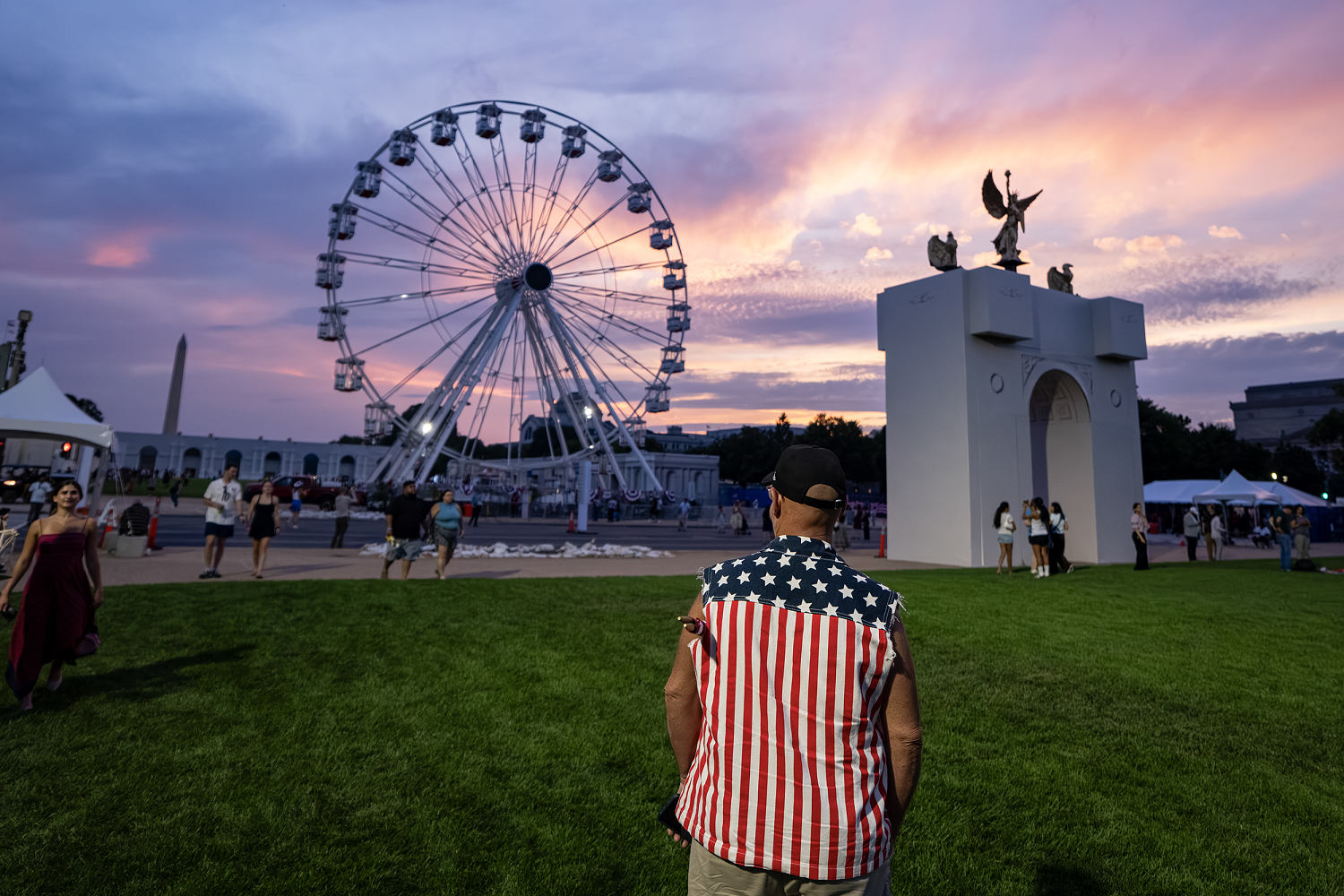
The polarization of public space operates under a precise economic trade-off: as political signaling intensifies, consumer conversion rates typically decay. Yet, the opening of the Great American State Fair on the National Mall demonstrates a sharp decoupling between institutional conflict and ground-level consumer behavior. While eight state governments withdrew from the event over structural costs and partisan friction, and high-profile musical acts canceled bookings under the threat of brand dilution, the primary consumer segment on-site remains highly insulated from these macro-level dynamics.
This insulation is not an accident of public sentiment. It is the direct output of a distinct psychological and behavioral framework. To understand why individual attendees report a neutral, apolitical experience amidst an overtly weaponized event structure, analysts must bypass superficial interview data and evaluate the mechanical friction points of the modern mass-gathering event.
The Three Pillars of Consumer Path Insulation
Superficial journalism frames the lack of attendee political concern as a cultural indicator. A structural analysis reveals it is a product of consumer path isolation. The layout and behavioral mechanics of the fair isolate the user experience into localized, non-ideological transactions.
+-----------------------------------------------------------+
|               MACRO POLITICIZATION LAYER                  |
|  (Executive Rallies, State Opt-Outs, Structural Litigations) |
+-----------------------------------------------------------+
                             |
                             v [Friction Filters]
+-----------------------------------------------------------+
|               MICRO TRANSACTIONAL LAYER                   |
|   (Concession Queues, Regional Pavilions, Commodity Goods) |
+-----------------------------------------------------------+
                             |
                             v
+-----------------------------------------------------------+
|             INSULATED CONSUMER EXPERIENCE                 |
+-----------------------------------------------------------+
1. The Micro-Transactional Dominance Filter
The human attention span within a high-stimulus, high-temperature physical retail environment prioritizes physical comfort and immediate utility over abstract ideological processing. When an attendee enters the fairgrounds, their cognitive load shifts immediately to secondary-tier needs:
- The Cost of Physical Transit: Navigating the physical expanse between the Lincoln Memorial and the U.S. Capitol.
- The Sunk Cost of Acquisition: Managing families or logistics after traveling significant distances (e.g., cross-state travel).
- Commodity Consumption Metrics: The immediate calculation of waiting times for food concessions, shade utilization, and mechanical rides.
Because the baseline utility of a state fair is anchored in highly tactile, universally understood commodities—such as standard concessions and amusement rides—the micro-transactional environment dilutes the macro-ideological framing. A consumer purchasing high-margin fair food is operating within a standard commerce funnel that effectively crowds out political messaging.
2. Narrative Compartmentalization
Attendees demonstrate a sophisticated capacity to partition media-driven controversy from immediate physical experiences. Media reports highlighted the partisan mechanics of the opening ceremonies, including executive speeches and partisan attacks regarding artist cancellations. However, for a consumer arriving twelve hours post-event, those elements carry zero transactional relevance.
The consumer treats the event as a decentralized marketplace. If an attendee encounters a localized political signal (e.g., a "Freedom Truck" or partisan merchandise), they execute a low-friction cognitive bypass: they reframe the element as an isolated corporate sponsor rather than an overarching theme. This allows the consumer to preserve the perceived utility of their ticket or travel investment.
3. Asymmetric Information Processing between Producers and Consumers
The friction point that caused state governors (such as those of Massachusetts, Oregon, and North Carolina) to withdraw from the event was structural and financial. States were asked to absorb capital expenditures ranging from $100,000 to $500,000 to fund their respective pavilions. For a state executive branch, this allocation carries a high political cost function requiring strict justification to a divided electorate.
For the end-user on the National Mall, however, the absence of an official state booth is processed not as an ideological boycott, but as an optimization failure or an empty commercial storefront. The retail consumer does not calculate the governance decisions behind a vacant pavilion space; they merely reallocate their time and foot traffic to functioning exhibits, such as the heavily trafficked Florida pavilion. The macro-political conflict exists entirely at the institutional layer, leaving the ground-level experiential layer unaffected.
The Capital Sunk Cost Function of Event Attendance
To quantify attendee indifference, one must analyze the economic commitment required to access the fairgrounds. Political ideology behaves as a secondary variable when matched against significant upfront capital and time investments.
$$\text{Total Consumer Investment} = C_{\text{transit}} + C_{\text{opportunity}} + C_{\text{sunk}} + \text{Cognitive Load}$$
Consider the mechanics of a multi-state consumer segment:
| Investment Variable | Operational Mechanism | Impact on Political Sensitivity |
|---|---|---|
| Long-Distance Transit ($C_{\text{transit}}$) | Committing to 500+ mile vehicular transit or flights to Washington, D.C. | High sunk-cost commitment forces the consumer to maximize enjoyment, suppressing ideological objections. |
| Micro-Economic Sunk Cost ($C_{\text{sunk}}$) | Capital allocated to hotel lodging, premium parking, and inflated event food pricing. | The need to recoup value from spent capital overrides secondary considerations about event organization. |
| Time Allocation ($C_{\text{opportunity}}$) | Dedicating multi-day vacation blocks planned months in advance. | High temporal investment reduces a consumer's willingness to abandon an experience over localized controversies. |
When an individual has crossed an economic threshold—spending hundreds of dollars and sacrificing finite vacation capital—the psychological cost of acknowledging that an event is overly partisan creates severe cognitive dissonance. The rational consumer response is to ignore institutional friction points to extract maximum practical utility from the spent capital.
Structural Bottlenecks of the Semi-Quincentennial Model
The strategic error made by the event's central organizing body, Freedom 250, lies in the misalignment between top-down public funding structures and decentralized execution. By bypassing traditional, bipartisan legislative committees in favor of a centralized executive-backed group, organizers introduced structural vulnerabilities that directly depressed physical attendance and infrastructure density.
The first bottleneck is the infrastructure deficit caused by the localized funding mandate. Forcing states to self-fund exhibits on federal land transformed a national celebration into a pay-to-play regional trade show. This mechanism systematically excluded regions with strict balanced-budget mandates or hostile legislatures. The direct casualty was the structural integrity of the fair itself: empty exhibition plots visible to attendees degrade the premium nature of the venue.
The second limitation involves talent acquisition and brand safety logic. Modern entertainment assets—performers, musicians, and corporate sponsors—operate under rigid risk-mitigation frameworks. When an event’s positioning shifts from national heritage to a campaign-style environment, the brand safety index of third-party participants drops sharply. The mass cancellation of artists prior to opening night is a predictable outcome of corporate risk management. The resulting programming gaps had to be filled by executive rhetoric, creating a feedback loop that further solidified the event’s partisan profile.
Strategic Play for Corporate Sponsors and Regional Planners
Entities evaluating participation in highly polarized national milestones must abandon sentimental frameworks and look strictly at operational isolation. The data from the National Mall demonstrates that while macro-level polarization creates significant narrative noise in media channels, consumer foot traffic remains highly transactional and pragmatic on the ground.
Organizations must decouple their localized consumer activation strategy from the overarching event narrative. Brand messaging should focus exclusively on localized utility, high-demand physical commodities, and regional cultural capital, completely bypassing systemic themes. By ignoring macro-level controversies and optimizing for the immediate, transactional needs of the attendee on the ground, brands can successfully capture high-density consumer attention even within highly contested public environments.