The ice doesn't break with a roar. It speaks in a high-pitched, metallic snap, a sound like a violin string snapping under too much tension. On the shores of Lake Erie, that sound is the boundary between a quiet Saturday of fishing and a desperate fight for survival.
Twenty-seven people stood on that shifting boundary recently. They were anglers, mostly—men and women who had trekked out onto the frozen expanse near Port Maitland, Ontario, seeking the prehistoric pull of a yellow perch or the flash of a walleye. They had checked the reports. They had looked at the horizon. But Lake Erie is a shallow, temperamental beast. When the wind shifts from the south, the massive shelf of ice doesn't just melt; it detaches. It becomes a tectonic plate adrift in a freezing void.
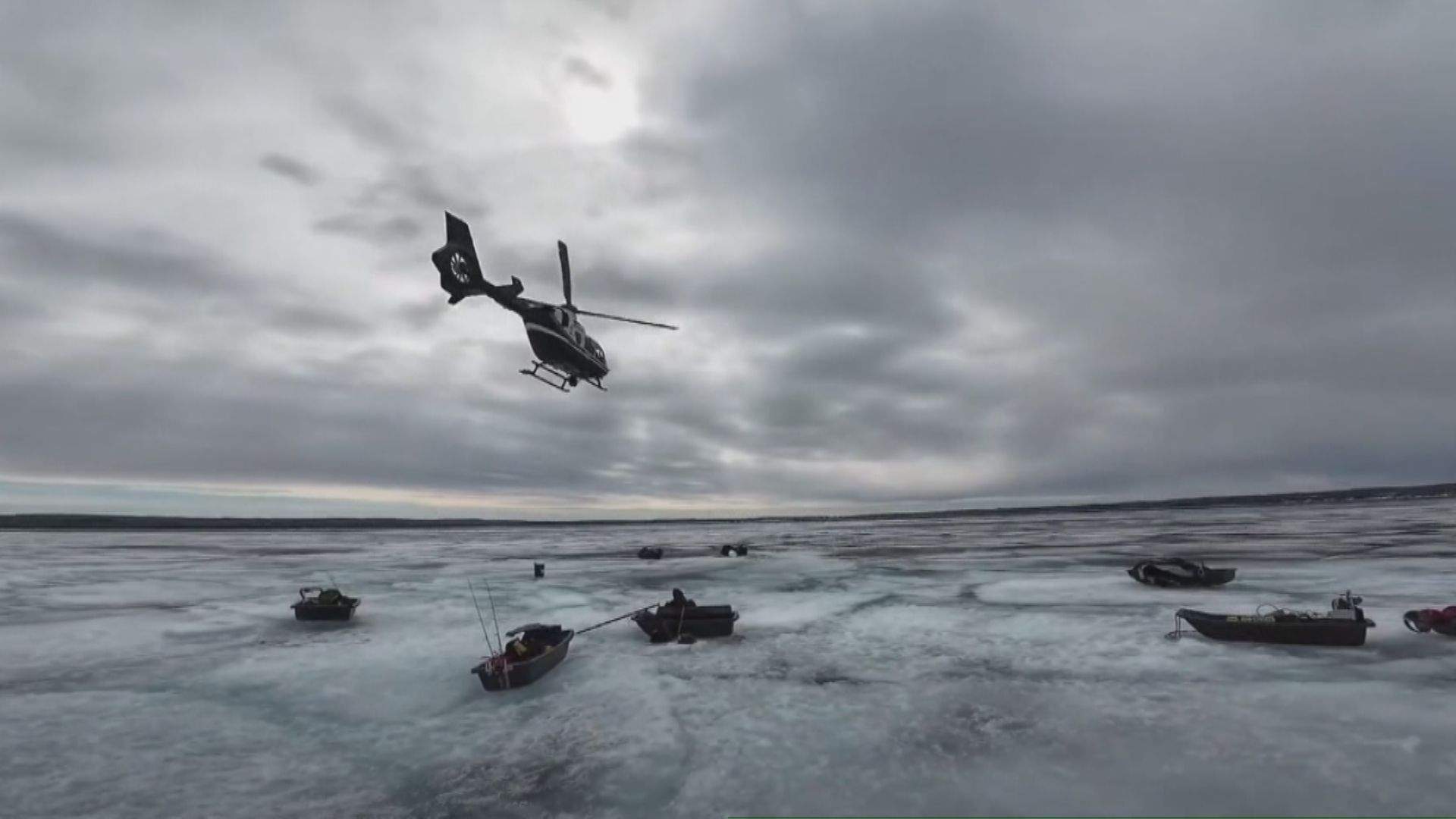
Within minutes, a gap of black, churning water opened between the anglers and the shore. They were no longer on solid ground. They were on an island of ice, drifting toward a horizon where the water never stops moving.
The Invisible Price of a Life
When the emergency calls hit the dispatch center, the machinery of the state began to groan into motion. Airboats roared to life, their massive fans cutting through the frigid mist. Search and rescue technicians donned neoprene suits that cost more than some used cars. A Griffon helicopter, a mechanical dragon of the Royal Canadian Air Force, was diverted from its path, its rotors beating the air into a frantic pulse.
Total cost for a rescue of this magnitude? Tens of thousands of dollars. Easily.
In many jurisdictions across North America, the bill for such an ordeal would land squarely in the mailboxes of the rescued. In parts of the United States, if you wander off a trail or get stuck on a mountain through perceived negligence, the government sends an invoice for the fuel, the flight hours, and the man-power. It is a policy designed to deter recklessness. It says: Your mistake, your debt.
But Ontario chooses a different path. The province confirmed shortly after the Port Maitland rescue that these twenty-seven souls would not be charged a single cent for their salvation.
To some, this feels like an injustice. There is a vocal segment of the tax-paying public that views ice fishing as an inherent gamble—a hobby for the "reckless" that the rest of society shouldn't have to subsidize. They see the helicopter fuel as money burned for the sake of a few buckets of fish.
But look closer at the mechanics of a rescue, and the logic of the "free" save begins to reveal a deeper, more compassionate wisdom.
The Danger of the Bill
Consider a hypothetical angler named Elias.
Elias is sixty-two. He’s been fishing Erie since he was a boy. He knows the ice, or he thinks he does. On a Tuesday morning, he notices the crack. He sees the water widening. He looks at his phone and thinks about calling 911. But then he remembers a headline he saw three months ago: Angler hit with $15,000 bill for air rescue.
Elias looks at his bank account in his mind. He thinks about his mortgage. He thinks about his granddaughter’s tuition. He waits.
He figures he can jump the gap. Or maybe the wind will shift back and close the lead. He waits an hour. Then two. By the time the fear of drowning finally outweighs the fear of bankruptcy, the gap is too wide for an airboat. The weather has turned. Now, instead of a simple ferry ride back to the pier, the province has to launch a full-scale night extraction in a blizzard.
The "cost-recovery" model creates a hesitation that kills.
When you put a price tag on a rescue, you aren't just charging for fuel; you are charging for the permission to stay alive. In the high-stakes environment of Lake Erie in January, a thirty-minute delay is the difference between a cold story told at a bar and a row of body bags lined up on the docks.
The Ontario Provincial Police and the Canadian Coast Guard don't want you thinking about your credit card balance when the ice starts to groan. They want you on the radio immediately.
The Myth of the Reckless Outdoorsman
There is a common misconception that everyone who ends up on an ice floe is an amateur who ignored a "Danger" sign. The reality is far more nuanced.
Ice is a living thing. It breathes. It expands and contracts. Satellite imagery can tell you the thickness of the shelf, but it cannot tell you about the thermal currents bubbling up from the lake floor or the exact moment a gust of wind will hit the "sail" of an ice pressure ridge.
The people out there on the ice are often the ones who respect it the most. They are the local guides, the lifelong residents, the people whose mental health is tied to the silence of the frozen lake. They provide the heartbeat of the local economy in towns like Port Maitland and Dunnville. They buy the bait, the gas, the lodging, and the gear. They are part of a cultural fabric that has existed since before the province was a province.
To penalize them for an act of God—a sudden shift in wind—is to penalize the very soul of the region.
The rescue teams themselves are the first to defend the "no-charge" policy. For a search and rescue technician, the nightmare isn't a busy day; it's a day where they arrive too late because someone was afraid to call. They train for these moments. The flight hours logged during a rescue are often hours that would have been spent in training anyway. The machinery needs to run. The crews need the "live" experience.
When we talk about the "cost" of the rescue, we rarely talk about the cost of the alternative.
A body recovery is an expensive, grueling, and traumatizing affair. It involves divers, coroners, and weeks of investigation. It leaves a hole in a family and a shadow over a community. Compared to the price of a funeral and the loss of a human life, a few thousand dollars in aviation fuel is a bargain.
The Weight of the Air
The twenty-seven people rescued from Port Maitland didn't walk away scot-free, even if their wallets remained intact.
There is a specific kind of shame that comes with being the person on the evening news, dangling from a cable beneath a yellow helicopter. There is the loss of equipment—thousands of dollars in snowmobiles, ATVs, and fishing huts often have to be abandoned to the lake, swallowed by the depths when the ice finally breaks apart. For many, that is the "fine" they pay for their misjudgment.
But as the last angler was lifted from the ice and the Griffon turned back toward its base, the true value of the policy became clear.
We live in a world that is increasingly obsessed with the "user-pay" model. We want to find someone to blame, someone to invoice, someone to hold accountable for the chaos of the natural world. But there are some things that must remain outside the realm of commerce.
Mercy shouldn't have a deductible.
If we start charging for the airboat, do we start charging for the fire truck that shows up when a stove malfunctions? Do we send a bill to the heart attack victim because they ate too much red meat? Do we invoice the victim of a car accident because they chose to drive during a rainstorm?
Ontario’s decision to keep the rescue "free" is a quiet, powerful statement about the value of a human life. It acknowledges that we are all, at some point, at the mercy of elements larger than ourselves. It recognizes that in the moment of crisis, the only thing that should matter is the hand reaching down to pull you from the dark.
The ice will always break. The wind will always shift. And as long as the water stays cold, there will be those who find themselves on the wrong side of the snap. But for now, they can look at the horizon and know that help doesn't come with a bill of sale.
It comes because it is the right thing to do.
The lake eventually took the ice floe. It drifted into the mist, a white ghost on a black sea, carrying the abandoned gear of twenty-seven people who got to go home and kiss their families. The snowmobiles are at the bottom of the lake now, silent and heavy. But the people are warm.
That is a trade we should be willing to make every single time.