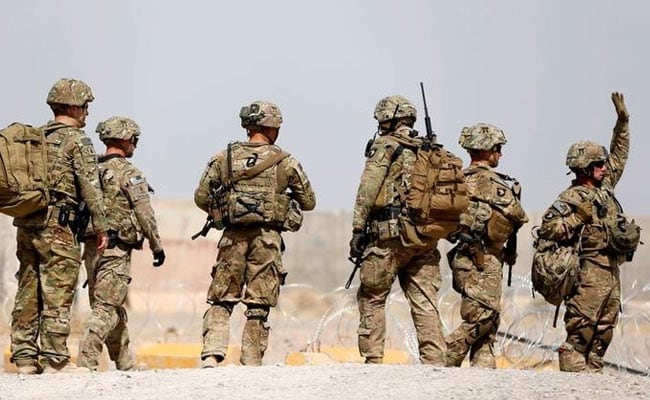
The mainstream defense media is obsessed with a comfortable lie. They call it the "new normal" or the "grey zone"—a state of perpetual friction where US troops sit in exposed desert outposts, absorbing drone strikes while waiting for a war that never quite starts. They frame this "not war, not peace" status quo as an unavoidable strategic challenge.
It is not a strategic challenge. It is a policy choice. And it is a failing one. For another view, consider: this related article.
The prevailing narrative suggests that maintaining a distributed, static footprint across Iraq, Syria, and Jordan deters Iranian aggression. This is pure theater. In reality, these isolated outposts do not project power; they serve as stationary targets. We are risking American lives not to achieve a decisive geopolitical objective, but to sustain a bureaucratic equilibrium that serves no one but the defense contractors supplying the counter-drone systems.
If you want to understand why US strategy in the Middle East has stalled, you have to stop asking how troops are "adapting" to the threat. You need to ask why they are being left in the crosshairs in the first place. Similar insight on the subject has been provided by BBC News.
The Myth of the Static Deterrent
For decades, the standard playbook for American power projection relied on forward deployment. The logic was simple: place boots on the ground, establish a perimeter, and the sheer presence of the American military will make the adversary think twice.
That logic died with the democratization of precision-guided munitions.
Today, cheap, one-way attack drones and unguided rockets have completely inverted the cost-benefit curve of forward defense. An adversary can build and launch a delta-wing drone for a few thousand dollars. The US military counters by firing an interceptor missile that costs hundreds of thousands, if not millions, of dollars.
Worse, our troops are placed in fixed positions like Tower 22 or Al-Asad Airbase. These are not secret installations; their coordinates are fixed on every adversary's digital map. I have watched defense analysts argue that these bases are critical for "monitoring regional stability." Let us be precise: you do not monitor stability by becoming a sponge for incoming artillery.
When you leave forces in a permanent defensive crouch, you hand the operational initiative to your opponent. They decide when to escalate, where to strike, and how much pressure to apply. The US military is reduced to a reactive force, celebrating the fact that it shot down 90% of an incoming volley while ignoring the fact that the 10% that got through caused traumatic brain injuries and American fatalities.
Dismantling the People Also Ask Premise
If you look at public discourse around Middle East deployments, the questions being asked prove how deeply the public has been misled by the defense establishment. Let us dissect the flawed premises driving these queries.
Does withdrawing US troops from the Middle East create a power vacuum?
This is the ultimate bogeyman of Washington foreign policy. The "vacuum" argument assumes that if the US pulls back, a monolithic hostile force instantly swallows the map.
History shows us a more complicated reality. When the US maintains a heavy, provocative footprint, it actually subsidizes the security of regional actors who should be defending themselves, while simultaneously giving disparate militant groups a unifying enemy to rally against. True regional balance occurs when local powers are forced to internalize their own security costs. By staying embedded in indefensible outposts, the US prevents a natural balance of power from forming. We are not filling a vacuum; we are freezing a conflict in its most volatile state.
How do US forces counter grey-zone tactics?
The very premise of this question is broken. You do not "counter" grey-zone tactics by playing by the rules of the grey zone.
The concept of grey-zone warfare—actions that fall below the threshold of open conflict—was designed by adversaries precisely because they know they cannot win a conventional fight against the United States. By accepting the "not war, not peace" framework, the US agrees to fight on the exact terrain where its conventional superiority is neutralized.
The only way to win a grey-zone game is to refuse to play. If an asset does not serve a clear, offensive wartime objective or a vital national security interest, it must be removed. If it is vital, it must be defended with overwhelming, disproportionate retaliatory options, not passive air defense batteries.
The Cost of the Bureaucratic Inertia
Why does this broken model persist? Follow the money and the career paths.
In my years tracking defense procurement and force posture shifts, I have seen how institutional inertia overrides strategic clarity. A regional command like CENTCOM exists to manage its area of responsibility. Shrinking that responsibility means a reduction in budget, a loss of high-profile commands, and fewer stars for the generals in charge.
Simultaneously, the defense industrial base has pivoted beautifully to monetize this endless state of minor crisis. The market is flooded with "counter-UAS" (Unmanned Aircraft Systems) solutions. Jamming rigs, directed energy experiments, automated kinetic interceptors—billions of dollars are flowing into protecting troops who are only in danger because they are occupying ground they do not need to hold.
Consider the dynamic at play. Imagine a scenario where a corporation keeps a retail branch open in a high-crime neighborhood where it loses money every month and its employees are constantly assaulted. Instead of closing the unprofitable branch, the CEO spends millions on armored glass, private security guards, and trauma counseling, justifying it by saying, "We must maintain our corporate presence on this block." Shareholders would fire that CEO within a quarter. Yet, this is exactly how US foreign policy operates in parts of the Levant and Iraq.
The Realist Alternative: Off-Shore Balancing
The alternative to this endless cycle of passive defense is not isolationism. It is strategic sanity. It is a doctrine known to realists as off-shore balancing.
The United States possesses unmatched global reach through its naval and long-range strike capabilities. We do not need a permanent, vulnerable human tripwire in a desert outpost to strike an adversary or protect an sea lane.
By shifting to an off-shore posture, the US immediately achieves three critical objectives:
- Target Denial: You cannot hit what is not there. Removing vulnerable ground garrisons instantly strips adversaries of their easiest leverage points.
- Restored Deterrence: An adversary willing to launch a cheap drone at a small outpost might think twice before targeting a strike group or risking a long-range cruise missile barrage directed at their homeland infrastructure.
- Strategic Flexibility: Forces tied down defending themselves in static Middle Eastern positions are forces unavailable for higher-priority theaters in the Indo-Pacific.
The downside to this approach is obvious, and we must be honest about it: it requires political courage. It means enduring the inevitable, short-sighted media panic claiming that America is "retreating." It means acknowledging that some regional dynamics are beyond Washington's control, and that some conflicts cannot be managed or smoothed over with a permanent deployment.
End the Theater
The current policy of leaving American service members to weather predictable rocket attacks under the guise of "adapting to a new normal" is a betrayal of basic military strategy. It prioritizes the appearance of resolve over the reality of security.
Stop pretending that surviving a drone strike is a strategic victory. Stop praising troops for their resilience in enduring a meat-grinder of low-level harassment that serves no grand strategic end.
Pack up the isolated outposts. Shift the weight to the seas and the skies. Force the region to reckon with its own geography, or continue to watch American blood and treasure evaporate in the grey zone, one cheap drone strike at a time.