Some buildings do not just occupy space. They land.
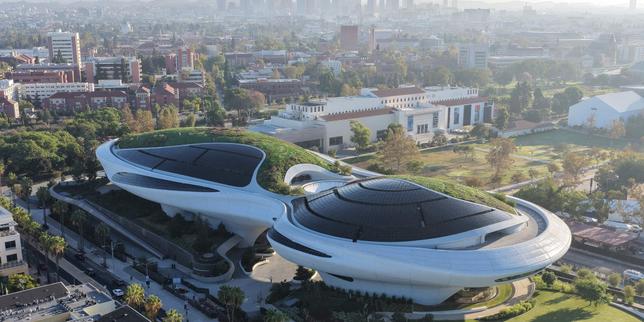
Consider the structure rising in Exposition Park, Los Angeles. It looks less like a traditional museum and more like a massive, obsidian starship frozen mid-descent over the Southern California asphalt. For decades, the mythos of a galaxy far, far away lived strictly inside two-hour cinematic bursts, flickering CRT televisions, and plastic action figures clutched in sweaty palms. Now, it has weight. It has geometry. It has shadow.
George Lucas is building a monument to visual imagination, but he is doing something much stranger than simply archiving movie props. He is demanding that we take make-believe as seriously as history.
The Architecture of an Obsession
Stand on the corner of Bill Robertson Lane and look up. The Lucas Museum of Narrative Art is a masterclass in architectural defiance, designed by MAD Architects. It curves, it bulges, it floats above open public green spaces like a monolith smuggled out of a science fiction storyboard.
Inside, thousands of original paintings, sketches, illustrations, and digital assets wait in climate-controlled silence. Think about what a painting actually is. It is a rectangle of canvas capturing a split second that never happened. A brushstroke of oil depicting a dragon, a dystopian city, or a solitary cowboy riding toward a dying sun. Lucas spent decades collecting these works, often outbidding high-end fine art galleries for Norman Rockwell canvases, Maxfield Parrish illustrations, and Ralph McQuarrie concept art.
Why? Because he understood a fundamental truth that traditional art historians spent generations ignoring. Popular art is the nervous system of society.
When a kid stares at a McQuarrie sketch of Darth Vader looming against a charcoal sky, that kid is not just looking at a drawing. They are absorbing a myth. They are learning how humans encode fear, power, redemption, and hope into visual language.
When Hollywood Builds a Temple
Los Angeles is a city built on the ephemeral. Movies turn to dust on decomposing nitrate film. Sets are struck, painted over, and thrown into dumpsters the moment a director yells cut. The town devours its own ghosts daily.
This museum is an act of rebellion against that amnesia.
By anchoring cinematic art to physical concrete and steel in the heart of Los Angeles, the project tells a different story. It whispers that our modern myths matter. They belong in the same conversation as Renaissance altarpieces and Impressionist landscapes. After all, what is a digital matte painting from a 1970s space opera if not a cathedral window for an industrial age?
Walking through the early planning phases of this institution was a lesson in bureaucratic patience. Delays piled up. Lawsuits threatened to choke the project in its cradle. Funding shifted. Yet the vision remained stubborn. Lucas poured over a billion dollars of his own fortune into the endeavor, turning a massive parking lot into an architectural pilgrimage site.
The Unseen Gallery
Imagine walking through the doors on opening day. The air is cool. The sound of Los Angeles traffic fades into a low, reverent hum.
You turn a corner and there it is. Not a digital file on a smartphone screen, but the actual grease pencil marks on a storyboard sheet. You can see the artist's hesitation. You can trace the frantic, brilliant strokes of someone trying to capture the exact angle of an exploding Death Star before the inspiration evaporates.
This is where the magic breaks down and transforms into something sturdier. Magic is easy when it stays on a silver screen. It is entirely different when you have to walk around it, touch the handrail, and look at the physical labor required to make people believe a spaceship could rust.
Artifice requires immense sweat.
We forget that behind every iconic frame of cinema sits an army of exhausted painters, sculptors, animators, and model makers who drank too much cold coffee under harsh fluorescent lights. The Lucas Museum exists to honor that invisible labor. It says that the people who paint the background plates are just as vital as the actors standing in front of them.
The Horizon
The starship has landed. The doors are open.
Children will walk beneath its sweeping curves, looking up at monsters, heroes, and strange worlds rendered in rich oils and precise digital strokes. They will realize that every great story starts as a messy thought in someone's head, dragged kicking and screaming into reality by sheer force of will.
The galaxy is no longer just on a screen. It is casting a shadow on the pavement.