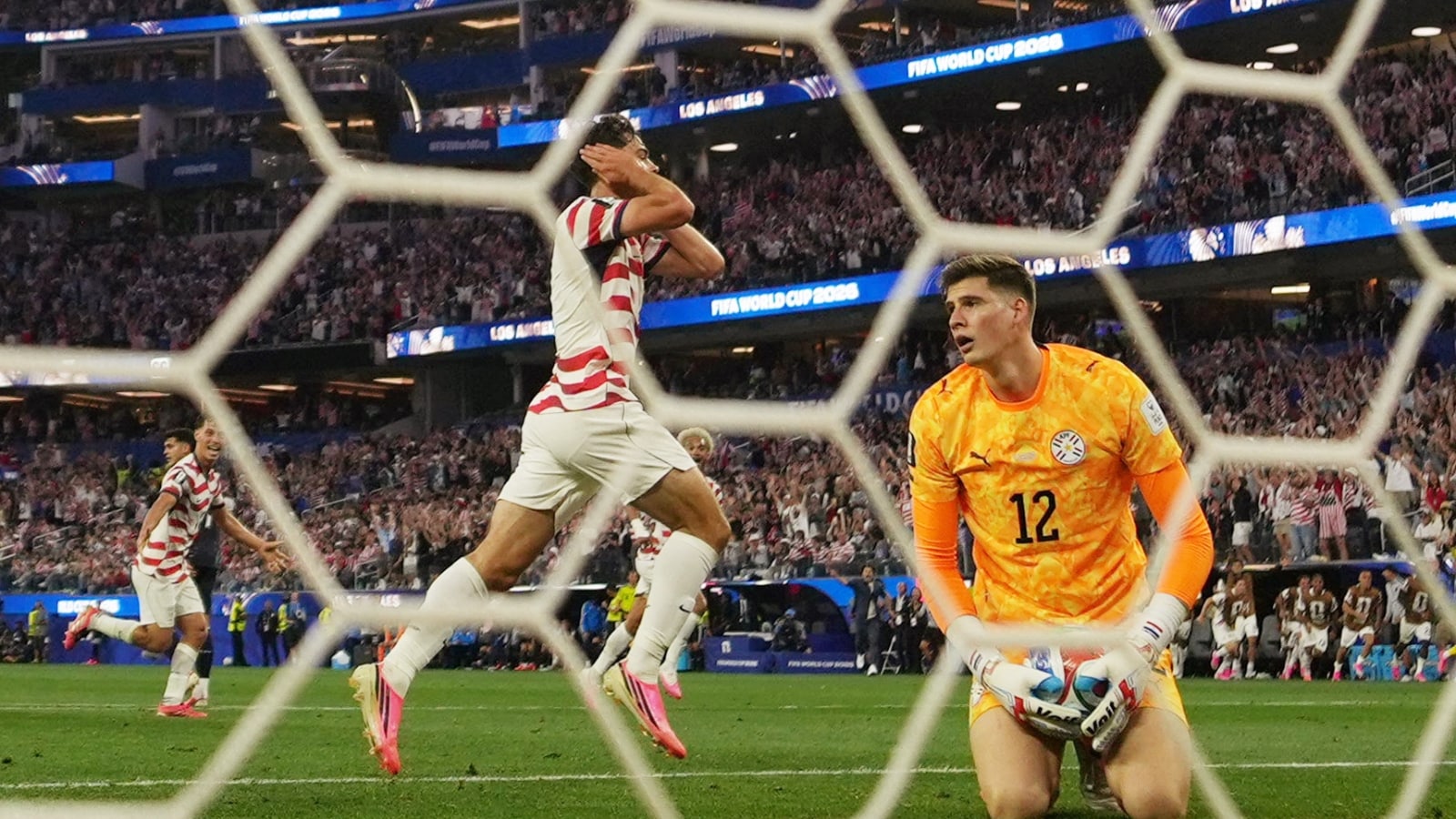
Folarin Balogun gave the United States Men’s National Team exactly what it wanted against Paraguay. He scored, he occupied center-backs, and he injected a sense of vertical urgency into a team that frequently suffocates under its own possession statistics. On paper, the performance validates the investment, the recruitment battle, and the narrative that the USMNT finally possesses an elite number nine capable of anchoring a deep tournament run.
But international soccer is a game of structural illusions. While the scoreline reflects a dominant American victory, a deeper tactical breakdown reveals that Balogun’s sparkling performance masked systemic flaws that continue to plague the American attack. The USMNT did not unlock a new tactical frontier; they simply executed a localized solution against a disorganized, transitioning South American opponent.
To understand where the American program is heading, we have to look past the highlights and examine the mechanical reality of how this team creates high-value chances.
The Structural Mechanics of the American Attack
Against Paraguay, the tactical mandate was clear from the opening whistle. The coaching staff wanted to isolate the opposition full-backs and create central overloads to free up Balogun.
For the first thirty minutes, the plan functioned with mechanical precision. The American midfielders operated on strict rotational cues, dragging the Paraguayan central defenders out of the low block. When Balogun scored, it was the direct result of a specific tactical trigger: a coordinated blind-side run that exploited a lack of communication in the opponent's backline.
- The Trigger: A deep central midfielder dropping between the center-backs to draw out the first line of pressure.
- The Rotation: Winger cutting inside to occupy the half-space, forcing the opposing full-back to tuck in.
- The Exploitation: Balogun running off the shoulder of the far-side center-back into vacated space.
It looked beautiful. It made for excellent television.
The underlying data, however, tells a more conservative story. This was not a sustained offensive demolition. It was an exercise in hyper-efficiency against a team undergoing a severe identity crisis. Paraguay arrived with a disjointed defensive shape, frequently failing to drop their midfield block to protect their exposed back four. When faced with a more rigid, disciplined low block—the exact type of defensive posture the USMNT encounters against elite global opposition—these specific passing lanes disappear.
The American program has a historical tendency to over-index on positive results in friendly matches or early-stage tournament games. We see a convincing win and assume the blueprint is solved. It is a dangerous habit. Balogun’s individual brilliance in these moments obscures the fact that the midfield progression remains heavily reliant on individual ball-carrying rather than automated, rhythmic passing sequences.
The Midfield Disconnect and the Service Problem
To evaluate Balogun fairly, one must analyze the service he receives. Striker play does not exist in a vacuum. A number nine is an ecosystem organism, entirely dependent on the nutritional value of the passes entering the final third.
Throughout the match, the gap between the defensive midfield line and the attacking trio frequently stretched beyond acceptable tactical parameters. This forced Balogun to drop deeper than his natural instincts dictate. He became a facilitator rather than a finisher. While his hold-up play has improved significantly since his arrival into the national team setup, every yard Balogun travels toward his own goal is a yard where he is not threatening the opposition box.
Consider the physical reality of modern international defending. Elite center-backs thrive when a striker wants to wrestle in the middle third. They want the physical confrontation. They want to pin the forward with their back to goal. Balogun is at his most lethal when he is facing the goal, utilizing his acceleration to exploit the channels between the center-back and the full-back.
The current American midfield configuration struggles to deliver that specific type of service on a consistent basis. The preference is to circulate the ball wide, recycling possession through the full-backs before attempting low-probability crosses into a crowded penalty area. This approach neutralizes Balogun’s greatest assets: his instinctual movement in tight spaces and his ability to finish on the first touch.
Against Paraguay, the opposition's sluggish recovery runs allowed the U.S. to play through the center of the pitch far more often than usual. It was a tactical luxury. Elite tournament opponents will not be so accommodating. They will clog the central corridors, challenge the U.S. to beat them over the top, and dare the American wingers to deliver world-class service from the flanks.
The Problem with Structural Crosses
The reliance on standard crossing is a structural flaw that requires immediate attention.
[Wide Area] ---> (Low-Probability Cross) ---> [Crowded Box / 3 Defenders vs 1 Balogun]
                                                      |
                                                      v
                                        [Turnover / Counter-Attack Risk]
When the team cannot penetrate the center, they default to the wings. The data shows that uncontested crosses from deep positions yield a remarkably low expected goals (xG) value. For a striker of Balogun's profile, these balls are often wasted property. He is not an aerial target-man in the mold of traditional American forwards of the past. He requires precision, low-driven balls across the face of the six-yard box, or incisive through-balls that slice between the lines of a back four.
The Illusion of Depth behind the Number Nine
The euphoria surrounding Balogun's performance highlights a deeper, more uncomfortable truth regarding the current state of the American player pool. The drop-off in elite production behind him is stark.
For years, the narrative surrounding American soccer development focused on the emergence of a golden generation. We pointed to the European club crests on the back of jerseys as proof of an unstoppable upward trajectory. Yet, when you strip away the branding and look at domestic development pipelines, the production of elite central forwards remains incredibly sparse.
The current pool features several intriguing prospects and reliable system players, but none possess the specific profile required to alter the tactical approach of an opposing manager. If Balogun suffers an injury or falls into a prolonged period of poor club form, the entire offensive structure of the national team requires a fundamental rewrite.
This lack of redundant quality forces the coaching staff into a tactical corner. They must tailor the entire offensive game plan to maximize one specific player's attributes, leaving the team highly vulnerable to tactical frustration. If an opponent successfully isolates Balogun, they effectively mute the entire American attack.
This is the hidden tax of relying on an individual star rather than a robust, automated system. The elite nations—the Frances, the Argentinas, the Spains—do not change their fundamental identity when a single piece rotates out of the lineup. The system remains supreme. The movements are institutionalized. The American team is not there yet. They are still dependent on individual moments of inspiration to break open tight matches.
The Physical and Tactical Demands of the Highest Level
International soccer at the highest level is defined by the elimination of time and space. Against Paraguay, Balogun enjoyed an average of two to three seconds of ball control inside the attacking third before a defender engaged him.
At a World Cup or the knockout stages of a major continental tournament, that window shrinks to milliseconds.
The true test of Balogun’s integration into this team will not be measured by how many goals he scores in dominant home victories. It will be measured by his ability to impact games where he only touches the ball fifteen times in ninety minutes. In those brutal, low-possession encounters, a striker’s value is determined by their defensive work rate, their ability to win fouls in areas that relieve pressure, and their efficiency in converting a solitary half-chance.
To elevate Balogun from an impressive international asset to a genuinely world-class centerpiece, the coaching staff must challenge the team to play with more vertical risk. The safe pass must be abandoned in favor of the ambitious, line-breaking ball. The central midfielders must be willing to accept the risk of a turnover in exchange for the reward of putting Balogun through on goal.
The victory over Paraguay provided a brief, glittering snapshot of what the American attack looks like when everything clicks into place. It was a deserved moment of celebration for a player who has carried an immense burden of expectation since making his international commitment.
But it was only a snapshot. The real work lies in transforming a sporadic tactical luxury into a repeatable, sustainable reality against opponents who refuse to cooperate with the script.