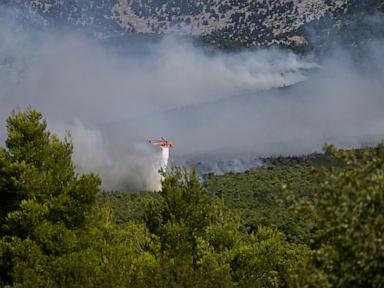
The smoke over the Gironde did not wait for July. By early June, the pine needles on the floor of the Landes forest were already crisp enough to crackle underfoot like dry bone, offering fuel to an emergency that arrived weeks ahead of schedule. While firefighters managed to secure a perimeter around the burning timber near Bordeaux, an entirely separate disaster erupted two hundred miles to the east in the scrublands of Provence. Fifteen hundred personnel found themselves stretched thin across uneven terrain, deploying heavy water-dropping aircraft against rapidly shifting winds.
This is the new baseline for Southern Europe. The traditional calendar of seasonal risk has dissolved, replaced by a year-round posture of crisis management that treats minor brush fires as potential catastrophes.
The Anatomy of a Dual Front
When two major incidents ignite simultaneously in different climatic zones, emergency response infrastructure experiences a severe stress test. The Bordeaux fire threatened the dense, highly flammable maritime pine plantations that blanket southwestern France. These trees produce resin that acts as an accelerant once ambient temperatures climb past thirty degrees Celsius.
Meanwhile, the Provence blaze encountered a completely different obstacle course. The Mediterranean maquis scrub—dominated by rosemary, cistus, and gorse—burns with explosive intensity. It releases volatile oils that create walls of flame moving faster than ground crews can retreat on foot.
Chief commanders in Paris faced an immediate triage problem. They could not concentrate their elite Dash water-bombers and Canadair fleets in a single sector without sacrificing the other. The allocation of heavy aviation assets became a high-stakes calculation of property value, human life, and strategic containment lines.
Why the Traditional Playbook Fails
Decades of fire suppression policy in France relied on a simple premise: hit hard, hit fast, and put the fire out before nightfall. That strategy worked when summers featured predictable heatwaves separated by weeks of moderate humidity and occasional rainfall.
Today, that model breaks down under the weight of accumulated drought. Soil moisture levels across southern departments have dropped to critical thresholds not normally recorded until late August. When subterranean roots dry out completely, surface fires routinely transition into crown fires that leap from treetop to treetop, rendering standard firebreaks obsolete.
Ground crews are discovering that wet dirt and hand lines do not hold when the relative humidity hovers in the single digits. The heat demands constant rotation of personnel to prevent exhaustion and heatstroke, reducing the effective manpower available on the frontline at any given hour.
The Strategic Shift in Forest Management
For generations, local populations viewed the forests through an aesthetic and economic lens. Timber production drove planting policies in the southwest, while rural depopulation in the south left vast tracts of agricultural land abandoned to wild overgrowth.
That neglect transformed rural acreage into a continuous tinderbox.
Foresters and civil defense coordinators are now locked in heated debates over preventive thinning and controlled burns. Environmental regulations often clash with emergency mitigation needs. Conservation groups fight to protect endangered bird nesting sites, while firefighters demand wide clear-cuts to stop crown fires from marching uninterrupted across county lines.
The compromise has been messy. Controlled burns require precise atmospheric windows—just enough wind to clear smoke, enough moisture to prevent escape, and cool enough temperatures to control the spread. Those windows are shrinking every year.
+-----------------------------------------------------------------+
|               EVOLUTION OF FRENCH WILDFIRE RISK                 |
+----------------------+------------------------------------------+
| 1990s Strategy       | Fast initial attack, complete suppression|
| Current Reality      | Multi-front deployment, extended drought |
| Structural Challenge | Shrinking environmental burning windows  |
+----------------------+------------------------------------------+
The Human Factor on the Ground
Behind the aerial footage and the political statements lie the tactical realities faced by local brigades. Many of these units rely on volunteer firefighters who leave their day jobs at factories, vineyards, and offices to man the trucks.
When the fire season stretches from June through October, the strain on these volunteers becomes unsustainable. Employers grow weary of extended absences. Families absorb the emotional tax of constant deployment warnings. The physical toll is relentless, breathing in fine particulate matter and radiant heat for fourteen-hour shifts without adequate relief.
The national government has poured millions into equipment upgrades, purchasing new heavy trucks and expanding the aviation fleet. Yet machinery cannot replace local knowledge. A veteran firefighter from the foothills of Sainte-Victoire understands how local thermals pull fire up a canyon long before any satellite telemetry flags the shift.
As climate patterns continue to compress the margins of safety, France finds itself racing to adapt an institutional culture built for the twentieth century to the realities of a burning continent. The containment of the Bordeaux perimeter and the stabilization of the Provence front offer temporary relief, but the underlying vulnerability remains entirely intact beneath the dry canopy.