A rocket launch usually ends in abandonment. For decades, the script of space exploration remained unchanged. A towering cylinder of metal and volatile fuel screams into the sky, fights gravity until its chest empties, and then tears itself apart. The spent stages tumble back toward Earth, burning into ash in the atmosphere or sinking into the silence of the Pacific Ocean. Millions of dollars of precision engineering, discarded like a used matchstick.
But on a quiet afternoon in the Gobi Desert, the script flipped. Discover more on a related issue: this related article.
China’s space program quietly wheeled out a prototype that looked less like a monument to the cosmos and more like a high-tech pendulum. It was a test rig designed for a single, agonizingly difficult trick: rising into the air, stopping in mid-air, and coming back down to stand exactly where it started.
When the engines ignited, the sound did not just shake the ground; it rattled the teeth of every engineer watching from the bunkers. The machine lifted. It climbed to an altitude of roughly twelve kilometers—high enough to see the curvature of the earth, low enough to still feel the thick, dragging weight of our atmosphere. Then, the engines cut out. Additional reporting by The Next Web explores related views on this issue.
For a terrifying moment, there was only gravity.
Imagine standing on top of a skyscraper, dropping a long, slender pencil, and expecting it to land perfectly on its eraser without snapping. That is the physics problem of vertical landing. In a hypothetical control room, a lead engineer—let us call her Lin—would be staring at a wall of telemetry data, her fingers hovering over a kill switch. Every millisecond, the wind shears against the falling metal hull. The rocket wants to tumble. It wants to turn into a chaotic, spinning javelin.
Then, the mechanical mind of the rocket wakes up.
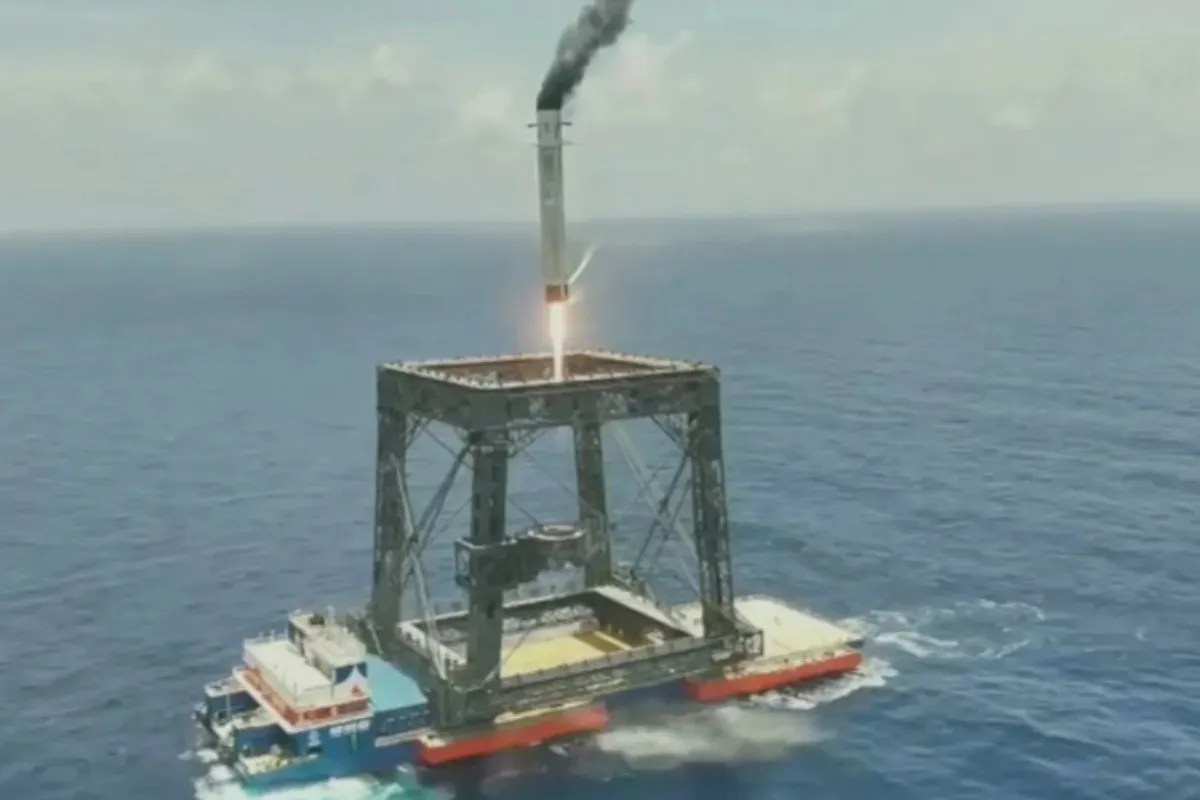
At a precise altitude, the engines re-ignited with a sudden, violent burst of pressure. Grid fins along the top of the hull bit into the rushing air, steering the falling tower with micro-adjustments. The descent slowed from a terminal plunge to a controlled hover. Leg mechanisms, tucked tightly against the frame during ascent, swung outward like the talons of a predatory bird.
With a final, deafening hiss of redirected gas, the prototype touched the concrete pad. The dust settled. The rocket stood tall, hot, smoking, but entirely whole.
China had just proven it could build a reusable rocket capable of heavy lifting.
The Tyranny of the Rocket Equation
To understand why a few minutes of a rocket falling backward matters, you have to understand how cruel space travel actually is. Aerospace engineers live under the shadow of what they call the Tsiolkovsky rocket equation. It is a mathematical rule that dictates a harsh truth: to carry fuel, you need more fuel.
If you want to put a satellite into orbit, the satellite itself makes up a tiny fraction of the weight on the launchpad. The rest is fuel, and the heavy metal tanks required to hold that fuel. In the old days of the space race, the only way to get anything into orbit was to throw the truck away after delivering the package.
This disposable model kept space the exclusive playground of superpowers and billionaires. A single launch could cost upwards of a hundred million dollars. Imagine if every time you flew from London to New York, the airline scrapped the Boeing 777 upon arrival and built a new one for the return trip. Ticket prices would be in the millions. No one would fly.
By mastering the vertical recovery of rocket stages, the economics shift completely. The metal, the software, the expensive engines—the parts that take months to manufacture—survive. The only major cost for the next flight is the kerosene and liquid oxygen. Space suddenly transforms from an elite, ruinous expense into a logistical route.
The recent test in the Gobi Desert used a 3.8-meter-diameter test hull, a scale model designed to validate the deep-throttling capabilities of China’s new oxygen-methane engines. Methane is the holy grail for reusable rocketry. Unlike traditional rocket grade kerosene, which leaves heavy deposits of soot inside the intricate plumbing of an engine, methane burns remarkably clean. A clean engine means less turnaround time between flights. You do not have to tear the machine apart to clean it; you simply refill the tanks and fly again.
The Invisible Stakes of the Gobi
This successful test is not a standalone achievement. It is part of a quiet, massive mobilization. For years, the global narrative around reusable rockets belonged almost entirely to American commercial enterprises. The images of twin boosters landing simultaneously in Florida became the definitive visual of modern space travel.
China’s successful twelve-kilometer test signals that the monopoly on reusable space tech is officially over.
The implications stretch far beyond national pride. The country is currently building its own massive satellite constellations to provide global internet coverage, mapping, and environmental monitoring. Doing that with disposable rockets is a statistical nightmare. It requires too many factories, too much raw material, and too much time. Reusability is the missing link that turns China’s space ambitions from a series of prestigious scientific missions into a high-cadence industrial conveyor belt.
Behind the data points and the successful press releases lie thousands of hours of failure. To get a rocket to throttle down to just a fraction of its maximum thrust without the flame blowing out is like trying to keep a birthday candle lit while riding a motorcycle through a hurricane. The computers must calculate wind resistance, mass distribution as fuel sloshes inside the tanks, and structural stress in real-time. A delay of three milliseconds in adjusting an engine valve means the rocket tips over and disappears in a fireball.
During the Gobi test, the prototype encountered fierce crosswinds as it neared the ground. The onboard guidance system had to make hundreds of corrections per second, tilting the entire roaring engine on a gimbal to fight the air. When the legs touched down, they absorbed a massive kinetic impact, distributing the force across the airframe without buckling.
The Changing Sky
We are moving into an era where the sky will no longer feel empty. The success of these tests means that within the decade, launches will become mundane. The spectacle of fire and thunder will give way to the predictable rhythm of a shipping port.
For the people living near the launch sites, the sounds will change too. They will become accustomed to the double sonic boom of returning stages breaking the sound barrier on their way back to Earth. They will see used rockets sitting on pads, charred and streaked with soot from the heat of re-entry, being prepped for their third, fifth, or tenth trip into the black.
The test in the desert was brief. The rocket flew for only a few minutes before returning to its pad. But those minutes rewritten the future of how humanity leaves this planet. The machine that learned to walk backward has proven that the path to the stars does not have to be a trail of discarded ruins. It can be a two-way street.
The rocket stands on the concrete pad, its metal skin popping and groaning as it cools under the desert sun.