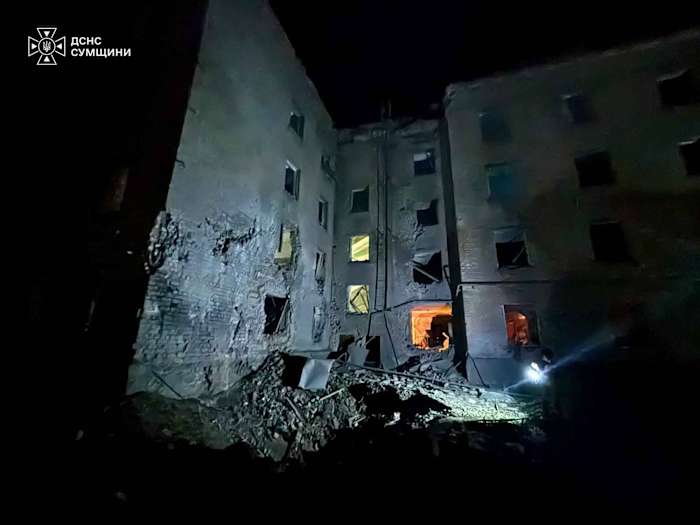
The air in the borderlands does not taste like politics. It tastes like sulfur, scorched grass, and the bitter copper tang of a world shifting its axis.
For months, the map of the conflict was read in inches. Trenches scraped into freezing mud. Fields of unharvested wheat turned into grey craters. Concrete apartment blocks reduced to jagged teeth against an ash-colored sky. In that static, brutal geography, distance was supposed to be a shield. If you were three hundred miles from the front lines, you could sleep. You could hear the distant rumble of a generator, perhaps, and tell yourself it was thunder. You could watch the orange flicker of a distant refinery on the horizon and convince yourself it was just another ordinary sunset over the industrial heartland.
That illusion is gone.
When President Volodymyr Zelenskyy confirmed the latest wave of long-range drone strikes hitting fuel depots and oil processing facilities deep within Russian territory, the geography of the war fundamentally shattered. Distance no longer equals safety. The war has stopped waiting at the border. It has grown long legs, flying hundreds of miles past air defenses and early warning radars to strike at the very bloodline of an industrial economy: fuel.
Consider what this means for a refinery worker standing a thousand miles from the nearest trench.
(Note: This depiction of an individual worker is a narrative scenario designed to illustrate the human reality behind industrial logistics, grounded in verified reports of deep-strike disruptions.)
Imagine standing on a catwalk of corrugated steel, your boots echoing over miles of convoluted piping that hums with millions of gallons of volatile hydrocarbons. You have lived your entire life believing that geography is an absolute armor. You read the state news; you hear about the invincible air shields. Yet, at three in the morning, the air does not rumble with thunder. It screams. A high-pitched, angry buzz like an industrial hornet fills the dark. Then comes the concussive wave, the orange bloom of a fireball turning the night sky into noon, and the sudden, terrifying realization that the war did not cross the border—it flew right over it.
Strategic logic dictates this pivot. Wars of attrition are won with arithmetic. Men, steel, fuel. For months, the consensus among military analysts was that Ukraine was fighting a purely defensive holding action, absorbing blows on its own soil, slowly bleeding out its demographic and economic vitality. But arithmetic changes when you alter the inputs.
If an army runs on fuel, and the refineries producing that fuel begin to burn, the tanks in the field stall. The logistics trucks delivering ammunition sputter and die on muddy backroads. The jet fighters waiting on remote tarmacs are grounded because the aviation kerosene failed to arrive. By targeting facilities hundreds of miles deep inside Russia, the strategy shifts from stopping punches to breaking the opponent's arms.
It is a bitter math.
We must confront the uncomfortable mechanics of modern conflict. Oil is not just a commodity traded on distant screens in London or New York; it is the physical kinetic energy of destruction. Every gallon processed in these interior hubs is a drop of momentum for a military machine thousands of miles away. By turning those facilities into targets, the calculus of the entire conflict accelerates.
The psychological toll is equally heavy. For the civilian population inside Russia, the war has historically been something watched on a screen—a distant broadcast of men in uniforms moving across unfamiliar maps. When the night sky over industrial regions lights up with burning depots, the abstract transforms into the immediate. Anxiety creeps into grocery stores, into subway cars, into quiet kitchens. The psychological distance collapses.
Yet, this escalation carries immense risks. Escalation is a two-way street paved with nitroglycerin. Every time a drone penetrates deeper into enemy territory, the threshold of retaliation lowers. The international community watches with bated breath, calculating the global ripple effects. Energy markets twitch. Oil prices fluctuate on the whispers of burning towers. Analysts in Washington and Brussels scramble to assess whether this tactical ingenuity will shorten the war or widen its gyre.
History offers grim mirrors. We have seen this chapter before in the twentieth century, when industrial total war erased the line between the front and the factory. When the tools of destruction became so sophisticated that no mountain range or river could serve as a permanent barrier. Technology shrinks the planet, and in doing so, it makes violence ubiquitous.
The drone does not care about borders. It does not care about politics or treaties or the intricate justifications offered by diplomats in suits. It follows a coordinate. It seeks a target. And when it finds it, it releases a cascade of consequences that no government can fully control once the fuse is lit.
We are watching the rewriting of military doctrine in real time. The old rules—that large nations can project power outward while remaining comfortably insulated at home—are dissolving in smoke and soot.
Standing on that borderland, watching the distant orange glow pulse against the dark, the truth is inescapable. The fire is no longer out there. It is everywhere, tracing the invisible lines of energy that hold the modern world together, burning them down one by one until nothing is left except the raw, unyielding weight of what comes next.