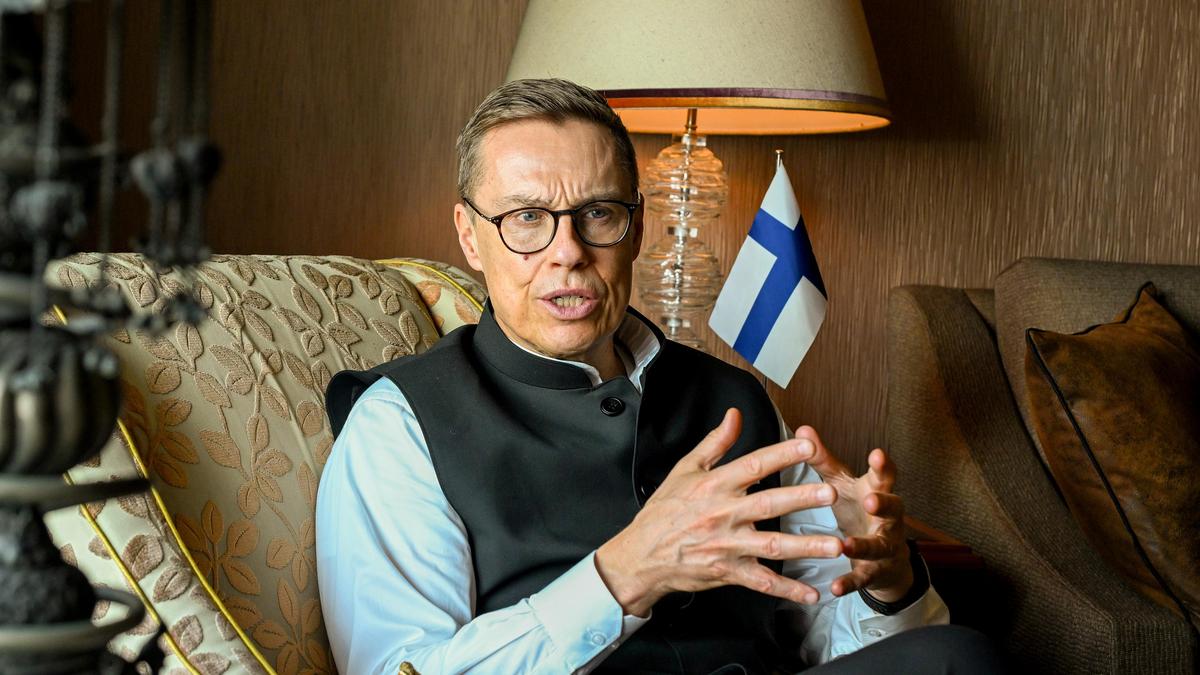
The world feels like it's tilting on its axis right now. If you've been watching the headlines, you've probably noticed a shift in how European leaders talk. Gone are the days of quiet, cautious diplomacy behind closed doors. Now, we’re seeing a new kind of bluntness. Finnish President Alexander Stubb is a prime example of this. He isn't just another politician repeating talking points; he’s a man representing a nation that shares an 800-mile border with Russia. When he speaks about the risk of a global conflict, we should probably listen.
Stubb recently made it clear that while Finland stands firmly with the United States, the escalating war in West Asia—what many call the Middle East—is keeping him up at night. It’s a delicate balancing act. On one hand, you have the NATO alliance, which Finland joined in a historic pivot. On the other, you have a volatile situation in Gaza and Lebanon that threatens to pull the entire planet into a much larger, uglier fight. If you liked this article, you should look at: this related article.
Why Finland is the Canaries in the Coal Mine
Finland used to be the poster child for "neutrality." For decades, they played both sides, keeping Moscow calm while quietly building a Western-style democracy. That’s over. Russia’s invasion of Ukraine changed the math. Stubb knows that in 2026, you can’t sit on the fence when the fence is on fire.
By backing the U.S., Stubb is securing Finland’s house. But his concern about West Asia shows he understands that security isn't just about who is across your border. It’s about global stability. If the conflict between Israel, Hezbollah, and Iran boils over into a full-scale regional war, the ripple effects will hit Helsinki just as hard as they hit Washington or London. Energy prices spike. Refugee flows increase. Global attention shifts away from Ukraine, leaving Europe’s eastern flank vulnerable. For another angle on this event, see the recent update from BBC News.
It’s a nightmare scenario. Stubb is essentially shouting from the rooftops that we cannot afford to let the West Asia situation spiral. He's right. The world is too interconnected for "local" wars to stay local anymore.
The Problem with a Two Front Reality
The U.S. is stretched thin. That’s the reality Stubb is dancing around. While the Biden administration—and whoever follows—wants to focus on containing Russia and competing with China, they keep getting pulled back into the Middle East.
Finland’s support for the U.S. is strategic. They need the American security umbrella. However, Stubb’s "voice of concern" is a polite way of telling Washington not to lose sight of the bigger picture. If the U.S. gets bogged down in a multi-year conflict in West Asia, who is left to ensure that Eastern Europe doesn't become the next playground for expansionist regimes?
People often think of Finland as a small, quiet country. It’s not. It’s a military powerhouse relative to its size. They have one of the largest artillery forces in Europe. They have a conscription model that actually works. When Stubb talks about avoiding a global conflict, he isn't speaking from a position of weakness. He’s speaking as a leader of a nation that is ready for war but desperately wants to prevent it.
The West Asia Powder Keg
Let’s be honest about what’s happening in West Asia. It’s a mess of proxy battles and historical grievances that no one seems able to solve. Stubb’s focus on this area is telling. He recognizes that the "West" isn't a monolith. European interests in the Middle East often diverge from American ones, especially regarding energy and migration.
If a global conflict breaks out, it won't start with a single nuclear launch. It’ll start with a series of miscalculations. A strike in Lebanon leads to a counter-strike in Israel, which leads to Iranian intervention, which forces a U.S. response. Suddenly, the Mediterranean is a war zone. This is what Stubb is terrified of. He knows that once the gears of global war start turning, they are almost impossible to stop.
How to Read Between the Diplomatic Lines
When a President says they "back" a partner but "voice concern" about a specific policy or region, they are setting boundaries. Stubb is telling the world that Finland is a loyal NATO member, but they aren't going to follow the U.S. blindly into every fire.
- Strategic Autonomy: Finland wants Europe to be able to stand on its own feet.
- Prioritization: The threat to Europe’s east must remain the priority for the alliance.
- De-escalation: Military might is a deterrent, but diplomacy is the only way to avoid the "global conflict" Stubb fears.
Honestly, it's refreshing. Too many leaders try to pretend everything is fine. Stubb is saying the quiet part out loud. The international order is fragile. The systems we built after 1945 are cracking.
What This Means for You
You might think a Finnish President talking about West Asia doesn't affect your daily life. You'd be wrong. We live in a world of "just-in-time" supply chains and global markets. A major escalation in the Middle East means your gas prices go up tomorrow. It means the tech components for your next phone get stuck in a port. It means global inflation stays high.
Stubb is advocating for a world where we don't have to worry about these things. But he’s also a realist. He’s preparing his country for the worst while hoping for the best. That’s what real leadership looks like in 2026. It’s not about slogans; it’s about managing risk in an unmanageable world.
Keep an eye on the Nordic-Baltic cooperation. These countries are becoming the intellectual and military heart of the "New Europe." They don't have the luxury of distance that the U.S. or even France and the UK have. For them, global conflict isn't a theoretical exercise. It's a matter of survival.
If you want to understand where the world is headed, stop looking at the talk shows in D.C. and start looking at the border towns in Finland. That’s where the real story is being written. Stubb is just the one holding the pen right now.
To stay ahead of these shifts, start diversifying your information sources. Look at North European defense journals and Baltic news outlets. They see the world with a clarity that is often lost in the noise of Western European and American media. Pay attention to the Finnish model of "total defense"—it's likely coming to a country near you soon.