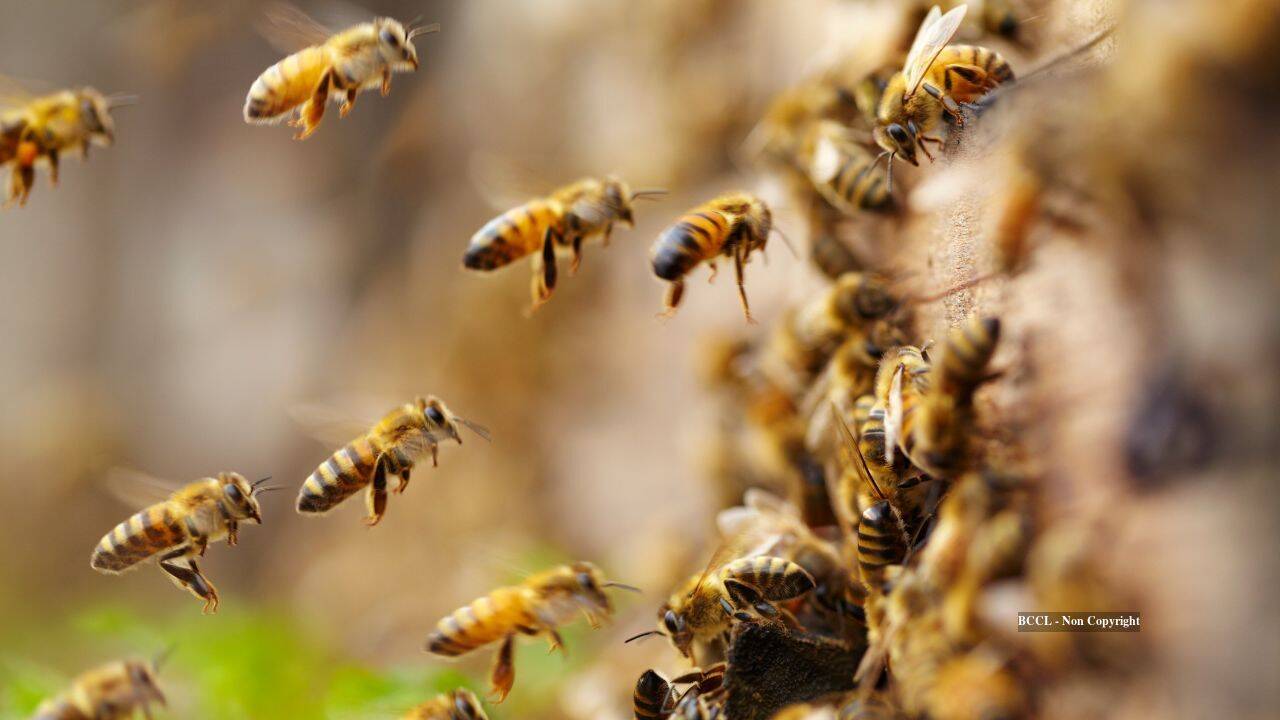
Every environmental outlet on the internet just lost its mind over a headline claiming that five and a half million wild bees were discovered nesting beneath a single one-and-a-half-acre cemetery in New York. The collective response was pure, unadulterated ecological romance. People read it and pictured a buzzing, golden utopia of hyper-abundant biodiversity quietly thriving in the heart of the urban sprawl.
It is a comforting delusion. It is also entirely wrong.
When you shove millions of solitary ground-nesting bees into an abnormally tiny, hyper-dense footprint, you are not looking at a triumph of nature. You are looking at a refugee crisis. You are looking at an ecosystem under severe structural distress, forced into a desperate, overcrowded urban encampment because the surrounding terrain has been paved, sprayed, and sterilized into an ecological dead zone.
I have spent years watching conservation trends romanticize bizarre anomalies while ignoring the systemic rot causing them. We celebrate the exception because looking at the rule is too depressing. But if you actually understand entomology and urban ecology, that cemetery wasn't a sanctuary. It was a pressure cooker.
The Myth of the Urban Eden
The lazy consensus in modern conservation is that density equals health. If bugs are abundant, the habitat must be thriving, right? Wrong.
Consider the mechanics of ground-nesting bees, species like Colletes inaequalis or various mining bees. These insects do not live in hives with a queen and coordinated workers. They are solitary. Every single female digs her own individual tunnel, provisions her own cells with pollen, and lays her eggs. To pack five and a half million of them into ninety thousand square feet requires an unimaginable density of nesting sites.
Why would millions of insects cram themselves into a postage-stamp-sized plot of dirt? Because there is literally nowhere else for them to go.
Imagine a neighborhood where every single house for fifty miles has been bulldozed, poisoned with glyphosate, or covered in astroturf, leaving only one tiny patch of lawn where demolition hasn't reached yet. When ten thousand displaced families pitch tents in that single vacant lot, you don't call it a vibrant housing market. You call it a humanitarian emergency. Yet when insects do it on cemetery grounds, we print feel-good headlines about how resilient nature is.
Nature is resilient, sure. But resilience is not the same thing as health. Resilience means surviving a beating.
Why Urban Sprawl Creates Dead Zones
To understand why this massive cemetery aggregation is an indictment of our land management rather than a victory for conservation, look at what surrounds these urban green spaces. Modern zoning and landscaping practices have systematically eradicated the continuous tracts of wild, undisturbed earth that ground-nesters require.
We trade complex, multi-layered root systems and native underbrush for sterile suburban lawns. We blanket cities in impervious surfaces. When a female ground-nesting bee emerges in the spring, she needs three things within a short flight radius: well-drained soil with the right texture and solar exposure, an uninterrupted succession of native blooms from April to October, and an absence of systemic pesticides.
In most metropolitan environments, those three requirements almost never overlap except in weird, highly specific microclimates. Cemeteries often fit the bill because they feature old trees, minimal tilling, decades of undisturbed soil chemistry, and sparse pesticide application compared to commercial agriculture or manicured municipal parks.
So the bees find the cemetery. And because the surrounding fifty square miles are an ecological desert of concrete and monoculture grass, every single displaced bee from miles around funnels into that one tiny patch of dirt. It is a spatial bottleneck.
The Hidden Costs of Hyper-Density
When populations are artificially compressed into cramped quarters, evolutionary biology dictates that things get ugly very quickly.
Pathogens spread like wildfire. Fungal diseases and parasitic mites love high-density host populations. When millions of ground-nesting bees share overlapping subterranean real estate, the transmission rates for brood parasites like cuckoo bees and fungal pathogens skyrocket. A sprawling, low-density population can absorb disease outbreaks because infected individuals are isolated by distance. A hyper-dense colony of millions in a tiny plot of land is a petri dish waiting for a match.
Furthermore, local resource depletion becomes a lethal reality. Five and a half million hungry insects require an astronomical volume of nectar and pollen. Do you honestly think a one-and-a-half-acre patch of urban cemetery grass and ornamental plantings produces enough floral resources to sustain millions of specialized foragers? Of course not. Those bees are forced to fly immense distances into hostile concrete territory just to find a meal, burning through their energetic reserves and shortening their lifespans.
We are forcing native pollinators to run a daily marathon through exhaust fumes and pesticide-laden window boxes just to survive the day.
What We Should Be Doing Instead
Stop treating these anomalies as feel-good human-interest stories. Every time we marvel at a freak concentration of wildlife surviving inside an urban pocket, we absolve ourselves of the real work of systemic ecological repair.
If we actually cared about urban biodiversity, we would stop obsessing over isolated miracle sites and start fixing the broken landscape between them. That means tearing up sterile turfgrass on corporate campuses, highway medians, and municipal verges. It means legislating against the over-the-counter sale of neonicotinoids to homeowners who think a dandelion is a moral failing. It means creating corridors, not islands.
An island of bees surrounded by a sea of concrete is just a slow-motion extinction trap with good PR.
The next time you read about a record-breaking concentration of wildlife in an unnatural setting, don't smile and scroll past. Ask yourself what drove them there, what killed their alternatives, and how long that fragile bubble can hold before it pops.
Nature doesn't want your sympathy. It wants room to breathe.