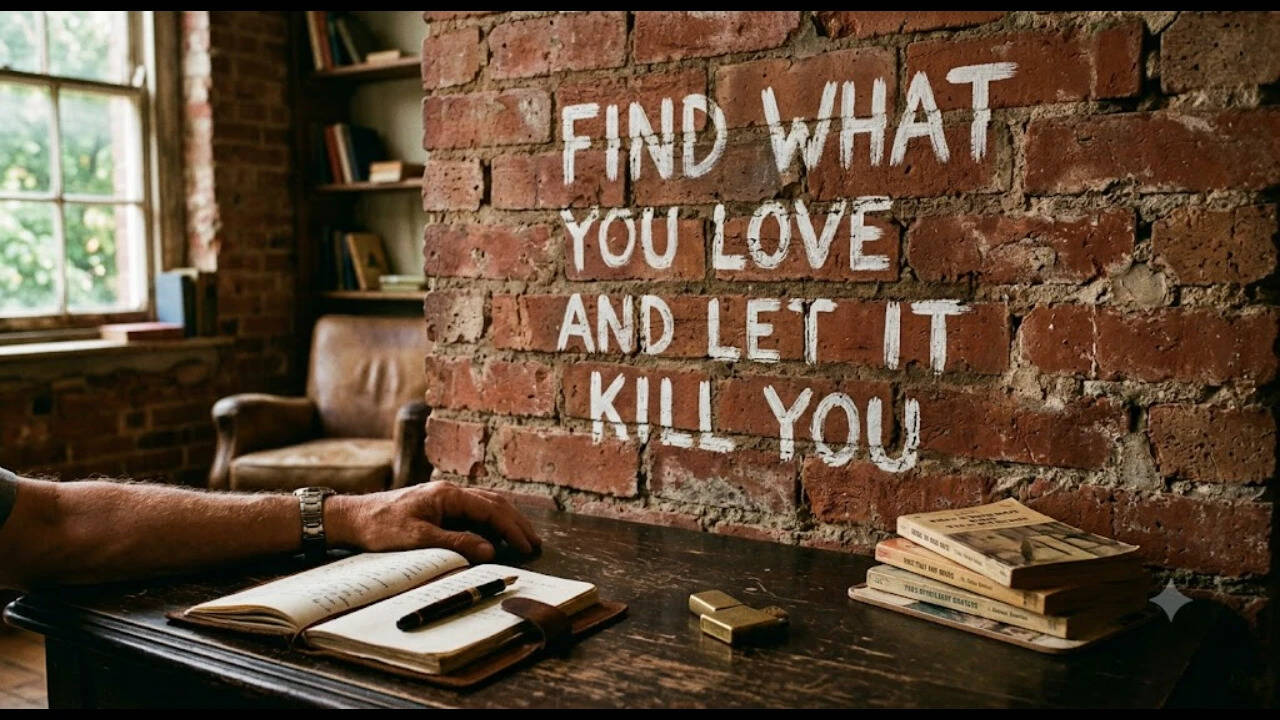
Charles Bukowski wrote a lot of things. Most of them were messy, brutal, and soaked in cheap alcohol. But his most famous line gets plastered across Instagram quote graphics every single day. People treat Find what you love and let it kill you like a profound manifesto for living with purpose. It is actually a recipe for burnout, self-destruction, and misery.
Let us be completely honest about what this phrase asks you to do. It demands that you tie your entire identity, your mental health, and your physical well-being to a single pursuit. It tells you that suffering for your passion is noble. If you are exhausted, broke, or miserable, you must be doing it right. You are letting the craft consume you.
That mindset destroys people. I have watched talented writers, artists, and entrepreneurs run themselves into the ground because they thought exhaustion was proof of dedication. They treated warning signs like badges of honor.
The Romanticization of Suffering
We love martyr stories. Society rewards the artist who starves for their art or the founder who sleeps under their desk for three years. We act like professional agony is the only valid path to greatness.
Bukowski himself lived a chaotic life, working at the post office by day and hammering out poetry by night, fueled by booze and cynicism. But copying the romanticized struggles of a broken alcoholic is a terrible strategy for building a sustainable life.
When you decide that your passion needs to destroy you, you stop listening to your body and your mind.
- You skip sleep.
- You neglect relationships.
- You ignore clinical anxiety.
You tell yourself it is all part of the price of admission. It is not. It is just slow-motion self-sabotage.
What Passion Actually Requires
Real competence is boring. It requires boundaries, eight hours of sleep, adequate hydration, and the ability to walk away from your desk at five o'clock.
Passion does not need your blood. It needs your sustained, clear-headed attention.
Think about the most effective people you know. Do they look like hollowed-out zombies who are currently letting their work destroy them? The genuinely skilled professionals usually look remarkably calm. They have systems. They have hobbies outside of their primary career. They understand that if they burn out completely, their work stops permanently.
Letting something kill you is a permanent solution to a temporary productivity slump. If your obsession requires your destruction, you are doing it wrong.
The Myth of the Single Calling
The phrase implies there is one single thing waiting for you. Find it, lock onto it, and let it consume you.
This creates paralyzing pressure. What if you like three different things? What if your interests change every five years? What if your primary passion pays zero dollars and you still need to pay rent?
Human beings are versatile. We evolve. We pivot. The idea of a singular, all-consuming purpose locks you into a cage of your own making. You force yourself to stick with a career path or a creative project long after it has stopped serving you, simply because you bought into the myth that quitting equals failure.
True expertise often comes from combining multiple mediocre skills into a unique, hybrid capability. You do not need a single obsession that drains the life out of you. You need a collection of interests that sustain you.
Boundaries Beat Burnout
If you want to create good work, build things that matter, or master a craft, you need stamina. Stamina requires recovery.
Athletes understand this. LeBron James spends millions of dollars a year on his body, sleep, and recovery. He does not let basketball kill him; he manages his energy meticulously so he can play at a high level for decades.
Why do knowledge workers and creators think they are exempt from basic biology? You cannot run your brain at maximum output indefinitely without paying a heavy price.
Set limits. Turn off your notifications. Take actual weekends. Your work will not suffer because you took a walk. In fact, it will get better.
Redefining Dedication
Stop looking for things that destroy you. Look for things that challenge you while leaving enough of you intact to enjoy the results.
Success is not about how much pain you can tolerate. It is about how consistently you can show up over decades. You cannot show up for decades if you let your passions burn you to ash in year three.
Redefine what dedication means to you. Make it about longevity. Make it about curiosity. Make it about building a life you actually want to inhabit, rather than a monument to your own exhaustion.
Put the Bukowski quote down. Get some rest. The work will still be there tomorrow, and you will be in a much better position to tackle it.