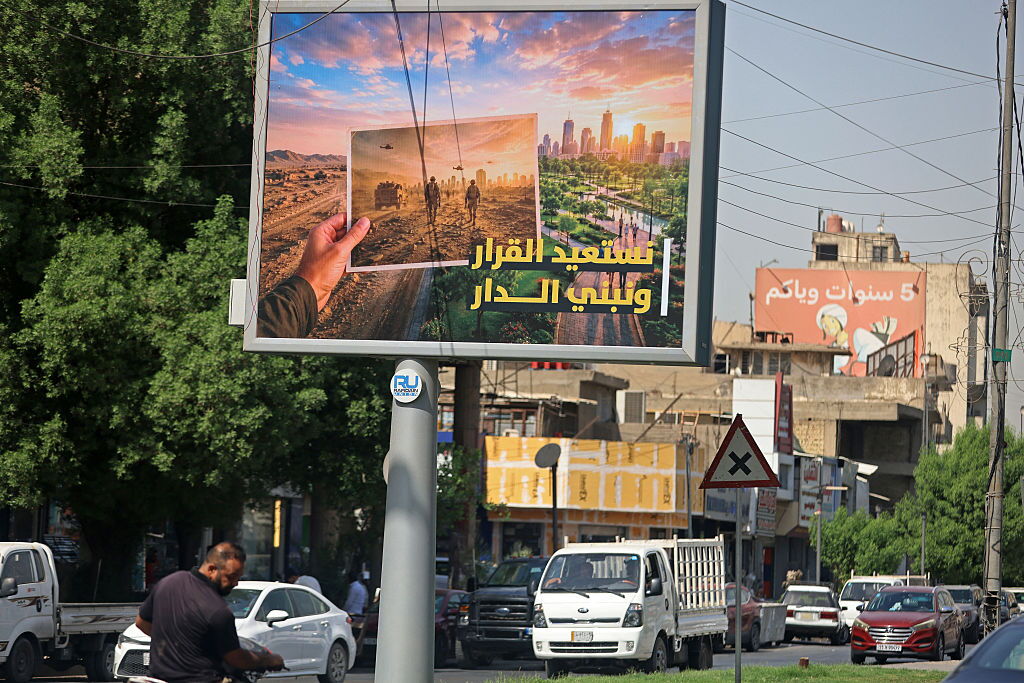
The air in Baghdad tastes of old dust and sulfur before the rain ever hits. It is a heavy, metallic air, thick with the weight of decades that refuse to settle into history. Stand on a concrete blast wall long enough, and you stop seeing the gray slabs; you only see the horizon—jagged, broken, and waiting for the next shoe to drop.
For months, the rumors had been circulating through the markets like dry leaves blown down a narrow alley. They are leaving. Not just scaling down. Not just shifting advisors. Packing the tents. Rolling the treads of the heavy armor back toward the ramps of Cargo aircraft.
When the actual orders came down from Washington and the regional command centers, they did not arrive with a thunderclap. They arrived as an administrative whisper, translated through secure channels, echoing down the chain of command until it hit the dirt. U.S. forces are winding down their operational footprint in Iraq. The shadow that has stretched across the Tigris for over twenty years is folding inward.
And yet, this is not a story about a withdrawal. It is a story about a vacuum.
To understand what happens when a superpower pulls its weight out of a room, you have to look at the furniture left behind. You have to look at Erbil, where the hum of generators competes with the prayer calls echoing from concrete minarets. You have to look at the border posts where the intelligence officers are burning notes and packing hard drives.
The backdrop is not a peaceful handover. It is a regional chessboard that has just been violently upended. Across the border, the shadow of a widening confrontation with Iran looms over every calculation. The Iranian proxy networks—the militias that have spent years testing the perimeter walls with rockets and drones—are watching. They are calculating the angle of the exit. They are wondering if the departure is a retreat or a trap.
History rarely offers clean breaks. It leaves ragged edges.
Consider a hypothetical staff sergeant stationed at a logistics hub outside the Green Zone—let's call him Miller. Miller has spent sixteen months living out of a duffel bag that smells like desert sand and instant coffee. He knows every pothole on Route Irish. He knows the exact pitch of the incoming warning sirens that send everyone diving for reinforced concrete bunkers at three in the morning.
On the night his unit gets the green light to prepare the final manifest, Miller doesn't celebrate. He walks the perimeter line with a flashlight, checking the locks on containers filled with sensitive gear. He looks out past the razor wire toward the dark expanse of the city.
"What happens when the lights go out?" he asks an Iraqi counterpart standing nearby.
The Iraqi officer, a veteran of three different iterations of the security forces who goes by Tariq, doesn't look at him. He just lights a cigarette, the tiny ember glowing orange against the night.
"The lights don't go out, Sergeant," Tariq says quietly. "They just change hands."
That is the invisible stake. The United States entered Iraq with a roar of shock and awe in 2003, promising to remake the Middle East in the image of Western stability. It stayed through the sectarian slaughter of 2006, the surge, the rise of the Islamic State, and the endless, grinding low-intensity war of attrition. Billions of dollars poured into the soil. Thousands of lives altered or ended.
Now, the exit is dictated not by a triumphant victory, but by exhaustion and a strategic pivot toward other global horizons—toward the Pacific, toward Eastern Europe, toward a world where asymmetric drone warfare has rewritten the rules of engagement.
The geopolitical seismograph is trembling far beyond the borders of Mesopotamia. While the convoys rumble toward the Kuwaiti border under the cover of night, another tectonic shift is rattling the domestic landscape half a world away.
In Washington, the Supreme Court has just breathed new life into a dormant legal weapon: the Trump-era deportation framework.
At first glance, the war in Baghdad and the marble halls of the Supreme Court in D.C. appear to exist in different universes. One is played out in the dust and fire of the Levant; the other in the sober, measured cadences of legal briefs and constitutional originalism.
They are the same story.
Both represent the contraction of American power, the drawing inward of a nation trying to figure out its place in a century it can no longer unilaterally command. One is foreign; the other domestic. Both are soaked in the friction of law, force, and human dislocation.
When the high court greenlights a sweeping enforcement mechanism that bypasses conventional judicial roadblocks, it sends a shockwave through immigrant communities from Los Angeles to Houston. It creates its own kind of shadow.
Picture a kitchen table in a modest suburban home in Queens. It is midnight. A father and mother sit under the harsh glare of a fluorescent bulb, their children asleep in the next room. Spread across the table are manila folders, tax returns, utility bills, and a stack of legal notices that look like hieroglyphics to anyone without a law degree.
The father, an undocumented worker who has spent twelve years framing houses in New Jersey, is looking at his phone. He is reading the news alert about the Supreme Court's decision.
He doesn't know the Latin legal terms. He doesn't know the nuances of executive authority versus judicial restraint. He only knows what the words mean for his morning commute. He knows the fear of the unexpected knock on the door. He knows the sudden, cold realization that the rules of the game have changed while he was busy trying to earn an honest living.
"Are we safe?" his wife asks.
He looks at her. He wants to lie. He wants to offer the easy comfort of a parent reassuring a child. But he can't.
"We stay quiet," he says.
That is the human cost of the high court's docket. Just as the Iraqi soldier watches the American convoys roll out and wonders who will hold the line against the encroaching militias, the father in Queens watches the federal machinery pivot and wonders who will protect his family from the machinery of removal.
Power is exercised at the extremes. On one end, a C-17 transport plane lifts off from an airfield in Erbil, its cargo bay packed with gear, leaving behind a nation teetering on the edge of Iranian hegemony. On the other end, a federal marshal signs an administrative warrant in a windowless office in Washington, setting off a chain reaction that will echo through thousands of living rooms across America.
We live in an era of great unraveling.
For decades, the American narrative was one of endless expansion—building bases, signing treaties, welcoming immigrants, projecting force and ideals across every ocean and border. It was an expensive, messy, often hypocritical enterprise, but it provided a framework. The world knew where the center of gravity was.
Now, the center is shifting under our feet.
Look closely at the mechanics of the withdrawal from Iraq. It is not just about soldiers getting on planes. It is about the realization that military force has limits. You can spend twenty years trying to graft a democratic state onto a fractured sectarian foundation, and when you pull the scaffolding away, you discover whether the structure can stand on its own.
The answer on the ground is terrifyingly ambiguous. The Iraqi security forces are better equipped than they were a decade ago, but they are riddled with political patronage, factional loyalty, and the corrupting influence of neighboring powers. When the American logistics tail vanishes, the spare parts dry up. The intelligence-sharing slows down. The tactical edge blunts.
And waiting in the wings are the same forces Washington fought for a generation.
It is a bitter pill for the veterans who lost limbs or friends in Fallujah, Ramadi, or Mosul. They scroll through the news feeds and ask the hardest question a soldier can ask: Was it worth it?
There is no neat answer. History does not hand out gold stars for effort. It only records the aftermath.
Meanwhile, back home, the legal battle over deportation touches the raw nerve of national identity. Who belongs? Who gets to stay? What are the moral obligations of a nation founded by immigrants when it faces the demographic and security pressures of a modern, interconnected world?
The Supreme Court's ruling on the deportation framework is not happening in a vacuum. It is fueled by the same public exhaustion that demands an end to foreign wars. The desire to pull back, to seal the borders, to stop fixing the world's broken pieces and start guarding the perimeter—it is all part of the same psychological pulse.
Isolationism is a seductive drug. It whispers that if we just close the door, the rest of the world's chaos will stop knocking.
It never does.
When U.S. forces leave Iraq, the vacuum doesn't stay empty. Iran steps into the parlor. Regional trade routes shift. Radical elements recalculate. The instability does not vanish; it simply migrates closer to home, manifesting as cyber threats, refugee crises, and global economic shockwaves.
And when a government cracks down on immigration through sweeping executive enforcement, it does not solve the underlying global economic disparities that drive millions of people to cross continents in search of safety and work. It simply pushes the desperation deeper into the shadows.
We are caught between two impulses: the hubris of empire and the cowardice of retreat.
Back in Baghdad, the sun is beginning to crest over the concrete blast walls. The morning haze burns off, revealing the dusty, sun-baked sprawl of a city that has survived empires, Mongols, caliphates, and superpowers. The convoy is gone. The dust kicked up by the armored vehicles has settled back onto the road.
Tariq stands alone on the tarmac, watching the empty sky where the transport planes disappeared hours ago. He adjusts his rifle strap, checks his radio, and turns back toward the command post.
There is no cavalry coming back. There is only the work that remains.
In Queens, the sun is setting, painting the brick apartment buildings in shades of amber and bruised purple. The father finishes his shift, locks his tool bag in the trunk of his battered sedan, and drives home through the evening traffic. He walks up the steps, opens the front door, and listens to the quiet breathing of his children sleeping down the hall.
The legal battle is just beginning. The geopolitical shockwaves are only starting to ripple outward. But tonight, the house is still.
The world turns on its axis, indifferent to our grand strategies and our bitter regrets. The borders shift. The armies pack their bags. The laws are rewritten in marble halls.
And the people who live in the crossfire just keep putting one foot in front of the other, waiting to see what the morning brings.