Dawn in Gloucestershire does not break with a trumpet blare; it arrives as a slow bleed of bruised gray over the rolling hills, dissolving the hedge-lines and sheep pastures into a quiet, damp uniformity. Here, the earth smells of wet loam, crushed clover, and diesel exhaust from the morning milk trucks. But this pastoral stillness is a thin skin stretched over a very different reality.
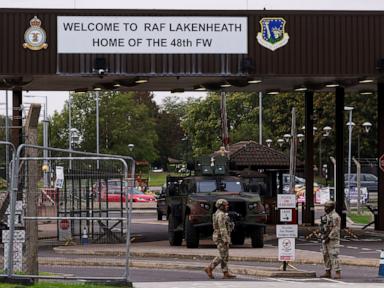
Just beyond the sleeping village of Fairford, the runway stretches like a massive slab of charcoal-colored obsidian, long enough to catch the curvature of the earth. This is RAF Fairford, a military installation where global power is parked in hangars and fueled on tarmac. It is a place of profound contradiction. Local farmers graze sheep within earshot of B-52 Stratofortresses capable of carrying the weight of empires on their wings.
Then, the fence is breached.
Or, more accurately, the line is crossed.
Five ordinary citizens—let us call them Arthur, Clara, Julian, Maeve, and Thomas, names born of ordinary streets and quiet living rooms—found themselves standing on the wrong side of that razor wire. Not soldiers. Not foreign saboteurs. Five UK nationals. British passports in their pockets, mortgage payments waiting on kitchen counters, anxieties about heating bills humming in their minds just like anyone else.
They were arrested. Handcuffed. Driven away from the perimeter lights into the sterile white hum of a police station holding room.
And now, they are out. Released on bail.
The news flash is dry as bone. A couple of sentences on a local news ticker, swallowed whole by the roaring cycle of global headlines. Five people arrested. Five people bailed. Case pending. Move along.
But bail is not freedom. Bail is a suspension in amber. It is the strange, hollow space between an action and its reckoning, where the air tastes like copper and every knock at the door carries the weight of an approaching storm.
To understand why five people would walk toward a heavily guarded military perimeter knowing full well the steel teeth waiting for them, one has to look past the police blotter. One has to step away from the abstract vocabulary of national security and look closely at the human friction generated when local soil intersects with international machinery.
The Geography of Silence
Airfields like Fairford possess a unique psychological gravity. They are sovereign thresholds. Though situated firmly in the English countryside, beneath skies crowded with rooks and gray drizzle, these bases operate according to an entirely different legal and logistical logic.
To a local resident walking a dog along the perimeter footpath, the fence is simply a boundary marker, like a drystone wall dividing one farmer's turnips from another's pasture. But to the Ministry of Defence and the United States Air Force, that same fence is an absolute boundary between civil society and strategic deterrence.
Step across it, and you cross from common law into the heavy, unyielding architecture of military protection.
Consider the sheer scale of what Fairford represents. When the massive strategic bombers descend from the stratosphere, roaring over thatched roofs and village churches, they carry a silent reminder of global volatility. For decades, this Gloucestershire tarmac has served as a staging ground for power projection spanning continents. For most people, the noise is just an annoyance that rattles tea saucers in the cupboard. For others, it is an unbearable moral proximity to distant conflicts.
That proximity breeds a very specific kind of restlessness.
When international tensions tighten like a garrote around the throat of global diplomacy, small towns in quiet English shires suddenly find themselves tethered directly to battlefields thousands of miles away. People feel that tether. They feel the strange, helpless weight of watching distant tragedies unfold on glowing television screens while massive military hardware warms up in their own backyard.
That is where the impulse begins. Not in boardrooms or party headquarters, but in the quiet, sleepless hours of the night when a conscience refuses to stay quiet.
Crossing the Line
Imagine the moment.
The grass is soaked with morning dew, soaking through canvas shoes within seconds. The air is cold enough to turn breath into small white ghosts. In the distance, the amber security lights hum with a low, electrical vibration.
Every instinct screams at the human animal to stay hidden, to keep the head down, to let the world turn without interference. Survival dictates comfort. Compliance dictates safety.
Yet five people kept walking.
Why?
Because abstract opposition feels like shouting into an empty cave. Writing letters to members of parliament, signing online petitions, marching in tidy, permitted lines down Trafalgar Square—these actions can sometimes feel like dropping feathers down an endless well. You hear no splash. You feel no impact. The machinery of state power simply absorbs the noise, digests it, and keeps grinding forward.
So the body becomes the message.
When five citizens step over the razor wire at RAF Fairford, they are performing a very ancient, very disruptive ritual of witness. They are saying: This thing is happening here, in our name, with our taxes, on our soil, and I refuse to look away.
The response is swift. Security sensors do not negotiate. Motion detectors register an anomaly; perimeter patrols converge with military precision; local police are summoned. In a matter of minutes, the quiet morning air is fractured by flashing blue lights, barking commands, and the click of handcuffs tightening around wrists.
The transition from citizen to suspect happens in the space of a heartbeat.
The Limbo of Bail
What happens after the cuffs come off?
That is the part the news bulletin leaves out. Television screens and morning papers love the adrenaline of the arrest—the sirens, the flashing lights, the dramatic confrontation at the gate. But drama is cheap. The real story lives in the aftermath.
Release on bail sounds like a reprieve. It sounds almost like walking free. But anyone who has ever worn the invisible shackle of a police bail notice knows that the cell door simply expanded to include the entire country.
For these five UK nationals, returning home did not mean returning to normal.
Houses feel different when you are waiting for a postal charge. The kitchen table, once a place of relaxed evening meals, becomes a command center of legal paperwork, consultations with defense solicitors, and quiet, agonizing calculations about the future. Friends call, offering cautious sympathy or awkward silence. Family members alternate between fierce pride and crushing anxiety.
Will there be a trial? What charges will stick? Will this mean prison time? Will it cost jobs, savings, relationships?
The state holds all the cards, and its favorite card is time. The investigative machinery grinds forward with glacial indifference, leaving the accused suspended in a protracted state of psychological wear and tear. This is not an accident of bureaucracy; it is an inherent part of the legal mechanism. Bail wears people down. It tests resolve. It measures whether conviction has deep roots or shallow ones.
Yet, sitting across from one of them in a quiet kitchen, listening to the kettle whistle on the stove, you notice something unexpected. There is no panic in their eyes. There is fatigue, yes—the deep, marrow-deep tiredness of sleepless nights—but beneath that fatigue runs a current of absolute clarity.
They do not regret the walk.
The Broader Mirror
Why should anyone outside of Gloucestershire care about five people stepping over a fence at a military base?
Because their action is a thermometer checking the fever of our political health.
In any functioning democracy, the friction between citizen conscience and state security is a vital, permanent tension. If the state is entirely unaccountable to the people living within its shadow, democracy withers into administrative management. If citizens can trespass with impunity on strategic military installations, national defense collapses into chaos.
The courts will eventually decide whether these five individuals broke the law. That is what magistrates and juries are for. They will weigh the statutes, examine the evidence, and apply the rules established by centuries of legal precedent.
But the legal verdict, whatever it may be, is only half the story.
The deeper question—the one that lingers long after the bail conditions expire and the headlines fade—is what it means when ordinary people feel so disconnected from the military apparatus operating in their midst that stepping over a fence becomes their only remaining megaphone.
When trust between the governed and the governing thins out to the consistency of tissue paper, every boundary becomes a flashpoint. Every fence becomes a question mark. Every arrest is a symptom of a much larger, quieter crisis of consent.
Outside the window, the Gloucestershire rain starts to fall again, drumming a steady, relentless rhythm against the glass. Somewhere out there, past the rolling hills and sleeping villages, the massive gray shadows of strategic bombers still sit silently on the tarmac at Fairford, waiting for orders that no one hopes will ever come.
And somewhere in a quiet house, five people wait for a letter in the mail, wondering how much a conscience costs in the modern world.