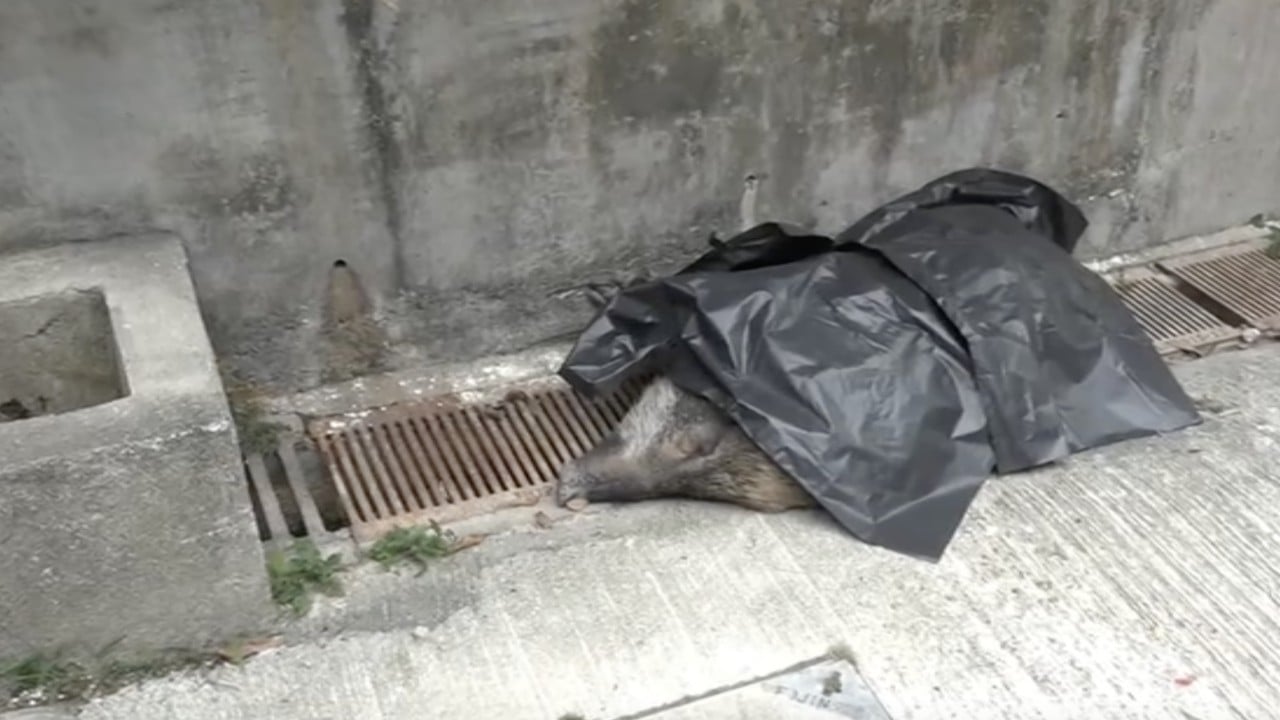
The headlines are predictable. They are lazy. "Wild boar bites hiker, tumbles to its death." It reads like a freak accident or a scene from a low-budget horror flick. The local news treats these encounters as anomalies—glitches in the matrix of a quiet village life. They want you to believe that a feral beast simply lost its mind, attacked a human, and then gravity took care of the rest.
They are wrong.
This isn't a story about a "rogue" animal. It is a story about the structural incompetence of human expansion. When we build stairs into the sides of mountains and call it a "village," we aren't just inviting nature in; we are forcing it into a corner. The boar didn't "tumble" because it was clumsy. It died because we have engineered environments that are lethal to everything except the bipedal mammals paying property taxes.
The Myth of the Aggressive Animal
The common consensus is that wild boars are naturally aggressive. Walk into any hiker’s forum and you’ll find "experts" telling you to carry bells or pepper spray. This is a fundamental misunderstanding of porcine psychology.
Sus scrofa is a creature of habit and calories. They don’t want your fight. They want your discarded compost and the fallen fruit from your unkept orchards. The hiker in this story wasn't a victim of a predator; they were an obstacle in a high-stress corridor.
When you look at the mechanics of these "attacks," they are almost always defensive. A boar's primary defense mechanism is a forward charge. It doesn't have the luxury of a complex social exit strategy when it’s trapped on a narrow flight of concrete stairs. By building rigid, vertical infrastructure in traditional foraging grounds, we have created biological pressure cookers.
The boar didn't choose to bite. It was forced into a binary choice: fight or fall. In this case, it did both.
The Architecture of Extinction
We need to talk about the stairs.
Villages built into hillsides—especially in regions like Italy, Spain, or Hong Kong—are architectural marvels for humans and death traps for megafauna. We use stairs to overcome gravity. Quadrupedal mammals with high centers of gravity and hooves designed for soft earth do not "do" stairs.
When a boar enters a village, it is often seeking the path of least resistance. On a map, that looks like a street. In reality, that street often turns into a narrow staircase flanked by stone walls. Once the animal is on those stairs, its flight response is neutralized. It cannot turn around easily. It cannot jump the walls.
The Physics of the Fall
Consider the mass of a mature male boar. We are talking about $100\text{ to }150\text{ kg}$ of dense muscle and bone. On a flat surface, that mass is an asset. On a 45-degree stone incline, it’s a liability.
The moment that animal engages in a defensive struggle with a human, its footing is compromised. A single slip leads to a catastrophic loss of equilibrium. The "tumble to its death" wasn't a poetic irony; it was a predictable outcome of $F = ma$ meeting a surface with a near-zero coefficient of friction for hooves.
Stop Blaming the "Wild"
I’ve spent a decade analyzing how urban sprawl intersects with local ecosystems. I’ve seen municipalities spend millions on "boar-proof" fencing that only serves to funnel the animals into even more dangerous pedestrian zones.
The lazy argument is that we need to cull the population. "There are too many boars," the politicians scream. While population density is a factor, it ignores the primary driver: Human magnetism.
We are the ones who changed the rules of the game.
- The Buffet Effect: We plant ornamental gardens filled with calorie-dense bulbs.
- The Water Magnet: We install irrigation systems that keep the soil soft and easy to root through, even in droughts.
- The Shield: We eliminate the boar's natural predators (wolves and bears) from the vicinity of our homes, making the village the safest place for a sow to raise her piglets—until she hits the stairs.
We have turned our villages into high-reward, high-risk casinos for wildlife. Then we act surprised when the house wins and the animal loses.
The "People Also Ask" Fallacy
If you search for "what to do if a boar charges," the internet gives you a list of survival tips. Climb a tree. Stand your ground. Don't run.
This is the wrong question.
The real question is: Why was there no wildlife corridor built into your $500,000 renovation project? If you live in a high-risk zone, you are an intruder in a biological highway. Expecting an animal with the cognitive capacity of a toddler to navigate a concrete staircase during a panic attack is the height of human arrogance.
The Brutal Reality of Coexistence
The contrarian truth that no one wants to admit is that "peaceful coexistence" is a marketing term, not a biological reality. True coexistence requires sacrifice. It means:
- Accepting that your village will have "no-go" zones for humans during dusk and dawn.
- Replacing aesthetic stone stairs with ramps or tiered landscapes that allow for multi-species movement.
- Ending the practice of feeding "cute" piglets, which effectively signs their death warrant by habituating them to human transit zones.
I have seen towns in Japan successfully implement infrared "early warning" systems that alert hikers to boar presence on specific trails. It’s expensive. It’s "annoying." But it works because it treats the animal as a predictable physical force rather than a malicious actor.
The Cost of the Status Quo
The hiker in the competitor's article got a bite and a story. The boar got a broken neck and a trip to the rendering plant.
This isn't a tragedy of nature; it’s a tragedy of engineering. We continue to build as if we are the only occupants of the planet, and when the planet pushes back, we cry foul. We cite "public safety" to justify the removal of any species that doesn't fit into our neat, right-angled world.
If we don't start designing for the "wild" in our backyard, we will continue to see these "freak accidents." They aren't glitches. They are the inevitable friction of two worlds colliding on a staircase that was never meant to be there.
Stop looking at the bite. Look at the blueprint.
The boar didn't fail. We did.