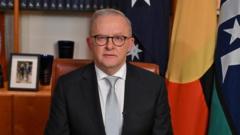
The global economy is not a fragile vase waiting for a single brick from Tehran or Tel Aviv to shatter it. Politicians love the "months of pain" narrative because it buys them cover for domestic failures. When Australian Prime Minister Anthony Albanese warns of "prolonged economic shocks" stemming from Middle Eastern instability, he isn't providing a forecast. He is providing an excuse.
The consensus view—the one currently clogging your news feed—is that a regional conflict will inevitably trigger a 1973-style energy paralysis. This logic is outdated, lazy, and ignores the structural evolution of global energy markets. We are no longer living in a world where a closed strait or a sabotaged refinery dictates the fate of the global GDP.
The "shocks" aren't coming from the supply side. They are coming from the panic-buying of incompetent bureaucrats.
The Myth of Oil Dependency
The primary argument for a sustained economic crisis relies on the "Energy Fragility" thesis. It suggests that because a specific percentage of global crude passes through the Strait of Hormuz, any disruption creates a permanent hole in the balance sheet.
This is a fundamental misunderstanding of elasticity.
In the 1970s, the world had few alternatives to crude. Today, the energy mix is a fragmented mosaic. When prices spike, industrial users don't just "suffer" for months; they switch. They optimize. They utilize localized storage that has been built out specifically to handle these exact scenarios. The strategic reserves of IEA member countries are not just for show; they are a massive, liquid buffer that renders "months of shock" a mathematical improbability unless every major power decides to stop trading simultaneously.
Why the Australian Prime Minister is Selling Fear
Australia’s position is particularly curious. As a massive net exporter of energy, the country should, in theory, be a beneficiary of price volatility. So why the gloom?
It’s a shell game. By focusing on external "geopolitical shocks," leadership diverts attention from internal inflationary pressures caused by decades of stagnant productivity and high domestic debt. If your grocery bill goes up, the PM wants you to blame a drone in the desert, not the central bank’s balance sheet or a failed housing policy.
I have seen boards of directors use this same tactic. They miss their quarterly targets and blame "macroeconomic headwinds" in the Middle East, even if their company sells software in Melbourne. It’s a convenient ghost.
The Invisible Hand of the US Shale Buffer
The "expert" class consistently underestimates the response time of the American Permian Basin.
In a scenario where Middle Eastern supply is throttled, the price mechanism triggers an immediate surge in North American production. This isn't a theory; it is a proven feedback loop. The "lag" that used to take years now takes weeks.
- Drilled but Uncompleted (DUC) wells can be brought online with terrifying speed.
- Infrastructure efficiency means that oil from the Americas reaches markets faster than a tanker navigating a war zone.
- Global arbitrage ensures that as soon as the price hits a certain threshold, the incentive to over-produce elsewhere becomes irresistible.
The idea that the world will sit on its hands for months while the economy grinds to a halt assumes that every energy CEO on the planet is allergic to profit.
The Liquidity Trap of Public Panic
The real danger isn't the oil. It's the velocity of money.
When leaders stand at podiums and preach about "economic shocks," they trigger a contraction in consumer spending. People stop buying cars. They delay home renovations. They hoard cash. This is a self-fulfilling prophecy. The PM isn't warning us about a recession; he is actively manufacturing one by eroding consumer confidence.
If you want to understand the "shocks," look at the data on capital outflows during the first 48 hours of a conflict. It isn't the physical barrel of oil that hurts; it's the algorithmic trading bots reacting to the rhetoric of the PM. We are being gaslit into a downturn by the very people tasked with preventing one.
The Technological Decoupling
We are currently witnessing the greatest decoupling in economic history.
The relationship between Energy Input and GDP Output is no longer linear.
The digitilization of the economy means that a significant portion of our "productivity" is powered by servers and silicon, which are increasingly insulated from the spot price of Brent Crude. A tech firm in Sydney or a logistics hub in Singapore doesn't stop functioning because gasoline is 20% more expensive. They find efficiencies. They automate. They utilize the $1.8 trillion invested globally in renewable infrastructure over the last year.
The "months of pain" narrative assumes we are still driving 1974 Holden Kingswoods. We aren't.
The Flawed Premise of "Global Connectivity"
The "People Also Ask" sections of the internet are obsessed with how a war in Iran hits the local gas station. They ask: "Will gas prices double?"
The honest, brutal answer: Perhaps for a week. Then, the market clears.
The downside of my contrarian view? It requires admitting that we are at the mercy of cold, hard market mechanics rather than the "steady hand" of government intervention. It means acknowledging that the volatility is a feature, not a bug. If you want a stable, predictable price, you have to accept a stagnant, non-competitive economy. You can't have both.
Stop Planning for the Shock and Start Planning for the Correction
Most businesses are currently "bracing" for impact. They are cutting budgets and freezing hires because the news told them to be afraid.
This is the "Lazy Consensus" in action. While everyone else is pulling back, the smart money is looking at the oversupply that inevitably follows a price spike. History shows us that every geopolitical price surge is followed by a massive, deflationary crash as production ramps up and demand gets destroyed by the high prices.
The shock doesn't last months. The over-correction lasts years.
If you are waiting for the PM to tell you it's safe to invest again, you’ve already lost the game. The real risk isn't a conflict in the Middle East. The real risk is believing that the people in charge actually understand the mechanics of the machine they are pretending to steer.
They are reading from a script written in 1980. The world has moved on. You should too.
Stop watching the tankers. Watch the data.