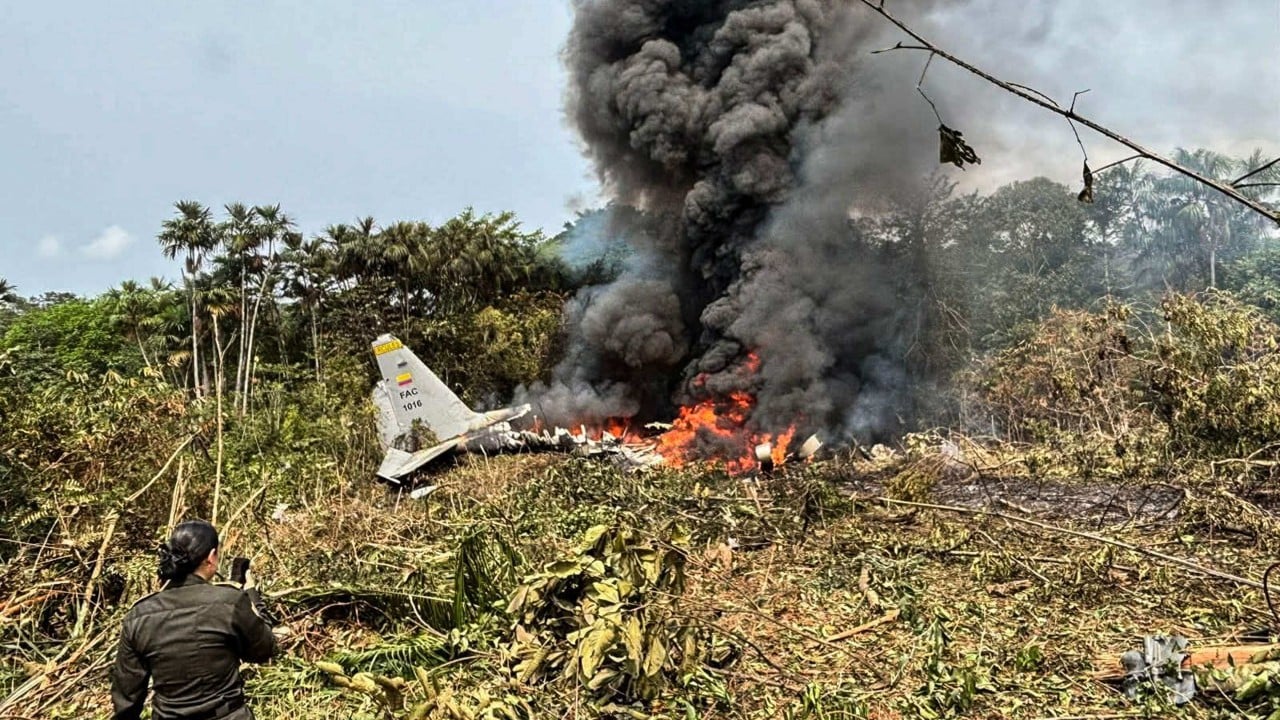
The crash of a Colombian Air Force transport plane shortly after takeoff from the military base at Melgar has left at least 34 dead, marking one of the darkest days for the nation's defense wing in recent history. While initial reports point to a sudden loss of power during the critical climb phase, this tragedy is not an isolated incident of bad luck. It is the predictable outcome of a fleet pushed beyond its mechanical limits. The wreckage scattered across the Andean foothills represents more than just a mechanical failure; it is a manifestation of a systemic crisis in how Latin American militaries maintain their aging hardware under the strain of constant operational demands.
Airborne transport is the backbone of Colombian internal security. Because the geography is defined by jagged peaks and dense jungle, the military relies on a fleet of aging workhorses to move troops and supplies. These aircraft are often decades old, kept in the air through cannibalized parts and the sheer ingenuity of ground crews. But ingenuity has a ceiling. When a plane fails seconds after leaving the runway, the margin for error disappears.
The Physics of a Takeoff Disaster
To understand why this specific crash was so lethal, one must look at the aerodynamic reality of the "dead man's curve." During takeoff, an aircraft is at its most vulnerable. It is heavy with fuel, moving at relatively low speeds, and fighting gravity to gain altitude. If an engine fails at this moment, the pilot has only seconds to react. In the thin air of the Colombian highlands, engines produce less thrust, and wings produce less lift.
The aircraft involved was reportedly operating near its maximum takeoff weight. When the primary power plant failed, the remaining torque likely caused a violent yaw, or a sideways skid, that the flight crew could not correct at such a low altitude. This led to an aerodynamic stall. The plane did not glide; it fell.
The Budgetary Noose
For years, the Colombian Ministry of Defense has balanced on a knife's edge. High-profile spending often goes toward shiny new strike capabilities or intelligence tech, while the "boring" logistics of transport maintenance are left to wither. The transport fleet is the workhorse that nobody wants to pay to shoe.
Maintenance logs for the specific airframe involved will likely show a history of deferred upgrades. In many South American air forces, a "fly until it breaks" mentality has taken root out of financial necessity. This creates a dangerous feedback loop. As airframes age, they require more frequent inspections. As budgets tighten, those inspections are stretched thin. Eventually, a microscopic crack in a turbine blade or a frayed hydraulic line goes unnoticed.
A Culture of Operational Pressure
The investigative trail leads beyond the hangar and into the command center. There is an immense pressure on Colombian pilots to complete missions regardless of equipment status. In a conflict-heavy environment where troop movements are time-sensitive, "no-go" decisions are often discouraged.
- Overloading: The official manifest says 34 were on board, but in tactical environments, weight limits are frequently treated as suggestions rather than hard laws.
- Pilot Fatigue: The crews flying these routes are some of the most experienced in the world, but they are also some of the most overworked.
- Environmental Factors: Sudden microbursts and shifting wind patterns in the Melgar region are notorious, yet the aircraft’s antiquated weather radar likely offered little warning.
If the military continues to prioritize mission frequency over structural integrity, the death toll will continue to climb. This isn't just about one plane. It is about an entire philosophy of aviation that treats 40-year-old metal as if it were immortal.
The Black Market for Spare Parts
One of the most overlooked factors in regional military crashes is the supply chain. Because of international sanctions on certain manufacturers and the sheer age of these planes, genuine parts are becoming impossible to find. This has birthed a gray market for "certified" components that are actually refurbished junk.
When a military cannot source a part from the original manufacturer, they turn to third-party brokers. These brokers often provide parts with questionable paper trails. A single counterfeit bolt in a landing gear assembly or a substandard seal in a fuel pump can bring down a $20 million aircraft. Investigators must now scrutinize the procurement records of the Colombian Air Force to see if "cost-saving" measures introduced lethal vulnerabilities into the cockpit.
The Training Gap
Modern flight safety relies on simulators that can replicate every conceivable emergency. However, many of the older models in the Colombian fleet don't have high-fidelity simulators available. Pilots learn how to handle engine failures in the air, during actual flight time, which is both expensive and risky.
Without the ability to practice "engine-out" scenarios in a safe, simulated environment, a pilot’s muscle memory may not be sharp enough when the real crisis hits at 500 feet. The delay of a single second in feathering a prop or dropping the nose can be the difference between a forced landing and a catastrophic fireball.
Technical Limitations of the Airframe
The aircraft in question was designed for a different era of warfare. It lacks the redundant digital flight control systems found in modern cargo planes like the C-390 or the latest C-130J variants. In an older cockpit, the pilot is the computer. They must manually manage the complex interplay of manifold pressure, pitch, and yaw while the world is spinning outside their window.
We are asking young men and women to fly 20th-century technology against 21st-century demands. It is a losing game. The metal fatigue on these wings is a silent killer that no amount of fresh paint can hide.
The Cost of Silence
Whenever these crashes occur, the official response is a blend of mourning and obfuscation. The "human error" tag is frequently applied because it is easier to blame a dead pilot than a living procurement officer. But human error is almost always the final link in a chain of mechanical and bureaucratic failures.
To prevent the next 34 deaths, the Colombian government must undergo a brutal audit of its flight lines. Every airframe with more than 10,000 hours needs to be grounded and subjected to X-ray wing inspections. The cost will be astronomical, but the alternative is a continued hemorrhage of the nation’s most valuable asset: its people.
The smoke rising from the hills of Melgar is a signal that the era of "making do" is over. You cannot fight a modern war—or even maintain a modern peace—with a fleet that is rotting from the inside out.
Ground the fleet and inspect the maintenance logs against the actual parts installed on the engines.