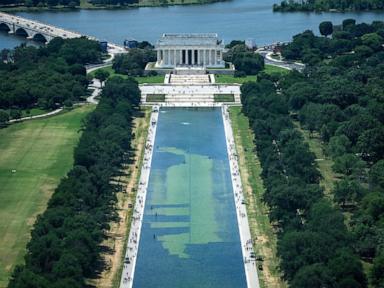
The physical transformation of the 2,030-foot Lincoln Memorial Reflecting Pool into an "American flag blue" basin failed because it ignored basic thermodynamic laws and structural fluid dynamics. By attempting to solve a biological and structural engineering problem with a superficial aesthetic treatment, the $14.2 million emergency renovation accelerated the exact ecological degradation it was designed to prevent. This project serves as a clear case study in how misaligned infrastructure procurement and a failure to understand environmental variables can cause civil engineering projects to collapse under the weight of unintended feedback loops.
Deconstructing the failure of this project requires analyzing three specific systems: the thermal dynamics of the basin coating, the hydraulic limitations of the underlying pipeline network, and the operational limits of the newly installed chemical and filtration systems.
The Thermodynamics of the Dark Blue Basin Coating
The primary driver of the immediate biological bloom in the pool is the modification of the basin’s albedo—the measure of solar radiation reflectance. Historically, the pool maintained a dull gray concrete base. The application of a dark blue, industrial-strength coating significantly lowered the surface albedo, changing how the pool absorbs energy.
A lower albedo means the surface absorbs a higher percentage of incident solar radiation rather than reflecting it back through the water column. In shallow water bodies—the Reflecting Pool holds roughly 6.7 million gallons (25.5 million liters) over an expansive six-acre footprint, averaging a depth of only 2 to 3 feet—this absorption creates an immediate thermal transfer. The dark blue floor acts as a heat sink, rapidly elevating the water temperature during summer heatwaves.
This temperature increase directly alters the biological growth equation. The kinetic growth rate of green algae accelerates exponentially within specific temperature bands. By warming the stagnant water column from the bottom up, the blue coating created a highly efficient incubator for algae. The dark background also increased visual contrast, making the bright green biological clusters highly visible to tourists and creating a stark aesthetic failure.
Furthermore, within two weeks of application, the dark blue coating began peeling away from the concrete floor. This peeling indicates a failure in chemical bonding or substrate preparation. Applying non-porous industrial coatings to massive, aging concrete structures subjected to constant hydrostatic pressure frequently encounters moisture vapor transmission issues. When water migrates through the concrete from the water table below, it exerts upward pressure against the impermeable blue layer, causing blisters, delamination, and eventual structural failure of the coating.
The Hydraulic Breakdown and the Stagnation Loop
The core structural failure of the pool does not stem from its surface appearance, but from its broken distribution system. The $14.2 million project focused on sealing the basin's expansion joints but left the primary subsurface logistics network completely untouched.
The pool relies on a 12-inch underground plastic piping system to transport water to and from a nearby purification facility. This pipeline network suffers from systemic structural vulnerabilities. Decades of soil shifting and pressure variations across the National Mall have cracked these lines, creating a phenomenon described by former National Capital Area officials as trying to fill a colander. The system leaks millions of gallons annually.
This continuous loss of water creates a compounding operational crisis. To repair the cracked, leaking subterranean pipes, engineers must completely isolate the pool from the filtration plant. This isolation cuts off the water movement required to keep the pool clean, forcing the 6.7 million gallons to remain entirely stagnant.
Stagnant water lacks the turbulent flow required to disrupt biological film formation. Combined with the elevated temperatures induced by the new blue coating, this lack of circulation eliminated any remaining environmental resistance to biological growth. The mechanical failure to address the transport pipes ensured that even a perfectly sealed basin surface would become a stagnant sink.
Mechanical Misalignments and Chemical Compensation
In an effort to mitigate the rapid biological growth caused by the new coating and stagnant conditions, operations teams introduced two corrective measures: an ozone nanobubbler filtration system and manual applications of hydrogen peroxide. The failure of these interventions highlights a clear mismatch between advanced technology and basic infrastructure reality.
An ozone nanobubbler system works by injecting microscopically small bubbles of ozone gas into the water. These nanobubblers remain suspended in the water column for extended periods, releasing ozone to oxidize organic material and destroy algae cells on contact. In a fully functional, high-flow hydraulic system, this technology can effectively manage biological loads.
However, the system requires uniform distribution to work. Because the primary distribution pipes remained broken and unable to maintain consistent flow dynamics, the nanobubbler deployment could not achieve the necessary concentration throughout the entire six-acre pool. Instead of a uniformly sterile water body, the system produced localized zones of clean water near the functioning injection points, while leaving vast, dead zones of stagnant water untouched. The visible accumulation of white foam and dead biological mass on the surface indicates that while the system killed some algae, the lack of functional surface skimmers and circulation loops prevented the removal of the dead organic matter.
To compensate for this lack of system-wide circulation, maintenance crews resorted to manually dumping large quantities of hydrogen peroxide into the basin from the edges. This chemical approach provides a temporary fix rather than a sustainable operational solution. Hydrogen peroxide acts as a rapid oxidizing agent, breaking down algae cell walls on contact. However, it degrades quickly into water and oxygen when exposed to sunlight and high temperatures. In a highly heated, low-albedo environment, the chemical half-life drops significantly, requiring continuous, costly chemical inputs to manage a symptom rather than curing the systemic hydraulic failure.
Procurement Models and Risk Allocation
The execution of this project highlights the significant risks associated with fast-tracked, non-competitive public procurement models. The $14.2 million contract was awarded as a no-bid contract to a Virginia-based contractor whose previous experience centered on residential and commercial swimming pools, including work at private golf clubs.
Large-scale public monuments operate on completely different structural scales than private recreation facilities. A standard swimming pool relies on high-turnover filtration loops, deep deep-water columns, covered off-season cycles, and heavy chemical saturation that is inappropriate for an open, multi-acre public monument that hosts wildlife, such as ducks, and deals with significant urban runoff.
| Factor | Standard Commercial Swimming Pool | Lincoln Memorial Reflecting Pool |
|---|---|---|
| Surface Area | Small to Moderate (e.g., 5,000 sq ft) | Massive (approx. 260,000 sq ft / 6 acres) |
| Water Depth | Deep (3 to 12 feet) | Shallow (2 to 3 feet) |
| Hydraulic Flow | High-rate turnover (4-6 hour cycles) | Low-rate, fragile pipe network |
| Environmental Exposure | Controlled, chemical-heavy, filtered | High organic loading, waterfowl, urban runoff |
| Albedo Expectation | Bright aesthetics for recreation | High reflectivity for historic architecture |
By utilizing a procurement path that bypassed traditional engineering reviews and competitive bidding, the project lost out on crucial technical oversight. A standard competitive review by federal civil engineers would have highlighted the thermal risks of the dark blue coating and prioritized fixing the underlying pipeline infrastructure before applying any cosmetic finishes. The accelerated timeline, driven by the goal of finishing before national anniversary celebrations, resulted in a superficial fix that fell apart under normal summer weather conditions.
Strategic Forecast and Engineering Directive
Left unchanged, the current setup will continue to experience rapid biological growth every summer, requiring expensive manual chemical cleanups and constant repairs to the peeling coating. The dark blue floor will keep absorbing heat, the broken underground pipes will keep leaking, and the nanobubbler system will remain ineffective without a working distribution network.
To fix these issues permanently, project managers must shift from cosmetic alterations to a full overhaul of the underlying infrastructure:
- Strip the Dark Base Coating: The blue industrial coating must be mechanically removed and replaced with a high-albedo, UV-reflective, light-gray mineral sealer. This change will reduce solar heat absorption, lower the water temperature, and naturally slow down algae growth.
- Reconstruct the Subsurface Distribution Network: Managers must stop attempting to seal surface joints and instead allocate funds to dig up and replace the cracked 12-inch plastic distribution pipes with high-density polyethylene (HDPE) lines. HDPE lines can handle soil shifting without cracking and will restore the continuous water flow needed for proper filtration.
- Integrate the Filtration Loops: The ozone nanobubbler system must be connected directly to a fully repaired, high-volume circulation loop. This integration will ensure that purified water is distributed evenly across all six acres, eliminating the stagnant dead zones that currently allow algae to thrive.