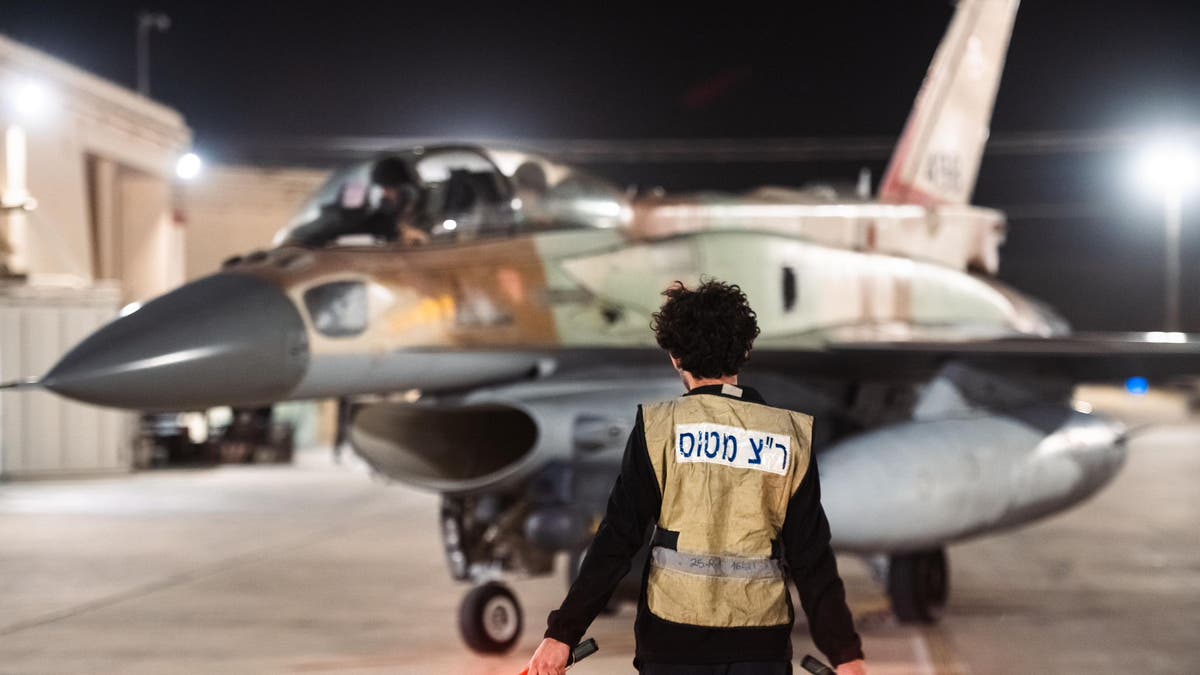
Benjamin Netanyahu stands on the tarmac, gesturing toward a row of F-35 "Adir" jets, promising that Israeli reach is limitless. The media laps it up. The EurAsian Times and others frame this as a definitive shift in the Middle Eastern balance of power. They treat the procurement of more Lockheed Martin F-35s and Boeing F-15IAs as a "checkmate" move against Tehran.
They are dead wrong. In related updates, take a look at: Asymmetric Threats to Energy Infrastructure Logic and Mechanics of the Fujairah Incident.
Buying more fifth-generation fighters to solve the "Iran problem" is like buying a fleet of Ferraris to navigate a minefield. It looks impressive in a brochure, but it ignores the brutal reality of modern integrated air defense systems (IADS) and the sheer physics of long-range attrition. Israel isn't buying a solution; it’s buying into a sunk-cost fallacy that privileges prestige over pragmatism.
The Stealth Myth and the Physics of Detection
The consensus view suggests that the F-35 is "invisible" to Iranian radar. This is a fundamental misunderstanding of low-observability (LO) technology. Stealth is not a cloak of invisibility; it is a delay mechanism. It reduces the range at which a radar can achieve a "track-quality" lock. Associated Press has provided coverage on this critical issue in extensive detail.
The F-35 is optimized for X-band radar suppression from the front. However, Iran—largely thanks to Russian and Chinese exports—utilizes a "system of systems" approach. They employ long-wavelength VHF and UHF radars. These systems don't care about the faceted geometry or the radar-absorbent material (RAM) of an F-35. They operate on the principle of Rayleigh scattering, where the wavelength is comparable to the size of the aircraft’s tail or wing structures.
When you fly a multi-billion dollar fleet across three hostile borders, you aren't just fighting one radar. You are fighting a networked web. The moment an F-35 opens its weapons bay to drop a GBU-39 Small Diameter Bomb, its radar cross-section (RCS) spikes. In that millisecond, a modern S-300PMU2 or a domestic Bavar-373 system doesn't need to be "stealth-killing" technology; it just needs to be fast.
The Distance Trap
Israel’s borders are roughly 1,000 kilometers from Iran’s primary nuclear facilities at Natanz or Fordow. The F-35A has a combat radius of approximately 1,090 kilometers.
Do the math.
That radius is calculated for a standard mission profile, not a high-stress penetration of the most contested airspace on the planet. To actually hit targets in central Iran and return, these jets require aerial refueling. The moment a giant, non-stealthy Boeing KC-46 Pegasus tanker shows up on the radar to feed these thirsty "stealth" fighters, the element of surprise is vaporized.
The competitor's narrative suggests that "reach" is a matter of pilot bravery and airframe quantity. In reality, reach is a matter of fuel logistics. If your tanker is forced to loiter in Iraqi or Saudi airspace, it becomes a massive, slow-moving target for long-range interceptors or "bolt-from-the-blue" missile strikes. Without the tankers, the F-35s are one-way suicide drones.
The F-15IA Is a Relic of a Gone Era
The recent approval to buy 25 F-15IA (the Israeli version of the F-15EX Eagle II) is being hailed as the "muscle" to the F-35's "brain." The logic is that the F-35 goes in first to kick down the door, and the F-15 follows with a massive payload of 13 tons of munitions.
This is 1990s thinking applied to a 2026 battlefield.
The F-15 has the radar signature of a flying barn door. In an era of 400km-range 40N6 missiles (used by the S-400), an F-15 is a liability, not an asset. Using an F-15 to "mop up" assumes you have already achieved total air superiority. Against a nation with the geographic depth of Iran, total air superiority is a fantasy. Iran is three times the size of France. You don't "clear the skies" over a territory that vast with a few dozen airframes.
The Wrong Tool for the Wrong War
The "People Also Ask" sections of the internet often focus on "Can Israel destroy Iran's nuclear program?" The answer is rarely about the planes. It’s about the earth.
The Fordow enrichment plant is buried under 80 meters of rock and concrete. Even the GBU-57 Massive Ordnance Penetrator (MOP)—which can only be carried by a B-2 Spirit bomber, a plane Israel does not have—would struggle to guarantee a total kill. Israel’s F-15s and F-35s are limited to smaller bunker busters.
By doubling down on fighter jets, Israel is choosing a high-visibility, high-risk political statement over a low-visibility, high-impact strategic capability. A thousand precision-guided cruise missiles launched from submarines or mobile ground units would be far more difficult to intercept and significantly cheaper than the $3 billion price tag for another squadron of F-35s.
The Maintenance Nightmare Nobody Admits
I have watched air forces grind to a halt because of "mission capability" rates. The F-35 is a maintenance diva. It requires specialized climate-controlled hangars to protect its RAM skin. Every hour of flight requires dozens of hours of specialized maintenance.
In a sustained conflict—not a one-off raid like Operation Opera in 1981, but a real, grinding war—Israel’s sortie generation rate will plummet. If Iran starts hitting Israeli airbases with its thousand-strong ballistic missile arsenal (Fateh-110, Kheibar Shekan), those F-35s won't be in the air. They will be trapped in smoking hangars, waiting for a proprietary spare part from a factory in Fort Worth, Texas.
The Economic Asymmetry
The cost-per-kill ratio is skewed heavily in Tehran's favor. An F-35 costs roughly $80 million to $100 million per unit. An Iranian-made Sayyad-4 missile costs a fraction of that. If Iran fires twenty missiles to take down one "Adir," they win the economic war.
Israel is playing a game of "quality over quantity" in a theater where quantity has a quality of its own. When you only have 50 or 75 top-tier jets, losing five in a single night isn't a setback; it’s a national catastrophe.
The Nuance: What Should They Be Buying?
If the goal is truly to deter or dismantle a hardened nuclear program, the fighter jet is the least efficient tool in the shed. The "lazy consensus" says planes equal power. The truth is that electronic warfare (EW) and long-range autonomous systems are the actual disruptive forces.
Instead of more F-15s, the IDF should be pouring that capital into:
- Loitering Munitions: Swarms of hundreds of drones that saturate and confuse IADS.
- Deep-Sea Strike: Expanding the Dolphin-class submarine fleet to provide a 360-degree launch threat that doesn't rely on overflight permissions.
- Hypersonic Interceptors: Investing in the defense side to ensure that while they strike Iran, Tel Aviv isn't leveled by a counter-volley.
The fighter jet purchase is a political sedative. It makes the public feel safe because they can see the sleek planes and hear the roar of the engines. It makes for a great photo op for a Prime Minister under domestic pressure. But against the jagged reality of Iranian geography and Russian-integrated sensors, these jets are increasingly becoming expensive ornaments of a bygone strategic era.
Stop looking at the planes. Start looking at the fuel lines, the radar wavelengths, and the depth of the bunkers. That is where the war is won or lost, and currently, Israel is buying the wrong map.
Build the swarm. Abandon the cockpit.


