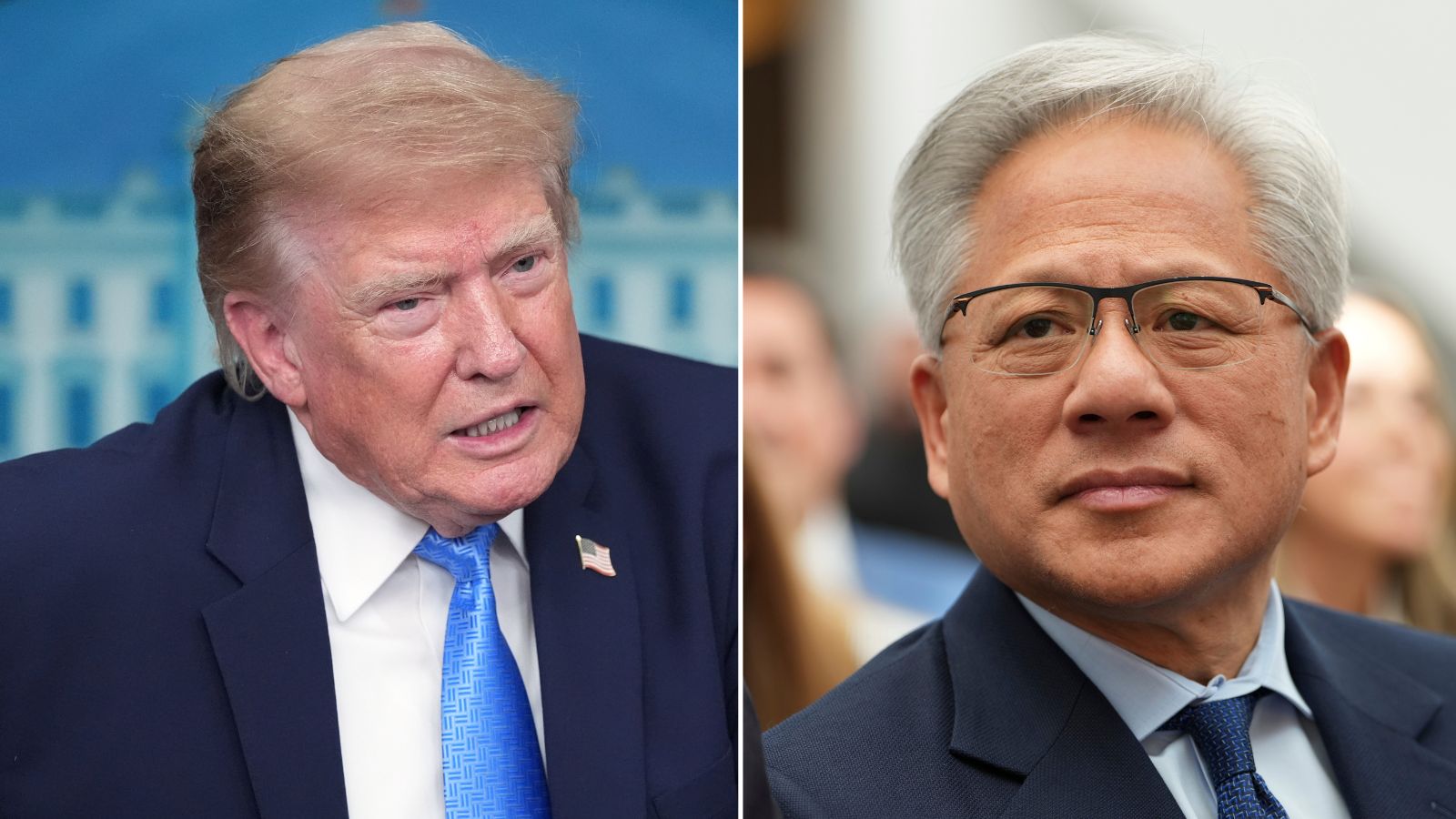
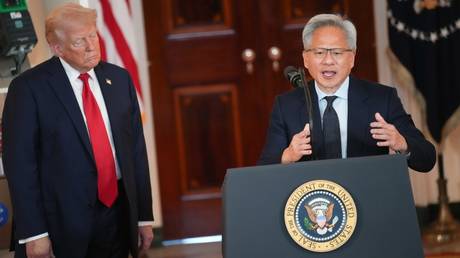
Public defense of a corporate chief executive by a sitting head of state during an active counterintelligence investigation signals a profound shift in how sovereign risk is managed at the intersection of artificial intelligence hardware and geopolitics. When President Donald Trump publicly absolved Nvidia CEO Jensen Huang of culpability regarding an alleged espionage operative—stating Huang had no awareness of the individual's intelligence ties—the intervention transformed a standard Federal Bureau of Investigation counterintelligence inquiry into a benchmark case study on executive insulation, state-capital alignment, and corporate vetting failures. To understand the operational reality beneath the political headline, strategists must separate the political signaling from the underlying mechanics of counterintelligence probes, corporate governance liabilities, and semiconductor export enforcement.
The Architecture of Executive Insulation
Standard corporate governance models dictate that a chief executive officer operates under a strict fiduciary duty of care, which theoretically extends to preventing the infiltration of sensitive intellectual property by foreign adversaries. In practice, modern multinational corporations at the scale of Nvidia employ tens of thousands of personnel across globally distributed research and development centers, making direct executive oversight of individual hiring decisions structurally impossible. For another view, consider: this related article.
When an FBI counterintelligence probe touches an organization of this magnitude, investigators operate along two distinct tracks:
- Tactical Compromise Assessment: Determining what proprietary architectures, source code, or supply chain schematics were accessed or exfiltrated by the targeted operative.
- Institutional Culpability Analysis: Evaluating whether corporate leadership ignored red flags, bypassed mandatory security protocols, or prioritized commercial expansion over statutory compliance.
Political intervention from the executive branch directly impacts the second track while leaving the first entirely intact. By publicly stating that Huang lacked knowledge of the operative's status, the White House established a political boundary around Nvidia’s top leadership, effectively signaling that the administration views the company as a strategic national asset rather than a negligent corporate actor. This dynamic alters the traditional risk calculus for technology executives. Instead of facing immediate calls for board-level restructuring or shareholder derivative suits predicated on governance failure, the chief executive is shielded by state-level endorsement. Related insight on this trend has been provided by Wired.
Mechanics of Counterintelligence Probes in High-Tech Enterprises
A Federal Bureau of Investigation counterintelligence operation differs fundamentally from a standard criminal investigation. Criminal probes seek evidence beyond a reasonable doubt to secure indictments in public courts. Counterintelligence operations prioritize neutralization, disruption, and intelligence collection over immediate prosecution. When an alleged spy operates within proximity to a major technology firm, the bureau's primary objective is mapping the adversary's collection network and assessing the damage to national security.
The operational friction arises from the competing incentives of the state and the corporation:
- State Incentive: Maximize visibility into foreign intelligence tradecraft, often by allowing an identified operative to remain active under surveillance to map their handlers and dead-drop mechanisms.
- Corporate Incentive: Immediately terminate access, scrub compromised networks, and contain reputational damage to preserve market capitalization and customer trust.
Because of this divergence, chief executives are frequently kept uninformed during the active phases of an FBI probe. Under standard counterintelligence protocols, federal agents rarely brief a company's CEO until the operational phase concludes or an imminent threat of irreversible data exfiltration forces an intervention. This procedural reality validates the factual premise that an executive can be entirely unaware of an operative within their orbit. However, lack of personal knowledge does not equate to institutional immunity. The legal framework governing corporate liability relies on constructive knowledge and systemic negligence—whether the organization maintained adequate internal controls to detect anomalous data access patterns.
The Political Economy of Semiconductor Sovereignty
The semiconductor sector no longer operates within a traditional free-market framework. Advanced graphics processing units and AI accelerators constitute the foundational infrastructure for both commercial economic dominance and military modernization. Consequently, the market leader in AI compute is functionally a quasi-sovereign entity whose operational continuity is tied directly to national security interests.
This structural reality explains the mechanics behind high-level political backing during a federal investigation. In a conventional industry, a major security breach or espionage scandal triggers immediate regulatory scrutiny, potential fines, and diplomatic distancing from political leaders seeking to avoid reputational contagion. In the contemporary semiconductor sector, destabilizing the dominant domestic supplier creates an immediate strategic vulnerability that benefits foreign competitors.
The political endorsement functions as a stabilizing mechanism across three critical vectors:
- Equity Market Stabilization: Preventing panic-driven sell-offs in a heavily weighted index component whose valuation underpins broader domestic capital markets.
- Supply Chain Continuity: Reassuring sovereign allies and hyperscale cloud providers that the vendor's leadership remains intact and capable of fulfilling multi-year hardware commitments.
- Regulatory Signaling: Indicating to enforcement agencies that punitive measures should target the foreign intelligence apparatus rather than crippling the domestic enterprise's operational velocity.
This alignment between executive branch politics and corporate leadership introduces a distinct moral hazard. When market dominance guarantees political insulation, the economic incentives to invest heavily in preventative counterintelligence infrastructure diminish. The cost of compliance becomes secondary to the speed of product deployment.
Differentiating Known Facts from Strategic Hypotheses
Analyzing a developing counterintelligence event requires strict adherence to evidentiary boundaries. Conflating political statements with investigative conclusions leads to flawed risk assessments.
Established Facts:
- The Federal Bureau of Investigation initiated a counterintelligence probe involving an individual alleged to have espionage ties intersecting with Nvidia's operational sphere.
- President Donald Trump issued a public defense of Nvidia CEO Jensen Huang, asserting that Huang possessed no prior knowledge of the individual's intelligence activities.
- Nvidia remains the primary supplier of high-performance AI compute hardware globally, placing its intellectual property at the apex of foreign intelligence collection priorities.
Educated Hypotheses:
- The alleged operative likely targeted human intelligence vectors—such as executive access, corporate events, or mid-level engineering personnel—rather than purely cyber-based network intrusion, given the framing of personal awareness around the CEO.
- Federal investigators likely utilized traditional counterintelligence compartmentalization, deliberately withholding the operative's status from Nvidia's executive suite during the surveillance phase to protect investigative sources and methods.
- The public backing from the White House reflects an intentional policy choice to decouple Nvidia's corporate brand from the security breach, preserving the company's leverage in ongoing global trade and export control negotiations.
Vulnerability Vectors in Rapidly Scaling Organizations
Hyper-growth technology firms experience a predictable degradation in internal security posture as headcount and market influence expand. When an organization transitions from a specialized hardware vendor to the central pillar of global computing infrastructure, its attack surface expands exponentially across non-technical vectors.
The primary vulnerability in these environments is not firewall architecture, which is typically heavily funded, but human-layer access control. High-profile executives and senior researchers operate within dense ecosystems of industry conferences, academic partnerships, joint ventures, and policy forums. Foreign intelligence services exploit these porous boundaries by deploying operatives who blend seamlessly into the commercial, academic, or media peripheries surrounding the target company.
Standard corporate vetting processes are structurally unequipped to detect state-sponsored operatives utilizing clean cover identities. Background checks conducted by private vendors verify criminal records, employment history, and creditworthiness; they cannot access classified counterintelligence databases. Therefore, relying on human resources screening as a primary defense against state-level espionage is a systemic failure.
Limitations of Political Shielding
While executive branch backing neutralizes immediate political fallout, it provides zero protection against the secondary and tertiary consequences of an espionage event. Corporate strategists and institutional investors must account for the hard limits of political insulation:
- Technical Exfiltration Irreversibility: Political statements cannot recall stolen architectural designs, weights, or manufacturing process parameters once they cross international borders. If intellectual property was compromised, the competitive moat narrows regardless of White House support.
- Statutory Enforcement Independence: While the President sets broad policy priorities, career prosecutors and counterintelligence officials operate under statutory mandates. If an investigation uncovers explicit violations of export control laws or willful blindness by mid-level managers, administrative penalties and compliance monitorships can still be imposed.
- Allied Regulatory Divergence: Domestic political backing does not bind foreign jurisdictions. European, Asian, and other international regulators evaluate data security and governance failures under their own statutory frameworks, potentially imposing operational restrictions or heightened audit requirements on the firm's international subsidiaries.
- Counterparty Risk Assessment: Enterprise customers and defense contractors conduct independent risk evaluations. An organization perceived to have porous human-intelligence defenses may face stricter compartmentalization requirements when bidding on classified government contracts, slowing down high-margin revenue streams.
Operationalizing Counterintelligence Resilience
Technology enterprises operating at the frontier of national security cannot rely on reactive political defenses to manage sovereign risk. Surviving sustained targeting by state-sponsored intelligence services requires structural changes to corporate governance and operational security.
First, boards of directors must establish dedicated national security committees staffed by former intelligence and defense officials who hold active security clearances. This structure creates a sanctioned channel for federal agencies to communicate classified threat briefings directly to corporate governance leaders without violating operational security protocols or alerting compromised internal personnel.
Second, organizations must implement zero-trust human access architectures around executive leadership and principal architects. Every external engagement—including media interviews, academic collaborations, and investor meetings—must undergo rigorous intelligence-led vetting that evaluates geopolitical exposure rather than basic criminal background metrics.
Finally, leadership must enforce strict data compartmentalization within research and development environments. By segmenting proprietary hardware schematics and foundational software stacks so that no single engineer or external partner possesses end-to-end architectural visibility, the company caps the maximum damage of any single human-intelligence compromise. The ultimate strategic play for dominant technology firms is to institutionalize counterintelligence defense as a core engineering discipline, eliminating the need for political rescues by making the enterprise structurally impervious to human-layer infiltration.