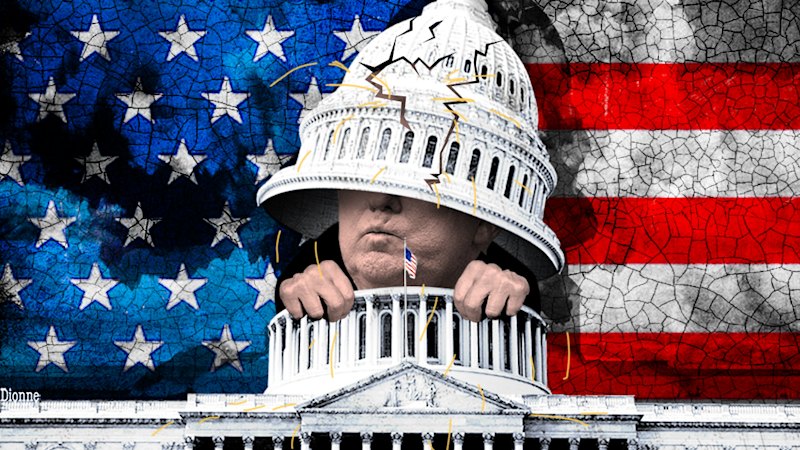
For decades, the foreign policy establishment has operated on a comfortable, highly profitable delusion. Washington think tanks, lifetime bureaucrats, and Davos regulars have sung from the same hymnal: American power equals multilateral treaties, open borders for capital, endless foreign aid, and the quiet management of managed decline. When Donald Trump shattered these assumptions, the commentary class reacted with predictable hysteria, diagnosing every tariff and broken treaty as a self-inflicted wound bleeding out American hegemony.
The lazy consensus claims Trump weakened America by alienating allies and abandoning the rules-based order. This is a profound misreading of how raw power actually functions in the twenty-first century. You might also find this similar story insightful: The Sound of a Breaking Line Where Uniforms Meet the Streets.
I have watched companies and sovereign states alike mistake compliance for respect, treating international agreements as sacred objects rather than what they truly are: temporary instruments of national interest. The conventional view looks at a broken treaty and sees tragedy. A realist looks at it and sees structural optimization.
To understand why the standard critique is entirely backwards, we have to look past the institutional panic and examine the mechanics of coercion, leverage, and hard national interest. As discussed in detailed articles by Al Jazeera, the effects are significant.
The Myth of the Multilateral Safety Blanket
The core failure of traditional foreign policy analysis is the belief that international organizations possess independent moral authority. They do not. The World Trade Organization, the Paris climate framework, and various regional security pacts were built underwritten by American capital and American blood following the Second World War. For decades, allies treated this arrangement as a permanent subsidy. They built export-driven economies behind American security shields while running trade surpluses against the US market.
When critics wring their hands over fractured alliances, they assume that harmony is the ultimate metric of success. It is not. Harmony is often just another word for acquiescence.
By treating trade as a zero-sum competition rather than a charity project, the America First framework forced a long-overdue reckoning. When tariffs are levied on traditional partners or trade deals are torn up, the immediate result is friction. But friction is the exact mechanism that forces dormant industrial capacity back online.
Consider the alternative. Continuing the post-Cold War consensus meant watching domestic manufacturing hollow out while strategic supply chains clustered in rival jurisdictions. Calling that process "leadership" required a staggering level of institutional self-deception. Disruption is messy, but stasis is fatal.
Transactional Diplomacy Versus Ideological Sleepwalking
Critics love to label transactional diplomacy as erratic or short-sighted. They argue that foreign policy must be guided by grand, values-driven strategies that transcend election cycles. In practice, "values-driven strategy" became a polite euphemism for endless military interventions in regions of marginal strategic importance, while domestic infrastructure crumbled and industrial communities rotted from within.
Trump replaced ideological mission creep with raw bilateral leverage. By demanding that NATO partners pay their own defense bills instead of outsourcing their security to the American taxpayer, he did not weaken the alliance; he forced it to shed its parasitic tendencies.
When nations are forced to negotiate bilateral terms face-to-face, power reverts to the entity with the deepest markets and the strongest military. That is the United States. Submerging American interests into bloated multilateral bureaucracies dilutes that advantage. Transactional deal-making strips away the diplomatic varnish and asks a simple question: What does the American worker get out of this arrangement?
If the answer is nothing, walking away is not a failure of statesmanship. It is the definition of it.
The Downside Nobody Wants to Admit
Intellectual honesty requires owning the cost of this disruption. A transactional, nationalist posture creates acute short-term volatility. Markets hate uncertainty, and sudden trade escalations ripple through global supply chains with painful precision.
Furthermore, when Washington signals that old commitments are negotiable, it incentivizes secondary powers to hedge their bets. Rivals like China step into diplomatic vacuums, offering alternative credit lines and infrastructure deals to nations bruised by American ultimatums.
This is the real hazard of the approach. It demands flawless execution and continuous pressure. If the domestic industrial base fails to materialize behind the protective wall of tariffs, or if political will falters, the country is left isolated without the compensating gains of domestic re-industrialization. It is a high-stakes strategy that trades the comfortable predictability of decline for the volatile possibility of renewal.
The Real Source of Leverage
The establishment fears Trump's foreign policy because it exposes a terrifying truth about their own careers: the rules-based international order was never self-sustaining. It survived solely because American power backed it up.
When you treat the protectorate as an equal partner while absorbing their economic blows, you are not projecting strength. You are managing your own retirement. Dismantling those arrangements is not an abdication of power. It is a brutal, necessary recalibration designed to ensure that the nation entering the next century is economically resilient, industrially independent, and beholden to no committee in Geneva. Stop mourning the consensus. It was killing you.


