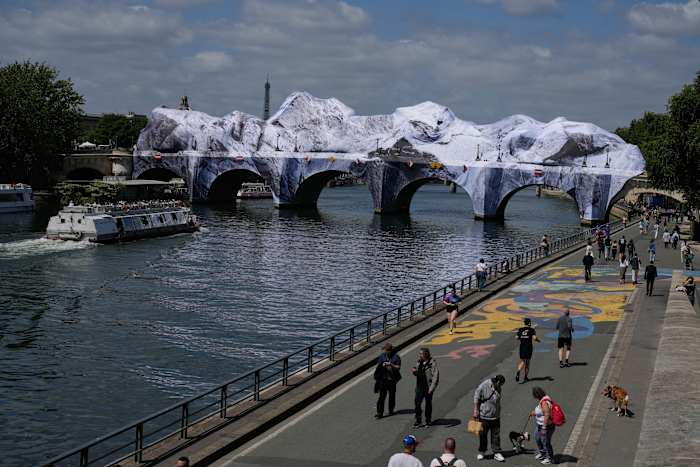
The French street artist JR just pulled off one of the most visually jarring stunts of his career, and it has nothing to do with his usual flat black-and-white portraits. He literally built a massive trompe-l'œil cave over the scaffolding of the historic Palais Garnier opera house in Paris.
If you are looking for the latest viral street art project that actually makes you question reality, this is it. It is huge. It is messy. It disrupts one of the most manicured tourist spots in Europe. Some people love it because it breaks the monotony of standard urban restoration. Others hate it, calling it an eyesore that ruins the classical view of a nineteenth-century masterpiece.
That polarization is exactly why JR matters. While most street artists are content with slapping a stencil on a brick wall, JR operates on a scale that forces entire cities to pay attention.
The Paris Cave Installation Broken Down
Let's look at what is actually happening at the Place de l'Opéra. The Palais Garnier is undergoing major restoration work on its facade. Usually, this means the building gets covered in ugly, corporate-sponsored tarpaulins or generic construction netting. Instead, JR turned the scaffolding into a canvas.
The installation portrays the entrance to a vast, rocky cavern. It is a massive photo-collage made of printed panels that line up perfectly when you stand at a specific vantage point in the square. Look at it from the right spot, and the stone facade of the opera house seems to split open, revealing a primitive, subterranean world.
JR calls it Retour à la caverne (Return to the Cave). It is a direct nod to Plato's allegory of the cave, playing with the ideas of illusion, reality, and knowledge. The project rolls out in two distinct acts. The first act appeared in September, showing the cave entrance bathed in light. The second act, revealed later in the autumn, changes the perspective entirely, moving the viewer inside the cave with a massive display of human silhouettes and handprints.
Moving Beyond the French Banksy Label
The media loves calling JR the "French Banksy." It is a lazy shorthand. It makes sense on a surface level because both artists emerged from the underground graffiti scene, keep their full identities relatively guarded, and command massive international audiences.
But the comparison falls apart when you look at how they work.
Banksy relies on anonymity, dark satire, and stencils that can be applied in seconds before the police show up. His work is subversive because it happens without permission. JR operates in broad daylight. He works with city officials, secures massive budgets, and recruits hundreds of local volunteers to help him paste his images.
Banksy comments on the system from the outside. JR uses the system to build monuments.
This cave installation proves that difference. You don't get to cover the facade of a state-owned French monument without months of bureaucratic meetings, safety permits, and architectural sign-offs. JR is an insider playing an outsider's game, and he does it brilliantly.
Why This Project Actually Matters for Urban Art
Most public art is boring. It consists of corporate-approved bronze statues or safe, abstract murals that blend into the background. JR's cave installation does something entirely different by engaging with the architecture rather than just covering it up.
Consider the history of the Palais Garnier. It was designed by Charles Garnier during the reign of Napoleon III, a time when Paris was being radically redesigned with grand boulevards and opulent monuments. It represents the height of nineteenth-century French theatricality and wealth.
By plastering a prehistoric cave over this symbol of high culture, JR creates a brilliant contradiction. He drags a temple of elite art back to the very dawn of human expression—the cave painting. It forces you to think about how far human culture has traveled, or if we are still just drawing on walls to make sense of the dark.
The scale of the project is staggering:
- Thousands of square meters of printed paper panels.
- Hundreds of hours of precise architectural mapping.
- A structure designed to withstand Parisian autumn weather while attached to fragile historical scaffolding.
The Real Impact on Paris Tourists and Locals
Go to the Place de l'Opéra right now and you will see chaos. Hundreds of people are holding up their phones, trying to find the exact sweet spot where the perspective locks into place.
It changes how people interact with the city. Instead of just walking past a construction site with their heads down, locals are stopping. Tourists are looking away from their maps. It turns a public square into a shared theater experience.
Not everyone is a fan. Architectural purists argue that wrapping a historic monument in a giant optical illusion cheapens the heritage of the city. They think Paris should look like a postcard at all times. But cities are living organisms, not museums. The Palais Garnier is being repaired anyway; it might as well say something while it is under the knife.
How to Experience JR's Work Yourself
If you want to understand what makes this installation click, you need to change how you look at public art. Don't just view it through a screen.
Walk around the square. Notice how the image distorts and shatters when you move away from the central viewing line. Watch the way the natural light changes the texture of the printed rock formations throughout the day. The installation is temporary, and that ephemerality is part of the point. It will disappear when the scaffolding comes down, leaving only the memory of a cave in the middle of a modern metropolis.
Pay attention to the details in the paper paste-ups. Look for the seams where the panels meet. It is a reminder that this massive illusion is fundamentally made of simple materials—paper, ink, and glue—scaled up to an impossible size through sheer human effort.