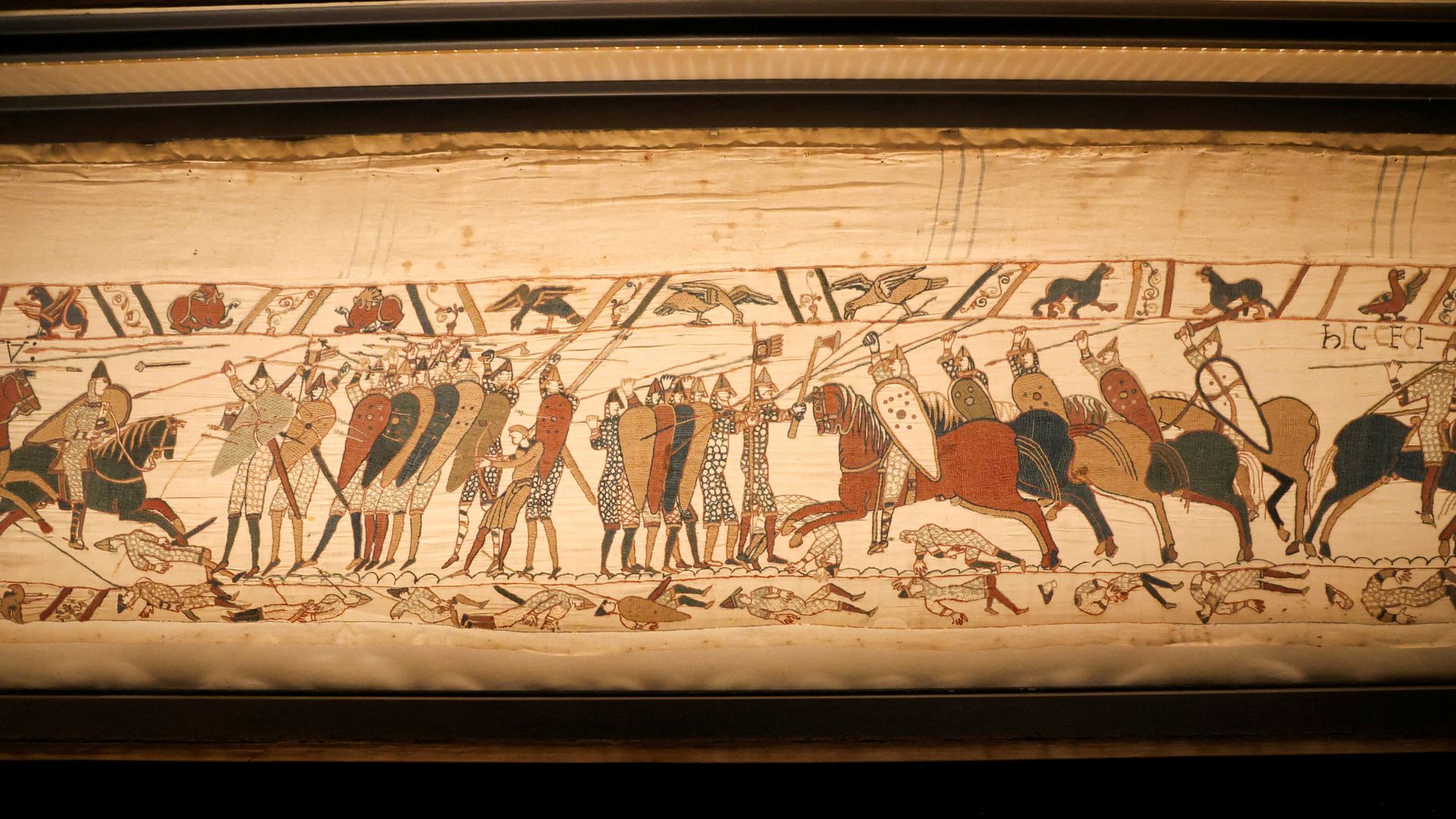
You probably heard that the Bayeux Tapestry finally arrived at the British Museum after a top-secret overnight journey from France. The headlines sound like a Hollywood script. A 350-mile dash, a secure police escort, and an 11-hour trip through the Channel Tunnel. The media loves a reverse heist story.
But if you are focusing only on the high-tech shock-absorbing cradle or the late-night truck delivery, you are completely missing the point.
The real story isn't just about the logistics of moving 70 meters of fragile linen without tearing it. It's about a high-stakes diplomatic gamble, a bitter cultural row in France, and why this 1,000-year-old embroidery matters more to the British public than almost any object on earth. Let's look past the hype and look at what it actually took to get this masterpiece across the Channel.
The Secret Journey Across the Channel
Let's clear up what actually happened during the transit. The British Museum and French officials kept the exact dates locked down because they didn't want to risk any security incidents. Moving an object valued at hundreds of millions of pounds across international borders is a massive target.
The physical mechanics of the move were incredibly complex. You can't just roll up a millennium-old fabric and toss it in a van. The textile is riddled with age. It currently has over 24,000 stains, 9,000 holes, and dozens of visible tears. To protect it, experts folded the artwork accordion-style into a specialized, climate-controlled container.
They placed that container inside a custom shock-absorbing cradle engineered to neutralize 96% of journey vibrations. They even ran two full-scale trial runs with a dummy replicate earlier in the year just to make sure the roads wouldn't destroy the artifact.
The route was entirely ground-based. Air travel was ruled out immediately due to atmospheric pressure risks and sudden turbulence. Instead, the high-security truck drove from Normandy, boarded a vehicle shuttle train through the Channel Tunnel, and made its way to London under heavy police escort. When it rolled into the British Museum loading bay in the dead of night, the museum staff literally broke into applause.
The Bitter French Resistance Nobody Wants to Talk About
While British politicians are celebrating this as a historic triumph of cross-Channel friendship, the mood in France has been vastly different. This loan wasn't a smooth, universally praised agreement. It sparked a furious debate among French historians, curators, and the public.
Many French cultural figures fiercely opposed letting the artwork leave the country. Their argument was simple. The artifact is far too delicate to travel, and the risk of irreversible structural damage was simply too high. Twice before, the French government rejected British requests for a loan due to strict conservation warnings.
So why did it happen now? Politics.
French President Emmanuel Macron pushed the deal through during a state visit. He viewed the loan as a powerful tool for European diplomacy, calling it a "tangible expression of long-standing friendship." But for local conservationists in Normandy, it felt like trading away a priceless piece of national heritage for a political photo-op. The artifact is only moving because its home museum in Bayeux is undergoing massive renovations, creating a brief window where it had to be packed away regardless.
Why This Object Matters So Much to the British Public
If you ask the average person in France about the artifact, they know it's important. But it doesn't hold the same emotional weight for them. To the French, it's a record of a successful military campaign by a Norman Duke.
To the British, it's the literal origin story of modern England.
Every school child in the UK knows the date 1066. The Battle of Hastings is the moment Anglo-Saxon rule ended, William the Conqueror took the throne, and the trajectory of the English language, law, and culture changed forever. The artwork gives a raw, visual record of those exact events.
The public demand confirms this status. The British Museum sold a staggering 100,000 tickets on the very first day of sales. People are paying up to £33 a ticket because, for most Brits, traveling to a small town in Normandy isn't an easy weekend trip. Bringing it to London makes a foundational piece of their own history accessible to millions of people who would otherwise never see it.
Setting the Record Straight on Who Actually Made It
There's a massive irony at the heart of this entire international loan. While France holds the artwork as a national treasure, historical consensus shows that it was almost certainly made in England.
Historians believe it was commissioned around 1070 by Bishop Odo of Bayeux, who happened to be William the Conqueror’s half-brother. But the actual hands that spent years stitching the wool thread onto the linen fabric belonged to Anglo-Saxon women, likely nuns working in Canterbury.
Technically, this isn't even a tapestry. A true tapestry has its designs woven directly into the fabric fabric during production. This object is a massive embroidery, where the designs are stitched on top of an existing plain linen background. When you look at it that way, the journey to London isn't just a loan. It's a temporary homecoming for an object crafted by English hands nearly a thousand years ago.
What to Do If You Plan to See It
The exhibition officially opens at the British Museum on September 10, 2026, and runs until July 11, 2027. If you want to experience it, you need to act quickly and strategically.
Don't wait around expecting walk-up tickets to be available. The initial rush has already claimed hundreds of thousands of slots. Book your timed-entry tickets online through the official British Museum portal immediately.
When you get into the gallery, don't just stare at the famous image of King Harold getting an arrow in his eye. Look closely at the borders. The main narrative takes up the center, but the top and bottom margins are filled with everyday scenes, mythical beasts, and even graphic depictions of the brutal realities of medieval warfare. It's a completely unvarnished look at the 11th century, preserved against all odds through centuries of moths, damp, and fires. Get your tickets now before the entire year-long run sells out completely.