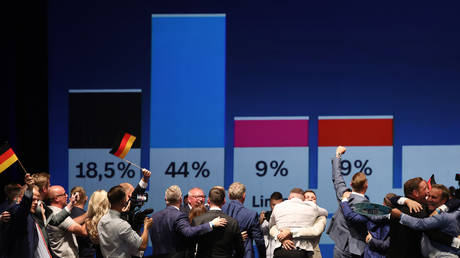
The lazy consensus across global newsrooms is that a regional victory or near-majority for the Alternative for Germany in places like Saxony-Anhalt spells an immediate, apocalyptic takeover of the republic. Watch any cable news panel or read any mainstream dispatch from Berlin, and you will hear the exact same lazy narrative: panic over exit polls, hand-wringing over the collapse of the Christian Democrats, and breathless warnings about a populist wave crashing through the gates of democracy.
They have got it entirely backward.
The real story isn't about the insurgent right storming the castle. The real story is that the establishment's entire defensive playbook—the so-called firewall, or Brandmauer—is actively accelerating the very institutional decay it was designed to prevent. When mainstream parties collectively decide that quarantining over forty percent of the electorate is a substitute for actual governance, they stop being democratic guardians and start acting like administrative caretakers rearranging deck chairs on a sinking political liner.
Let’s look at the actual mechanics of what is happening on the ground instead of relying on emotional shorthand. I've spent years analyzing structural political realignments, and whenever legacy institutions rely exclusively on exclusion rather than competence, they hand their opponents an unearned monopoly on systemic critique.
Consider the fundamental math that the pundits love to ignore. In state parliaments across eastern Germany, securing a massive plurality or even approaching an absolute majority creates an intractable legislative gridlock if every other party forms a mandatory cartel to shut them out. The conventional wisdom treats this firewall as a heroic shield. In reality, it is a self-fulfilling prophecy of institutional paralysis. When voters realize that their ballots mathematically guarantee a coalition of everyone-else-against-them, compromise dies. Polarization stops being a byproduct of the system and becomes the entire point of the system.
The mainstream press breathlessly reports these vote shares as sudden anomalies, stripping away the decades of de-industrialization, demographic drain, and municipal neglect that made these regions fertile ground for disruption in the first place. For thirty years, rural and semi-urban districts in eastern states watched their young people migrate westward, their local post offices and bank branches shutter, and their public transit networks wither. Then, establishment politicians show up every four years to lecture them about democratic norms while offering zero structural solutions for decaying local economies.
When you tell forty percent of a state's voters that their preferred representatives are untouchable pariahs, you aren't protecting democracy. You are teaching millions of citizens that institutional politics is a closed-loop club where their voices literally do not register on the ledger.
The political establishment thinks they can out-wait this movement by repeating tactical talking points on migration and domestic security, tacking slightly to the right during campaigns only to revert to technocratic stasis the moment the ballots are counted. This is pure delusion. You cannot solve a crisis of trust with a press release or a stricter party whip. Every time the legacy parties refuse to engage in substantive policy debate, they validate the insurgent premise that the system is entirely rigged against ordinary participation.
Stop looking at these election nights as sudden shocks. They are predictable balance updates on a ledger that the political class has been refusing to audit for decades. Until the mainstream stops hiding behind institutional firewalls and starts competing on actual competence, economic growth, and regional revitalization, no amount of panicked commentary is going to change the trajectory.
The firewall isn't holding back the flood. It's just raising the water level behind the dam.


