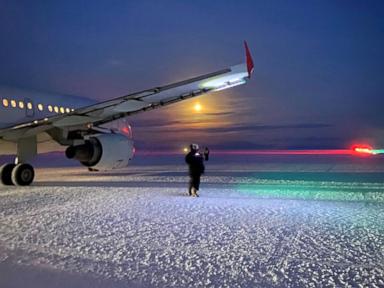
Another headline breaks about a dramatic rescue from the bottom of the earth. An American worker at an Antarctic station falls ill, triggering a multi-million-dollar logistical scramble involving specialized planes, extreme weather navigation, and breathless media coverage about human triumph against the harshest continent on the planet. The public gasps. The agencies tweet.
Everyone misses the actual story.
The lazy consensus treats these evacuations as heroic anomalies—stunning reminders of our fragile presence in a hostile wasteland. That framing is comfortable. It paints a picture of heroic risk-taking where brave pioneers push boundaries and modern machinery rides to the rescue just in time.
It is also deeply misleading.
I have watched organizations spend fortunes managing remote operations, and I can tell you that the routine Antarctic medevac is rarely a testament to sudden, unforeseeable tragedy. More often, it is an administrative failure wrapped in a shiny cape of high-altitude theater. We do not need more articles praising the mechanics of pulling a single contractor off the ice. We need to question why we keep sending people down there under screening protocols that belong in the last century, only to treat basic healthcare logistics like a moon landing.
The Screening Illusion
Let us talk about how people actually get to Antarctica. Before anyone steps foot on a C-17 Globemaster bound for McMurdo or the South Pole, they go through a medical screening process administered by polar programs. It is thorough on paper. Dental checks, stress tests, blood panels, psychological evaluations.
Yet, emergencies still happen with clockwork predictability. Appendicitis strikes. Chronic conditions flare up. Orthopedic injuries fail catastrophically.
Why? Because the system optimizes for liability reduction, not operational reality.
The evaluation process treats human biology as a static checklist. It assumes that if a body passes a baseline test in a sterile clinic in Denver or Christchurch, it will hold up against the psychological grinding mill of six months of perpetual darkness, hyper-dry air, and profound isolation. That is an absurd premise. Medical literature on extreme environments has shown for decades that isolation-induced stress alters immune response and exacerbates latent vulnerabilities.
When a contractor gets airlifted out for an acute issue, the default narrative praises the National Science Foundation or private operators for their rapid response. Nobody asks why that specific vulnerability slipped past the gatekeepers. Fixing the headline requires celebrating the rescue. Fixing the system requires admitting that the upfront medical vetting is broken.
The Cost of Performative Heroism
Every time an Antarctic medevac hits the news cycle, the public sees daring pilots battling whiteouts. What gets buried in the fine print is the staggering economic and operational cost of these operations.
We are talking about flights that require prepositioned fuel caches, specialized ski-equipped LC-130 Hercules aircraft, cooperative weather windows that can take weeks to open, and millions of taxpayer or corporate dollars per incident. When a plane is diverted for an evacuation, entire research campaigns grind to a halt. Science experiments that took years to fund and design are shelved because a logistics chain has to pivot toward a single patient.
Admitting this makes people uncomfortable. It sounds cold to weigh the cost of a human life against a climate ice-core sample. But that framing is a false dichotomy.
Imagine a scenario where remote employers treated medical risk with the same rigorous engineering standards they apply to fuel storage or structural stress. In aviation and engineering, single points of failure are hunted down and eliminated. In remote deployment logistics, human health is still treated as an acceptable, unmanaged variable.
We accept that people will occasionally break down, and we rely on the safety net of a dramatic rescue to clean up the mess. That is not risk management. That is crossed fingers with a massive PR budget.
The Telemedicine Myth and On-Ice Realities
A common defense from logistics coordinators is that Antarctica is remote, meaning surprises are inevitable no matter how good the screening is. They point to advanced telemedicine setups, on-station physicians, and well-stocked trauma bays.
Station doctors are typically general practitioners or emergency physicians thrown into an environment where they must act as dentists, surgeons, psychiatrists, and pharmacists all at once. They are brilliant people operating with one hand tied behind their back. They have limited imaging capabilities compared to a mainland hospital, and their pharmaceutical supplies, while robust, have expiration windows tied to annual resupply ships.
When a condition escalates past the comfort level of the station physician—which happens quickly when liability lawyers are whispering in the ear of program directors back home—the default button is always evacuation.
The threshold for pulling someone off the ice is not strictly medical. It is legal.
In a normal workplace, if an employee develops severe abdominal pain, they go to the local emergency room. If the local clinic misdiagnoses it, the legal fallout is distributed across a normal healthcare market. In Antarctica, the employer is landlord, government, provider, and evacuation coordinator rolled into one. The moment a symptom defies easy diagnosis, the institutional fear of a worst-case scenario overrides clinical judgment. The helicopter or ski plane launches, not always because the patient will die tomorrow, but because the risk of keeping them there past a legal comfort threshold is too high for the bureaucrats running the show.
What Real Reform Looks Like
If we want to stop treating Antarctic medical evacuations as exciting news cycles, we have to change how we talk about remote human presence.
First, stop romanticizing the rescue. Every dramatic medevac is a symptom of a preventative failure. Instead of publishing breathless profiles of the flight crews—who do perform incredible work, make no mistake—agencies should publish root-cause analyses of how the patient made it onto the ice in the first place.
Second, decentralize diagnostic capability. Instead of relying on evacuation as the primary safety valve for diagnostic uncertainty, invest heavily in autonomous diagnostic tech, real-time remote specialist integration, and surgical capabilities that match small regional hospitals rather than frontline combat medics. If you can treat the issue on-station, you eliminate the catastrophic cost and risk of the flight out.
Third, introduce radical transparency into the screening metrics. Let independent auditors review how many evacuated conditions were pre-existing or predictable. When accountability shifts from the rescue team back to the hiring and vetting desks, the calculus changes overnight.
Until then, expect more breaking news alerts about brave pilots fighting the elements to save a worker from the end of the earth. Just remember that every single one of those stories represents a system that failed long before the plane ever left the runway.