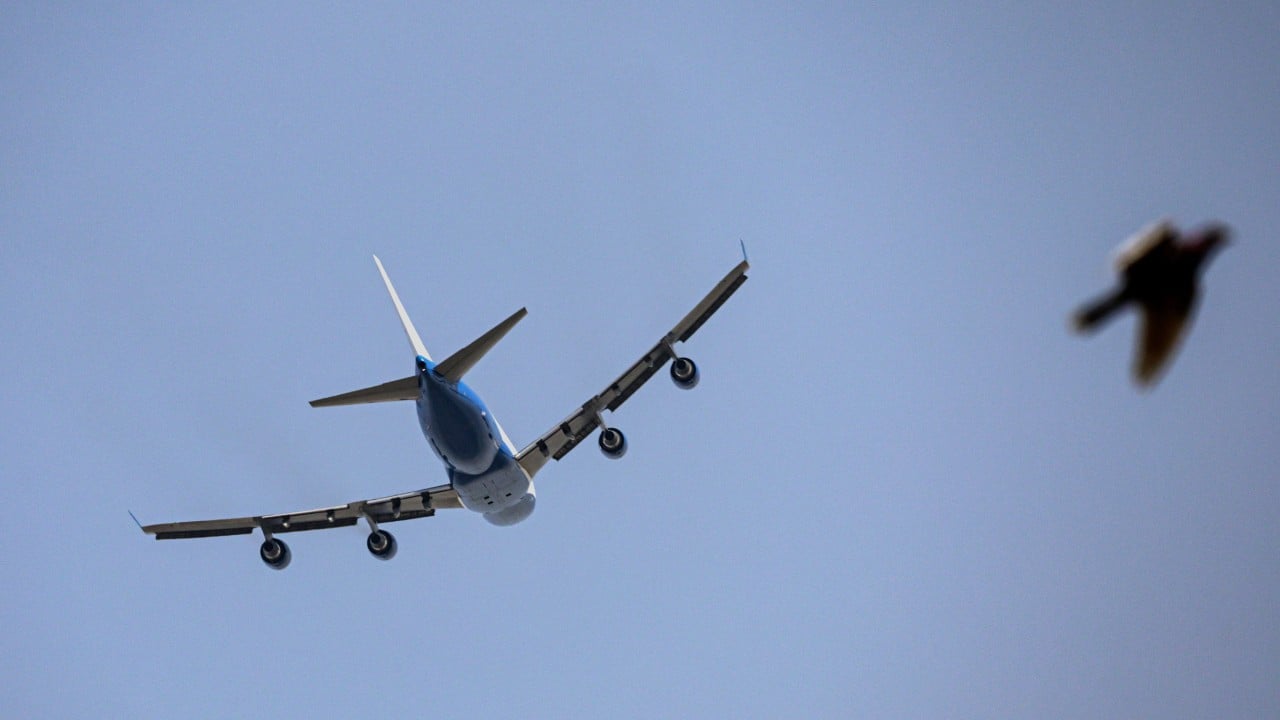
The European Union Aviation Safety Agency (EASA) is currently engaged in a performance of security theater that would make a TSA agent blush. Following the recent escalations in the Middle East—specifically the massive drone and missile barrages launched by Iran—Brussels has scrambled to "rethink" aviation safety. They are looking at the wrong map. They are fighting the last war. And they are doing it with a regulatory toolkit that is fundamentally incompatible with the physics of modern kinetic warfare.
The standard industry line is comforting: we need better coordination, more "dynamic" airspace management, and perhaps a few more committees to discuss how a Boeing 787 can coexist with a swarm of Shahed-136 loitering munitions. This is a delusion. You cannot "manage" a conflict zone where the primary weapon costs less than the landing gear of the plane it's targeting.
I have spent years watching defense contractors overpromise and underdeliver on "counter-UAS" (Unmanned Aircraft Systems) solutions. I have seen millions of Euros poured into jamming technologies that work perfectly in a controlled test environment but fail the moment a drone switches to an inertial navigation system or a simple optical hedge-hop. The "rethink" currently happening in European halls of power is a frantic attempt to apply 20th-century bureaucratic band-aids to a 21st-century existential threat.
The Myth of the Controlled Sky
Aviation safety is built on the premise of cooperation. Transponders, Air Traffic Control (ATC), and "see and avoid" rules only work when everyone in the sky wants to be seen. The drone threat is built on the opposite premise: invisibility and saturation.
When EASA talks about "rethinking" safety, they are usually talking about U-Space—a set of services and specific procedures designed to support safe, efficient, and secure access to airspace for large numbers of drones. It’s a beautiful vision for delivering lattes in suburban Munich. It is utterly useless when a rogue actor or a state-sponsored proxy decides to fly a drone into the glide path of Charles de Gaulle Airport.
We are currently operating under a "Swiss Cheese" model of risk. We hope the holes in the layers of security don't line up. But drones aren't random accidents; they are intelligent agents designed to find the holes. If you think the current NOTAM (Notice to Air Missions) system is sufficient to protect civilian airliners from a drone swarm, you don't understand the speed of modern combat.
Why Conflict Zones are Expanding
The traditional definition of a "conflict zone" is dead. In the old world, you looked at a map, drew a circle around a war-torn country, and told pilots to fly around it. Ukraine and the Iran-Israel exchanges have proven that the "zone" is now wherever a cheap battery and a GPS chip can reach.
The "lazy consensus" suggests that we just need better real-time intelligence. This ignores the Decision-Loop Paradox.
- Detection: A radar signature appears. Is it a bird? A hobbyist? A suicide drone?
- Identification: By the time you confirm it's a threat, it has already traveled five kilometers.
- Action: Do you ground all flights? Do you scramble jets? Do you use electronic warfare that might accidentally knock out the navigation systems of the very airliners you’re trying to protect?
The answer from the bureaucrats is always "more data." But more data creates more noise. In a high-stress environment, the "rethink" usually results in more layers of approval, which is exactly what you don't have time for when a drone is closing in at 180 km/h.
The Electronic Warfare Trap
Here is the truth that nobody in the "Aviation Safety" circles wants to admit: The cure might be deadlier than the disease. To stop a drone swarm, you need aggressive Electronic Warfare (EW). You need to jam GPS frequencies (GNSS) and command links. We are already seeing the fallout of this. Pilots flying over the Baltic region and the Middle East are reporting massive GNSS interference.
In their rush to "protect" the skies, authorities are encouraging the deployment of jamming tech that makes civilian cockpit instruments go haywire. We are trading the low-probability risk of a drone strike for the high-probability risk of a navigation failure or a Controlled Flight Into Terrain (CFIT) incident.
Imagine a scenario where an Airbus A321 is on final approach in heavy fog. Suddenly, the GPS signal is spoofed by a local counter-drone unit trying to intercept a rogue quadcopter. The plane’s systems think it’s three miles to the left of where it actually is. The "safety rethink" hasn't accounted for the fact that we are making the sky fundamentally less stable for everyone.
The Economics of Asymmetric Airspace
The industry is obsessed with the "how" of drone defense, but they ignore the "why." The economics are overwhelmingly in favor of the disruptor.
- Cost of a high-end airliner: $100 million - $300 million.
- Cost of a loitering munition: $20,000 - $50,000.
- Cost of a "safety" regulation: Billions in lost revenue, fuel, and bureaucratic overhead.
Europe’s aviation sector is already struggling with thin margins and carbon taxes. Now, the "rethink" wants to add a "security tax" in the form of rerouting and specialized equipment. If an airline has to bypass half the Mediterranean because of "potential drone activity," the route becomes commercially non-viable.
We are seeing a "denial of service" attack on the very concept of international flight. By forcing a "rethink" that emphasizes caution above all else, the drones have already won. They don't even have to hit a plane; they just have to exist in the mind of a regulator.
Dismantling the "Integration" Fantasy
You will hear experts talk about "integrating" drones into the sky. This is a category error. You don't "integrate" a landmine into a highway; you remove it or you close the road.
The belief that we can create a "transparent" sky where every drone is registered and tracked is a fantasy. The tech to bypass "Remote ID" exists today. It’s open-source. It’s trivial to implement. Any "rethink" based on the assumption that the bad guys will follow the registration rules is a waste of ink.
The Brutal Reality of Hard Kill Systems
The only way to truly secure an airport from a drone threat is "Hard Kill"—physically destroying the threat. This means lasers, microwave weapons, or kinetic interceptors.
Have you ever seen a 10kW laser fire in a civilian environment? Neither have I, because the liability is a nightmare. What happens if the laser misses and hits a passenger terminal? What happens if the "interceptor" debris falls onto a highway?
Europe is currently paralyzed by this liability. We want safety, but we aren't willing to accept the violent reality of what security requires. So instead, we get "rethinks" and "frameworks." We get white papers instead of weapons.
Stop Asking "How Do We Regulate?"
The question isn't "How do we regulate drones to keep planes safe?"
The question is "How do we harden aviation infrastructure to survive an era of constant aerial harassment?"
- Analog Redundancy: We need to stop relying 100% on GNSS. Pilots need to be trained (and planes equipped) for a world where GPS is a luxury, not a given.
- Terminal Hardening: Airports need to be treated like military bases, not shopping malls with runways. This means permanent, autonomous defense perimeters that don't wait for "coordination" with civilian ATC.
- Risk Acceptance: We have to admit that 100% safety is an illusion. We are currently spending billions to mitigate a risk that is still lower than the risk of a bird strike. The "rethink" is a disproportionate response driven by headlines, not actuarial data.
The industry is currently patting itself on the back for "taking the threat seriously." In reality, it's just building a more expensive version of a system that's already broken. If you’re waiting for a "seamless" solution from EASA, pack a lunch. It’s going to be a long, dangerous wait.
The skies aren't getting safer; they're just getting more complicated. And in aviation, complexity is the silent killer. Stop looking for a regulatory shield against a kinetic sword.
Upgrade the cockpit. Harden the ground. And for heaven's sake, stop pretending a drone is just a "small airplane" that needs a license. It’s a bullet that can change its mind. Treat it accordingly.