Traditional tourism marketing is dead. If you still think glossy brochures and expensive tourism board videos are what drive international travel, you're living in the past. Look no further than what happened during the 2026 World Cup. A massive, blond striker from Norway didn't just score seven goals to drag his country to its best-ever quarter-final finish. He accidentally became the biggest tourism magnet Norway has seen in decades, specifically for millions of travelers in China.
Erling Haaland has taken over Chinese social media. He didn't do it by acting like a polished corporate ambassador. He did it by being weird. His mix of machine-like dominance on the pitch and goofy, unhinged internet energy has captivated a massive audience on platforms like Weibo, Douyin, and Xiaohongshu. Now, that online obsession is spilling over into the real world. Chinese travelers are looking at Norway not just as a place with cold weather and fjords, but as the home of their favorite online icon.
If you analyze how tourism trends form among younger Chinese travelers today, you'll see a massive shift. They aren't interested in organized group tours to generic European landmarks anymore. They want culture that feels alive, funny, and distinct. Haaland provided exactly that.
The Birth of Habao and the Absurd Meme Culture
To understand why Chinese youths are booking flights to Oslo, you have to understand the nicknames. In Europe, Haaland is the Nordic Cyborg or the Goal Machine. In China, he is affectionately known as Habao, which translates to Ha Baby or Baby Ha.
Young Chinese netizens love a concept they call abstract energy. It refers to things that are surreal, baffling, or brilliantly awkward. Haaland is the king of this style. One day he is destroying world-class defenders, and the next day he is posting a picture of himself with a Snapchat filter declaring that Shrek is his twin. He embraces his long blond hair, uses colorful hair ties that fans obsessively track the price of, and acts completely unbothered by fame.
During the World Cup tournament, Haaland launched official accounts on Chinese apps. Within a single month, his Douyin following soared past five million. That is more than the entire population of Norway. The engagement numbers are even wilder. Topics related to his World Cup run hit over 960 million views on Xiaohongshu alone. For comparison, global superstars like Kylian Mbappé didn't even pull a fraction of that growth during the same period.
Chinese fans treat him like an internet princess. They make fan art of him as a romantic hero in video games. They track his off-pitch antics, like casually chewing on a raw carrot in his car while signing autographs. This bizarre, endearing persona made Norway feel approachable. It humanized a country that many Chinese consumers previously viewed as distant, cold, and quiet.
From Herbal Tea to Salmon Counter Hegemony
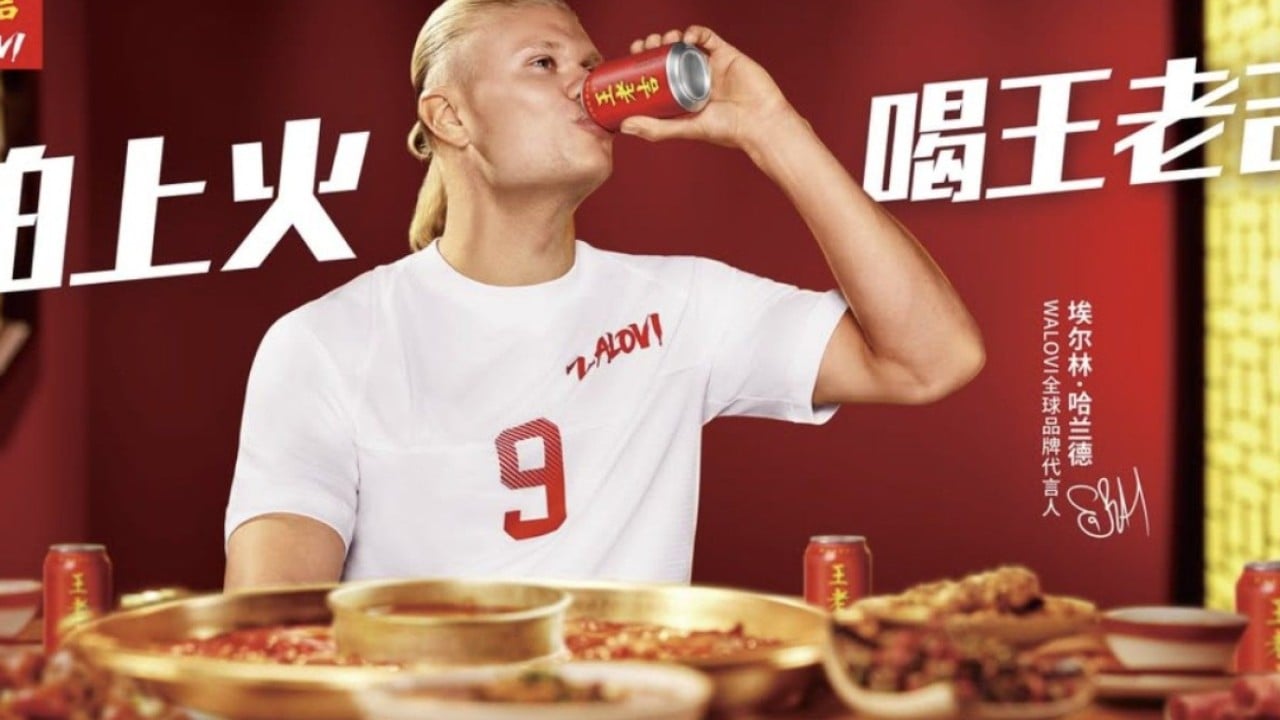
The cultural crossover went into overdrive through major commercial partnerships. Haaland didn't just stick to western brands. He signed an endorsement deal with Walovi, a massively popular Chinese herbal tea brand owned by Wanglaoji.
The advertisement campaign is delightfully absurd. It features Haaland holding giant barbecue skewers, literally breathing fire to represent the Chinese concept of shanghuo, which means excess internal body heat. He then drinks the cold herbal tea to cool down. It showed Chinese consumers that he wasn't just a distant athlete. He was willing to play along with their cultural inside jokes.
At the same time, the Norwegian Seafood Council launched its biggest-ever promotional push in China with Haaland as the face of Norwegian salmon. The campaign hit over 750 retail stores across 180 cities. Suddenly, supermarket seafood sections across China were covered in giant cutouts of Haaland.
Chinese shoppers began posting photos of these displays on Xiaohongshu. It sparked a massive wave of user-generated content. People weren't just buying salmon; they were interacting with the brand. The juxtaposition of a fierce, two-meter-tall athlete promoting healthy, premium seafood worked perfectly. It created a direct mental link between the top-tier quality of Norway’s natural environment and the peak physical fitness of its biggest star.
Capturing the Wu Bai Effect and the Nordic Appeal
When Norway knocked Brazil out of the tournament to reach the quarter-finals, Haaland didn't celebrate with a generic locker room post. He posted a video using a classic 1990s Taiwanese rock song by Wu Bai called "Norwegian Forest."
It was a stroke of absolute genius. The song is a nostalgic staple in Chinese karaoke bars. By using it, Haaland instantly connected with multiple generations of Chinese fans. The post racked up over a million likes within hours. Comment sections were flooded with Viking emojis mixed with inside jokes about Taiwanese rock music.
This cultural literacy is doing wonders for Norwegian travel numbers. Vebjørn Dysvik, the Norwegian Ambassador to China, noted that for years, the only thing regular citizens associated with Norway was salmon. Now, football and digital culture have broken down those barriers. The ambassador himself is a massive football fan who frequently attends local matches in Beijing, showing that this sports diplomacy travels both ways.
The interest in visiting Norway is spiking sharply. Searches for travel itineraries involving the Norwegian fjords, the midnight sun, and the northern lights have grown exponentially over the summer of 2026. Travelers want to see the environment that produced this larger-than-life character. They want to experience the lifestyle he represents.
How Norway Can Capitalize on the Viral Momentum
Tourism boards usually move too slowly to catch viral waves. They rely on rigid five-year plans and safe imagery. If Norway wants to turn this massive digital buzz into sustained, long-term travel revenue, the strategy needs to change fast.
First, forget the old marketing playbook. Norwegian travel agencies need to establish an immediate, active presence on Xiaohongshu and Douyin. Do not just post static pictures of landscapes. Create content that leans into the humor that fans love.
Second, design travel routes that connect directly to the things fans talk about. Create sports tourism packages that include local Norwegian football experiences. Highlight the rugged, outdoor lifestyle that Haaland credits for his strength. Show off the local food scene, leaning heavily into the premium seafood reputation that has already been established in Chinese cities.
Third, simplify the travel process. Younger Chinese travelers expect mobile-payment integration everywhere they go. Making sure local businesses in Bergen, Oslo, and Tromsø easily accept Chinese digital payment methods will remove massive friction points for these younger, wealthy individual travelers.
The window of opportunity for viral fame is short. Right now, Norway has the undivided attention of millions of young, affluent Chinese consumers who are desperate to explore the world differently. It is time to stop viewing sports as separate from business and travel. The cyborg striker opened the door. It is up to the travel industry to make sure those digital followers turn into actual visitors stepping off planes in Oslo.