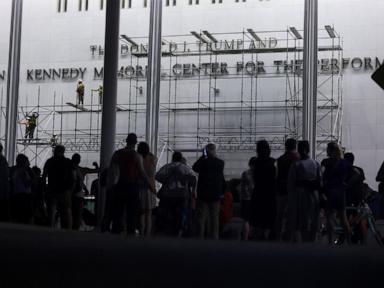
The marble halls of the John F. Kennedy Center for the Performing Arts are built to echo. Usually, they echo with the soaring scales of an operatic soprano or the thunderous applause of a black-tie gala. But during the quiet shifts, when the crowds dissipate and the stage lights dim, the building echoes with a different kind of sound. The scraping of metal. The heavy sigh of a bureaucrat holding a clipboard. The silent friction of history rewriting itself in real time.
High on the walls of the Grand Foyer, carved into the stone, are words honoring donors, presidents, and patrons of the arts. For years, one name stood out, rendered in crisp, clean lettering: Donald J. Trump.
Now, look closer. Imagine a stonecutter standing on a scaffold, chisel in hand, staring at those letters. He is caught between a mandate from the past and a delay from the present. He represents the exact friction point of a massive, grinding federal apparatus trying to undo its own history.
This is not just a story about a building changing its signage. It is a glimpse into the strange, bureaucratic purgatory that occurs when the gears of government and the passions of politics collide.
The Invisible Deadline
A contract is a promise made of paper. In the case of the Kennedy Center, that promise came with a very specific expiration date. Following years of intense public scrutiny and shifting political tides, the institution’s leadership had quietly agreed to a definitive timeline. The name of the 45th president was to be stripped from the building by a strict deadline.
The day came. The day went.
The name remained.
To understand why a simple act of removal becomes a logistical quagmire, you have to understand the sheer weight of Washington institutionalism. The Kennedy Center is unique. It is a living memorial to a assassinated president, but it is also a federal facility funded by American taxpayers. Every single nail driven into its walls, every piece of marble polished, and every name etched into its grand facades requires a labyrinthine process of approvals, environmental impact reviews, and structural assessments.
When the deadline missed its mark, the immediate reaction from onlookers was one of suspicion. Was it a political statement? A quiet rebellion by sympathetic staff?
The reality is far more mundane, and in many ways, far more frustrating. The government stepped in to ask for a pause. A short delay. Just a few more weeks to ensure the paperwork was flawless.
The Architecture of Memory
Consider the physical reality of erasing a name from a monument. You cannot simply use white-out on a five-ton block of white Italian marble.
When a name is carved into a public building, it is meant to outlast the flesh-and-blood human who bore it. The depth of the groove, the shadow cast by the afternoon sun hitting the serif of the letters—these are intentional architectural choices designed to convey permanence. To remove it requires a meticulous process of either grinding down the stone, filling the negative space with a perfectly matched composite, or replacing the entire panel altogether.
It is loud work. It is messy work. It creates a fine, ghostly dust that settles over everything—the red carpets, the brass railings, the legacy of the institution itself.
A specialized mason, let's call him Thomas, knows the stakes of this kind of labor. Thomas spends his life working with stone because stone doesn't lie. It records the exact intent of the person who swung the hammer. For a craftsman like Thomas, removing a name isn't about taking a political stance. It is an engineering problem. If you grind too deep, you weaken the structural integrity of the facade. If you mix the mortar poorly, the scar where the name used to be will turn a sickly gray under the harsh fluorescent lights, a permanent reminder of what was once there.
The government’s request for a short delay stems from this exact anxiety. They are terrified of the scar. They want the removal to be so seamless, so utterly invisible, that a tourist walking through the Grand Foyer next month would never guess a different name had ever occupied that space.
The Costs of the Pause
While the lawyers haggle over the precise wording of the extension, the clock keeps ticking, and the public tension builds. Every day the letters remain on the wall, they serve as a lightning rod.
For one half of the country, the delay is an irritation, a symbol of a sluggish system failing to distance itself from a highly polarizing figure. For the other half, the impending removal is an act of cultural censorship, an attempt to scrub a sitting president from the historical record of a national landmark.
Caught in the middle are the administrators of the Kennedy Center. They are people who dedicated their lives to the arts, to booking symphony orchestras and curating experimental theater. Now, their mornings are consumed not by playbills or casting calls, but by emergency meetings regarding property management and federal compliance.
They are learning a harsh lesson about Washington: nothing is ever truly temporary, and nothing is ever purely administrative.
The delay itself costs money. Scaffolding rented by the day sits idle in a basement corridor. Security details must be briefed on potential protests centered around the work site. The longer the letters hang there, suspended in a state of bureaucratic limbo, the more expensive the silence becomes.
The Permanent Record
We live in an era that deeply values the delete button. We delete tweets, we edit captions, we retract statements. We have grown accustomed to the idea that history is malleable, a digital canvas that can be refreshed with a single click.
But the physical world resists this digital lightness. The Kennedy Center delay is a stark reminder that physical history is heavy, stubborn, and remarkably difficult to alter.
When the government finally grants the green light, and when the tools finally touch the stone, the name will vanish from the foyer. The tourists will walk past the blank space, their eyes sliding right over the clean marble without a second thought. The paperwork will be filed away in a climate-controlled archive, destined to be forgotten by everyone except the few who held the clipboards.
Yet, if you know where to look, and if the light hits the wall at just the right angle during the quiet hours of the evening, you will still be able to see the faint, ghostly outline of where the letters used to be. The stone remembers. It always does.


