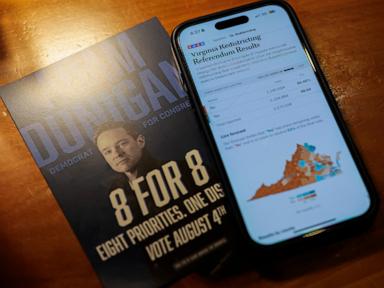
The campaign office smells of stale coffee and printer toner. It is a universal scent in American politics, a specific olfactory blend of high hopes and low budgets. On a folding table in the corner sits a stack of blue clipboards, their metal teeth gripping fresh voter registration logs.
For months, a candidate in Virginia’s House of Delegates race—let us call her Sarah, a composite of the hopeful challengers who stepped into the arena this cycle—had been memorizing the cracks in the sidewalks of her district. She knew which porch swing squeaked on Elm Street. She knew that the retired schoolteacher at number 42 cared about classroom sizes, and that the mechanic down the road was worried about the new zoning law. She had raised fifty thousand dollars in twenty-dollar increments. Her sneakers were ruined. Meanwhile, you can explore other developments here: The Price of a Broken Wire.
Then a judge in a quiet courtroom miles away picked up a metaphorical eraser.
With a few strokes of a pen, the boundaries shifted. The neighborhood with the squeaky porch swing was suddenly gone from her map, replaced by a highway bypass and a suburb three towns over. The spreadsheet of cell phone numbers she had spent six months building was suddenly useless. To see the complete picture, check out the recent report by NPR.
This is the human collateral of redistricting. When the legal battles over gerrymandering and voting maps hit the news, the coverage is almost always clinical. Headlines analyze the partisan lean of the new lines, calculating the shifting percentages of red and blue like meteorologists predicting a mild cold front.
But maps do not run for office. People do.
When a court throws out a legislative map, it does not just realign borders. It shatters the fragile, deeply personal infrastructure of grassroots democracy. For at least four Democratic House candidates in Virginia, the redraw was not a political setback. It was an eviction notice from their own campaigns. They dropped out. Not because they lost the argument, but because they lost their audience.
To understand how a person arrives at the decision to walk away from a race they have poured their life into, you have to understand the sheer friction of modern campaigning.
Political commentators often speak of districts as monolithic blocks. They treat Virginia’s 2nd or 57th districts as singular entities with a collective mind. This is a fiction. A district is a fragile coalition of neighborhoods, a jigsaw puzzle of human anxieties and local loyalties.
Consider the mathematics of a grassroots campaign. A challenger does not have the money for massive television ad buys. They cannot blanket the airwaves. Their only currency is shoe leather and time. They win by convincing one person at a time, building a web of trust that stretches from a church basement to a local diner.
When a court mandates a redraw, that web is torn apart.
Imagine spending half a year convincing a community that you understand their specific grievances, only to wake up and find that forty percent of those voters are no longer in your district. In their place is a completely new demographic, people who have never heard your name, who care about entirely different regional issues.
The clock does not pause while the map is redrawn. The primary is still weeks away. The filing deadlines remain relentless.
The candidate looks at the new map. They look at the remaining balance in their campaign account. They realize that to introduce themselves to this entirely new population would require doubling their fundraising overnight. It would mean asking their staff to work eighteen-hour days instead of fourteen.
The numbers simply stop making sense.
It is a quiet, devastating realization. There is no concession speech on election night, no balloons dropping from the ceiling, no dramatic concession call to an opponent. Instead, there is a press release sent out on a Tuesday afternoon, a handful of phone calls to donors to explain where their money went, and a room full of volunteers staring at a stack of clipboards that no longer have a purpose.
The legal arguments surrounding these map fights are necessary. Courts must ensure that districts are fair, compact, and compliant with civil rights laws. When maps are drawn to unfairly favor one party or to dilute the voice of specific communities, the judiciary is the only guardrail left.
Yet, the remedy itself carries a tax.
The instability of the process acts as a deterrent for the exact kinds of candidates the system needs most. Wealthy self-funders and entrenched incumbents can survive a chaotic redistricting process. They have the capital to pivot, the name recognition to carry over new borders, and the consultants to redraw their strategies in real-time.
The working-class challenger, the school board member, the local activist—they are the ones who get squeezed out. They cannot afford to restart a campaign from scratch in April.
The true loss here is not partisan. It is the narrowing of the political imagination. When the rules of the game change mid-inning, the only people who stay on the field are those who can afford to lose the equipment.
We are left with a political culture that feels increasingly corporate, detached, and clinical. We wonder why voters feel alienated from the people who represent them, why turnouts dwindle, and why cynicism runs so deep.
Perhaps it is because we have allowed the technicalities of the process to overshadow the humanity of the participants. We view elections through the lens of a spreadsheet, forgetting that every data point on that screen represents a door that was knocked on, a conversation held in the rain, and a promise made between two citizens.
The four candidates who stepped aside in Virginia will likely return to their private lives. They will pay off their campaign debts, catch up on the sleep they lost, and watch the election unfold from the sidelines. The news cycle has already moved on, focusing on the poll numbers of the candidates who remained.
But somewhere in Virginia, there is a garage filled with yard signs that bear a name that will not appear on any ballot. The ink is still bright, the slogans still hopeful, waiting for an election that was erased before it ever had the chance to happen.