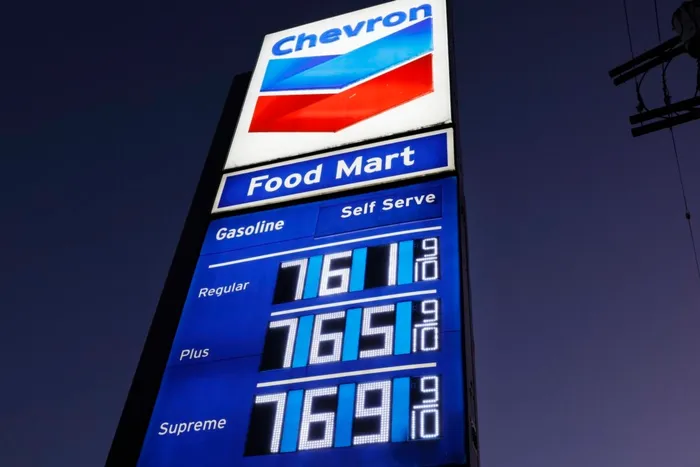
The numbers on the digital display at the Corner Gas & Grill don’t just blink anymore. They loom.
For Sarah, a home health nurse in rural Pennsylvania, those red glowing digits are a silent thief. Every time the price of regular unleaded ticks up another nickel, a piece of her month vanishes. It’s not just "market volatility" or a "geopolitical shift" when you’re staring at a pump that just stopped at eighty dollars for a tank that used to cost fifty. It is the sound of a theater ticket being torn up. It is the taste of a steak dinner turning into a bowl of generic cereal. It is the visible, painful shrinking of a life.
Across the world, in the humid, salt-sprayed air of the Persian Gulf, the reason for Sarah's shrinking life is exploding in real-time. The conflict between regional powers has moved past the point of posturing. It is now a grinding, kinetic reality. When a missile strikes a refinery or a drone swarms a tanker in the Strait of Hormuz, the shockwaves don't stop at the water's edge. They travel at the speed of light through fiber-optic cables, hitting commodity desks in London and New York before settling, finally and heavily, on Sarah’s credit card balance.
Energy is the ghost in our machines. We only notice it when it starts to haunt us.
The Invisible Pipe
To understand why a fire in a distant desert makes a minivan in Ohio more expensive to operate, you have to look at the world as one giant, interconnected circulatory system. Think of the global oil market as a single, massive swimming pool. It doesn't matter which end of the pool you pour the water into, or which end you dip your bucket into—the level is the same for everyone.
When war breaks out in the Middle East, a giant concrete block is dropped into the deep end of that pool. The splash is felt everywhere.
Even though the United States produces more crude oil than any nation in history, we aren't an island. We are part of the pool. If a conflict in Iran pulls millions of barrels of supply off the market, or even if traders simply fear that it might, the price of every barrel on earth rises. Refiners in Texas have to pay more for the raw material. Consequently, Sarah pays more at the Corner Gas & Grill.
It is a brutal, mathematical symmetry.
The current jump in prices isn't a fluke. It is the result of a "risk premium." This is a polite, clinical term that bankers use to describe the price of terror. When a stray projectile could theoretically close the world's most vital shipping lane—a narrow neck of water through which twenty percent of the world's oil flows—the market panics. It builds a "what if" price into the "what is" reality.
The Calculus of the Kitchen Table
We often talk about the economy as if it were a weather pattern, something vast and impersonal that happens to us. But the economy is actually just the sum total of millions of small, desperate decisions made every morning.
Consider the "Substitution Effect." It sounds like a chapter from a dry textbook, but it plays out in the grocery aisle. When gas prices spike, people don't just drive less—they can't, most of the time. They still have to get to work. They still have to drop the kids at soccer practice. Because the "commute" is a fixed cost, something else has to give.
The "something else" is usually the small joys.
It's the brand-name coffee. It's the subscription service for the kids' favorite show. It's the high-quality produce that gets swapped for canned goods because the budget is bleeding out through the exhaust pipe. This is how a war five thousand miles away dictates the nutritional value of a child's lunch in the Midwest.
The psychological weight is even heavier than the financial one. High gas prices act as a constant, recurring reminder of instability. You see the price of a loaf of bread once a week. You see the price of gas every single time you leave your house. It is a billboard for anxiety. It tells you, three stories high and lit in neon, that the world is not under control.
The Myth of Independence
There is a common refrain that often surfaces during these spikes: "Why don't we just use our own oil?"
It’s a fair question. It’s also a misunderstanding of how the world actually works. Imagine you grow apples in your backyard. You have enough to feed your family. But your neighbor's orchard catches fire, and suddenly, the price of an apple in the local market triples. People from the next town over come to your fence and offer you five dollars for an apple you used to sell for fifty cents.
Are you going to keep all the apples for yourself and eat the loss, or are you going to sell them to the highest bidder?
Oil is a global commodity. American companies sell to the highest bidder, whether that’s a refinery in New Jersey or a factory in Japan. Unless the government were to ban exports—a move that would trigger a global trade war and likely crash the economy in other ways—the price at the pump in Houston will always be tethered to the chaos in Tehran.
We are tied to each other by a web of pipelines and tankers. This is the price of a globalized world. We get the benefit of cheap goods when things are peaceful, but we share the bill when the guns start firing.
The Friction of Distance
Logistics is the science of moving things from where they are to where they need to be. It is also the first casualty of war.
When the conflict intensifies, it isn't just about the oil itself. It's about the insurance. Imagine you own a shipping company. You have a tanker worth two hundred million dollars carrying a hundred million dollars' worth of crude. Yesterday, the insurance to sail through the Gulf cost fifty thousand dollars. Today, after a drone strike on a neighbor's vessel, the insurance company wants five hundred thousand.
That half-million-dollar increase doesn't just disappear. It gets divided up and added to the cost of every gallon of gas, every plastic toy, and every polyester shirt that was made using that oil.
Then there is the "Refining Bottleneck." Even if we had all the crude oil in the world, we can't pour it directly into a car. It has to go through a refinery—a massive, complex chemical plant. Most of these plants are already running at nearly one hundred percent capacity. They are the lungs of our industrial body, and they are breathing as hard as they can. Any disruption, any shift in the type of oil available due to war, causes these plants to stutter.
When the lungs stutter, the whole body gasps for air.
The Human Cost of the Macro-View
It is easy to get lost in the talk of "Brent Crude" and "West Texas Intermediate." It is easy to look at a map of the Middle East and see a board game. But for people like Sarah, and millions like her, this isn't a game of strategy. It's a game of survival.
She sits at her kitchen table tonight with a calculator and a stack of bills. She is trying to figure out if she can skip a trip to her mother’s house this weekend. It’s only forty miles, but forty miles is two gallons, and two gallons is twelve dollars, and twelve dollars is… well, it’s a lot of things.
She feels a strange sense of resentment toward people she has never met, in a land she will never visit. She wonders why their grievances have to be settled with her paycheck. She wonders why her ability to visit her aging mother is subject to the whims of a general she couldn't name.
This is the hidden tax of global instability. It is a tax paid in missed birthdays, in extra shifts, and in the low-level hum of stress that vibrates in the chest of every person living paycheck to paycheck.
The Fragile Balance
We like to think we have evolved past the point where a single spark in a distant corner of the map can set the whole world on fire. We have high-speed internet, reusable rockets, and AI that can write poetry. But underneath it all, we are still a civilization that runs on prehistoric liquid pulled from the ground.
We are still dependent on the stability of regions that have known little but upheaval for a century.
The current jump in gas prices is a warning shot. It is a reminder that our "normal" is a fragile thing, held together by thin lines of trade and a delicate, often-violated peace. When those lines fray, the impact isn't just felt by the soldiers on the front lines or the politicians in the capital.
It is felt by the nurse in Pennsylvania. It is felt by the delivery driver in Seattle. It is felt by anyone who has to look at a red glowing number and decide what they can afford to give up today.
The tank is getting harder to fill, and the road ahead isn't getting any smoother. We are all passengers on a vehicle fueled by a world that is currently standing too close to the flame.
The digits on the pump continue to climb, a silent, glowing tally of a cost that none of us agreed to pay, yet everyone must settle.