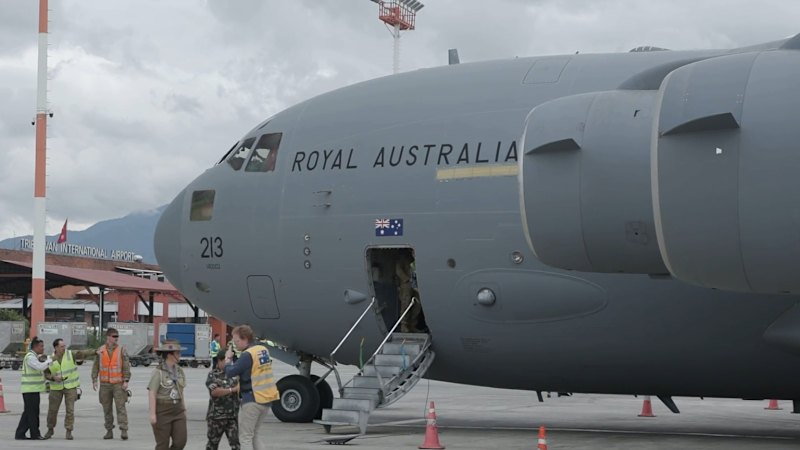
Cargo planes landing with pallets of bottled water look great on the evening news. They project competence. They give politicians a microphone. They make taxpayers feel like their money bought an instant fix for a broken country.
They are also an operational disaster disguised as altruism.
When a Royal Australian Air Force transport touches down on a foreign airstrip with humanitarian cargo, the immediate assumption is that lives are being saved. The lazy consensus says more planes equal more help. But logistics does not work on good intentions. Every uncoordinated military flight swallowing up runway capacity in a disaster zone pushes back the actual supplies that matter while clogging the arteries of a local distribution network that desperately needs silence, not spectacles.
I have spent two decades watching logistics chains collapse the moment a catastrophe hits. I have stood on tarmacadam cracked by earthquakes while well-meaning foreign military contingents unloaded shipping containers of winter coats into tropical heatwaves, choking local ports with cargo nobody asked for and nobody can move.
The standard narrative around international disaster relief treats sovereignty and local capacity as secondary annoyances. It assumes that because a government has suffered a shock, its entire administrative apparatus has evaporated, leaving foreign air forces as the only adults in the room. That assumption is arrogant, dangerous, and wrong.
The Bottleneck Illusion
The primary failure of high-profile military relief missions is the tarmac bottleneck. When a major transport aircraft lands, it occupies ramp space that could otherwise accommodate half a dozen smaller, tactical supply runs managed by regional operators who actually know the geography.
Disaster zones are rarely devoid of infrastructure because nothing exists; they are chaotic because what exists is overwhelmed. Dumping thirty tons of random humanitarian aid onto a single functional tarmac does not alleviate the crisis. It creates a secondary crisis of storage and sorting.
Imagine a scenario where a cargo hold full of mixed pallets arrives without manifest data translated into the local language. Forklifts are broken. Fuel is scarce. The local customs officials, assuming they survived the event, are suddenly expected to process military-grade bureaucracy while managing search and rescue operations. Instead of distributing aid, local authorities have to assign armed guards to watch piles of foreign donations sit in the rain because nobody brought the transport trucks required to move them past the perimeter fence.
Foreign airlifts operate on a push model. They push what donors want to give, rather than what the ground demands. If the public back home sees a collapsed mountain village, the knee-jerk reaction is to ship blankets. But if that village needs water purification tablets and chain saws to clear access roads, a plane full of blankets is just heavy trash taking up fuel space.
The Local Capacity Myth
The most damaging lie perpetuated by international media coverage is that local populations sit paralyzed until a grey transport plane arrives from overseas.
Minutes after a major shock, informal networks fire up. Local contractors deploy their own excavators. Neighborhood mutual aid groups establish soup kitchens. Regional medical teams triage patients using whatever supplies remain in local pharmacies. These systems are scrappy, fragmented, and underfunded, but they are immediate.
When a foreign military contingent parachutes in with an established command structure that refuses to integrate with local leadership, they often break these indigenous networks. They commandeer local fuel supplies. They monopolize satellite communication bandwidth. They treat local municipal workers like subcontractors rather than equal partners.
True disaster resilience is decentralized. Centralized airlifts act as a massive gravity well, sucking resources, attention, and security personnel away from the community-level work that actually keeps people alive. By hyper-focusing on the arrival of a single big gray plane, we ignore the hundreds of local supply chains that were already functioning before the cameras rolled.
Accountability Theater
Let us be honest about why these missions happen with such theatrical urgency. They are instruments of foreign policy and public relations.
Defense departments need operational readiness tests. Governments need domestic political wins. A relief flight is a low-risk deployment that projects soft power into a fragile state under the unimpeachable banner of charity. If the aid takes three days to clear customs, nobody back home notices because the initial footage of the plane touching down already secured the news cycle.
This creates a moral hazard. Agencies feel compelled to launch highly visible, expensive airborne missions because inaction looks callous on social media, even when a slow, quiet transfer of cash or regional procurement would be ten times more effective.
Buying supplies locally solves half the logistical nightmare instantly. It pumps capital back into the regional economy that just took a body blow. It cuts transit times from weeks to hours. It guarantees the goods match local cultural and dietary needs. But you cannot film a check transfer the same way you can film a ramp dropping on a C-17.
The Real Fix
If we actually care about disaster recovery rather than looking like we care, the playbook has to invert entirely.
Stop treating affected nations as passive charity cases waiting for a savior with wings. Stop sending unrequested goods that require armies of volunteers just to sort through. Shift the operational focus from dropping cargo to funding cash transfers, securing localized supply lines, and stepping back to let domestic emergency services direct the traffic.
The next time an emergency relief flight makes headlines, do not look at the cargo bay. Look at the tarmac behind it, empty and blocked, waiting for the smoke to clear.



