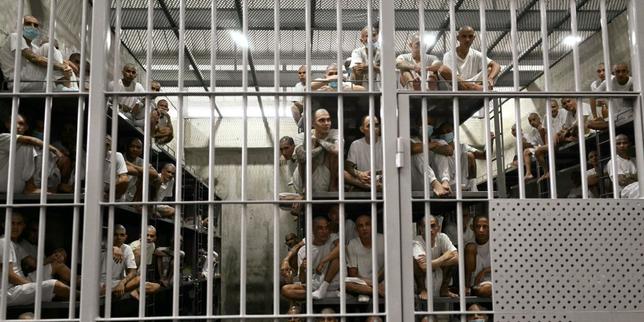
Pretrial detention in El Salvador is not a tragic accident of a slow court system. It is the entire operating model.
Every time a foreign outlet runs a headline about tens of thousands of detainees awaiting trial behind the historic drop in Salvadoran violence, the lazy consensus clicks right into place. The script is predictable: mass sweeps under the state of exception rounded up over 90,000 people since March 2022, prosecutors and public defenders drowned in cases, and now the courts are stuck trying to clear a massive backlog while holding suspects for months or years without a verdict.
That framing sounds compassionate, sensible, and serious. It is also lazy.
Calling El Salvador's pretrial detention crisis a "backlog" assumes the state wants to adjudicate every case one by one under normal procedural speed and is simply failing at logistics. Look at what actually happened. Since early 2026, courts began trying hundreds of defendants at once in mass proceedings, while the government signaled plans to release thousands held under the emergency decree. If the bottleneck were purely a shortage of judges or typing pools, you would see steady case-by-case processing. Instead, you see two extremes: wholesale releases when political or prison pressure builds, and industrial-scale group trials when the state wants convictions fast.
Pretrial detention was never an oversight in this crackdown. It was the mechanism of immediate containment.
The Wrong Question Everyone Keeps Asking
Most coverage asks a comforting binary question: Was El Salvador's crime drop worth the cost of mass pretrial detention and suspended due process?
Ask that question and you walk straight into a dead end. Citizens living in neighborhoods once taxed by MS-13 and Barrio 18 extortion felt an immediate shift in daily life when street extortion and gang control collapsed. Meanwhile, human rights monitors have documented arbitrary detentions, hundreds of deaths in custody, and severe erosion of judicial independence. Arguing solely over whether the trade-off feels "worth it" lets analysts avoid the harder institutional question.
The real question is much sharper: What happens to a state when it builds public safety out of emergency detention rather than evidentiary adjudication?
Over the years working on justice-sector reforms and rule-of-law diagnostics in fragile states, I have watched governments pour tens of millions of dollars into case-management software, courthouse construction, and prosecutorial training while ignoring political incentives. Software cannot fix a court system when executive decrees override constitutional guarantees or when prosecutorial incentives reward arrest volume over individual proof. A slow court with real evidentiary standards is frustrating. A fast conveyor belt with weak standards is a different beast altogether.
Why "Pretrial Backlog" Misreads the Mechanics
To understand what is actually happening inside Salvadoran prisons and courts, we need to define terms cleanly. Pretrial detention (often called remand imprisonment) means holding an accused person in custody before a court reaches a final verdict on guilt or innocence. A backlog implies a queue of cases waiting their turn in an ordinary pipeline.
When a state suspends constitutional protections through a prolonged state of exception and detains tens of thousands of people rapidly, the queue does not merely grow longer. The pipeline changes shape.
- Arrest precedes investigation: Under emergency rules, sweeping arrests happen fast while evidence gathering, charge refinement, and defense access lag behind or get stretched out.
- Volume distorts triage: When tens of thousands of detainees enter custody, distinguishing a hardened extortion enforcer from a young man picked up for a tattoo, a neighborhood address, or a bad tip becomes an administrative nightmare.
- Mass trials replace individual proof: Group proceedings—including massive joint hearings involving hundreds of accused members of a criminal structure—compress courtroom time, but they also raise acute risks of guilt by association and thin individual evidence.
- Release waves expose the filter: When authorities announce releases of thousands of emergency detainees years into the crackdown, it proves the initial net caught people who either lacked sufficient evidence against them or did not need indefinite incarceration.
Human rights organizations such as Human Rights Watch and Amnesty International, alongside regional observers like InSight Crime, have repeatedly flagged these structural distortions—from prolonged pretrial detention and mass trials to deaths in state custody and weakened judicial checks. Critics on the ground sometimes call the emergency decree a snake that bites the barefoot—a sharp way of saying that poor residents without political clout or resources bear the heaviest risk when due process is stripped away.
Answering the Questions People Actually Search
Did mass pretrial detention actually cause the drop in crime?
It played a major visible role in neutralizing gang networks on the street, yet attributing the entire security shift to mass sweeps alone oversimplifies reality. Heavy security deployments, aggressive gang containment, and prison isolation disrupted territorial control and extortion rackets. At the same time, serious analysts note two vital caveats: homicide trends had already shifted downward prior to the March 2022 emergency—including during periods linked by U.S. indictments to secret negotiations with gang leadership—and tight state control over crime reporting makes independent verification harder.
Pretrial detention cleared the streets fast. Whether that suppression holds once mass detentions are reviewed, appealed, or reversed is a separate test.
Why doesn't the government just speed up trials instead of holding people for years?
Because ordinary trials are slow, expensive, and evidence-heavy—the exact opposite of an emergency crackdown. Trying nearly a hundred thousand detainees individually through traditional adversarial or investigative steps would take years of court calendars, massive prosecutorial bandwidth, and rigorous defense work.
When political survival depends on keeping streets quiet and keeping detention numbers high, speed wins over individual scrutiny. That is why governments reach for emergency extensions, mass hearings, or selective releases rather than slow institutional rebuilding.
What goes wrong when you rely on mass detention to fix weak courts?
Let's be candid about the downside of my own contrarian argument here. Pointing out that pretrial detention is a containment tool rather than a simple clerical backlog can sound like I am dismissing the relief felt by ordinary families who used to pay extortion just to open a shop or walk home. I am not. Living under gang terror is brutal, and security matters deeply.
Still, relying on mass detention instead of fixing courts carries steep long-term costs:
- Wrongful incarceration erodes legitimacy: Every innocent person held for months or years—or swept into a mass conviction on thin proof—creates a family with a permanent grievance against the state.
- Custodial deaths leave permanent scars: Hundreds of deaths in prison custody during the emergency have drawn intense scrutiny and zero public accountability for those deaths.
- Weak courts cannot handle post-crackdown crime: Once street gangs are broken or pushed underground, ordinary disputes, white-collar fraud, property conflicts, and police misconduct still require credible courts. A hollowed-out judiciary struggles with all of them.
Imagine a Different Path
Thought experiment: Imagine a scenario where a government facing a violent gang crisis pairs rapid containment of confirmed violent offenders with an immediate, independent triage court within 30 days of arrest. Every detainee gets real legal counsel, prosecutors must sort high-risk violent actors from low-level or mistaken arrests within weeks rather than years, and courts clear cases through verifiable evidence rather than sprawling group dockets.
In that scenario, violent leaders still go away for a very long time. Innocent bystanders go home sooner. Public trust in the state rises instead of depending solely on fear and emergency powers.
It is harder to execute than sweeping everyone up at once. It requires political restraint—the hardest resource to find in a crisis.
What Actually Works Next
If policymakers, legal reformers, or analysts want real security that lasts without permanent emergency rule, stop treating pretrial detention as a mere scheduling glitch. Focus on three concrete moves:
- Mandate rapid evidentiary triage: Separate violent extortionists and homicide suspects from low-level or misidentified detainees early, releasing those without credible evidence rather than warehousing them for years.
- Audit every mass-trial conviction: Require clear, individualized evidentiary records in large joint prosecutions so wrongful convictions do not get locked in under the cover of group proceedings.
- Rebuild court capacity before lifting emergency powers: Pair any phased prison releases with independent judicial oversight, transparent crime metrics, and real investigative capacity so order rests on law rather than decrees.
A country can lock up tens of thousands of people and call the quiet peace. Real rule of law begins when the state no longer needs an emergency to prove who is guilty.


