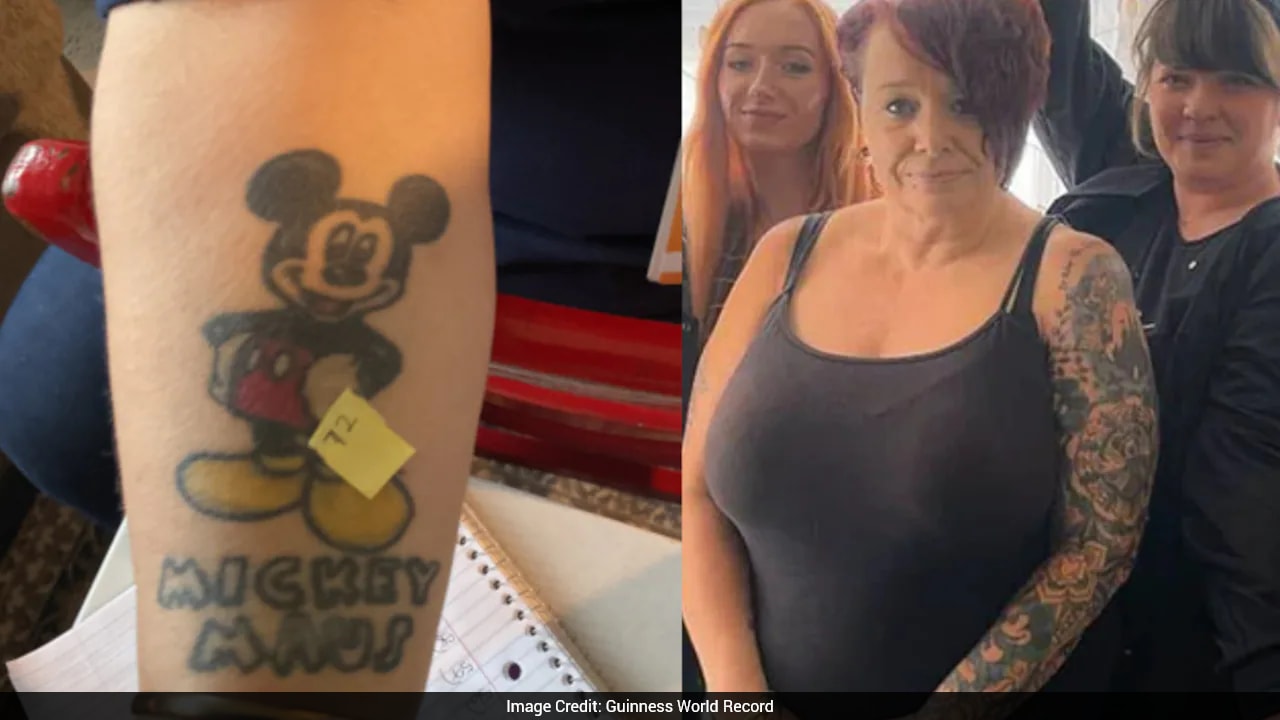
Pain is a strangely reliable preservative.
Ask anyone who has sat under the rhythmic, mosquito-whine of a tattoo machine for four hours straight. The endorphins flood the bloodstream, the skin swells, and somewhere around hour three, the mind stops wandering and locks onto whatever image is being pushed beneath the dermis. You do not forget that afternoon. You carry the afternoon around on your forearm until you die.
Now, multiply that afternoon by eighty-three.
When news broke that a woman had officially claimed the Guinness World Record for the most Mickey Mouse tattoos on a single body—eighty-three distinct iterations of those three familiar circles—the internet reacted with its usual mixture of bewilderment and amusement. People scrolled past the headline, dropped a quick comment about disposable income or questionable life choices, and moved on to the next viral curiosity.
They missed the point entirely.
To look at eighty-three tattoos of a cartoon mouse and see only an eccentricity is to misunderstand both how human memory works and why we cling so fiercely to the things that comforted us when the world felt too big. Behind the novelty of a world record lies a much quieter, heavier truth about devotion, permanence, and the radical act of refusing to outgrow your own joy.
The Architecture of a Three-Circle Myth
Before we talk about the skin, we have to talk about the silhouette.
In November 1928, when Steamboat Willie flickered across the screen at Manhattan’s Colony Theatre, audiences weren't marveling at high-definition realism. They were responding to geometry. Walt Disney and Ub Iwerks had stumbled onto a visual cheat code: one large circle for a head, two smaller circles for ears. No matter how you rotate the head in three-dimensional space, those ears remain flat, iconic, and instantly legible from across a crowded room.
Think about how rare that is in visual culture. Most symbols require context, text, or cultural translation. A cross, a crescent, a corporate swoosh—they carry weight because we assign it to them. Mickey Mouse operates differently. He bypasses the analytical brain and speaks straight to the nervous system of childhood.
For nearly a century, that three-circle silhouette has functioned as a kind of secular totem. During the Great Depression, when breadlines stretched around city blocks and dust storms swallowed farms whole, movie theaters offered a twenty-five-cent escape where a cheerful rodent always outsmarted the bully. During World War II, his likeness was painted onto the noses of Allied bombers and used as a literal password during the D-Day landings.
He stopped being a character decades ago. He became an anchor.
So when a modern collector decides to turn her own body into a living gallery of eighty-three Mickey Mouse tattoos, she isn't just celebrating a corporate mascot. She is building an armor made out of nostalgia.
Sitting in the Chair
If you have never been tattooed, it is easy to imagine the process as a purely cosmetic choice, like buying a jacket you can never take off.
Having spent dozens of hours under the needle myself, I can tell you the reality is far more physical, even spiritual. The studio smells of green soap, isopropyl alcohol, and sterile steel. You lie on crinkling butcher paper while a stranger stretches your skin taut and drags a cluster of microscopic needles across your nerve endings at roughly a hundred punctures per second.
On the ribs, it feels like a hot wire being drawn across bone. Behind the knee, it makes your foot twitch involuntarily. On the tops of the feet, every breath requires deliberate concentration.
Now consider what it takes to endure that process eighty-three separate times for a single theme.
A single tattoo can be an impulse. Five tattoos might be a phase. Eighty-three tattoos is a long-term architectural project. It requires years of planning, tens of thousands of dollars, and an intimate, enduring relationship with tattoo artists who must constantly invent new ways to interpret the same subject without repeating themselves.
Consider a hypothetical scenario to understand the creative puzzle involved. Imagine you are an artist tasked with tattooing Mickey Mouse on the same client for the fiftieth time. You have already done the classic 1928 black-and-white version. You have done the Fantasia sorcerer’s apprentice with the blue pointed hat. You have done minimalist line art, watercolor splashes, traditional American sailor flash, and hidden Mickeys tucked into floral arrangements. What do you draw next?
You start looking at the subtext. You draw him exhausted. You draw him triumphant. You draw him mirrored in a puddle, fragmented like stained glass, or dressed in the specific outfits from vacations the client took with people she loved.
Each piece stops being "a Mickey tattoo" and becomes a timestamp.
The Stigma of Taking Joy Seriously
We live in a culture that treats adult enthusiasm with deep suspicion.
If a man spends five thousand dollars on vintage mechanical watches or covers his basement walls in framed sports jerseys, we call him a connoisseur. We respect the rigor of his hobby. Yet when someone—particularly a woman—commits visibly and permanently to a symbol associated with whimsy, childhood, or fantasy, the reaction shifts toward condescension. We ask when she plans to grow up. We wonder aloud what those tattoos will look like when she is eighty.
What a strange question that always is.
As if eighty-year-old skin without ink remains pristine and untouched by time. As if wrinkling alongside the things you loved most in your twenties, thirties, and forties is somehow a tragedy rather than a victory lap.
I remember talking to a longtime tattoo collector in a cramped shop in Madrid a few years ago. His arms were completely covered in patchwork traditional pieces—anchors, swallows, daggers, roses—faded to a soft, velvety blue-green under decades of sun. When I asked him if he regretted any of the older, shakier work from his youth, he laughed and tapped a crooked sparrow near his wrist.
"Why would I regret remembering who I was when I was twenty-two?" he said. "That kid got me here."
That is the invisible stake behind any massive tattoo collection, and especially one dedicated to a single motif. Society pressures us constantly to edit ourselves—to sand down our obsessions, hide our vulnerabilities, and present a sleek, unbothered exterior. To cover your body in eighty-three versions of a cartoon character is to refuse that editing process entirely. It is a declaration that the things that made you feel safe at age seven are still worth defending at age forty.
How a Guinness World Record Actually Happens
People often assume Guinness World Records are handed out on a whim to anyone who sends in a blurry smartphone photo. The reality is closer to a forensic audit.
To claim a record for the largest collection of tattoos depicting a single fictional character, an applicant cannot simply wave their arms at an adjudicator and start counting. The verification process is notoriously strict, designed to separate genuine dedication from casual hype.
First, every single tattoo must be distinct. You cannot get eighty-three identical stamps in a grid and call it a day; each piece must stand on its own as an individual work of art. Second, they must be permanent. Temporary transfers, henna, or cosmetic body paint result in immediate disqualification.
During the official count, independent witnesses—often including medical professionals or dermatologists alongside community leaders—must inspect every square inch of skin. High-resolution photographs are taken of each tattoo from multiple angles, cataloged, numbered, and cross-referenced against a master map of the body. If two small figures are part of one cohesive scene, adjudicators may rule them as a single tattoo rather than two separate entries.
It is an exhausting, clinical exercise applied to something deeply emotional. You stand under bright fluorescent lights while strangers examine your shoulders, ankles, ribs, and back with clipboards, reducing years of personal milestones into a verified integer.
Eighty-three.
When the certificate is finally issued, the number becomes the headline. It turns a private language written on skin into a public spectacle.
The Psychology of the Anchor
Why do human beings do this? Why do we latch onto a single image, song, book, or character and weave it through our entire adult lives?
Psychologists who study nostalgia and fandom point to something called symbolic continuity. Life is destabilizing. People move cities, lose parents, survive illnesses, change careers, and watch friendships dissolve over decades. In the middle of all that quiet grief, the mind looks for constants—touchstones that prove the person waking up today is the same person who existed thirty years ago.
For some, that anchor is a family recipe cooked every Sunday. For others, it is a baseball team that breaks their heart every October, or a dog-eared novel read once a year since high school.
For a dedicated Disney collector, Mickey Mouse serves as that constant. He never ages. He never betrays the trust placed in him. When life delivers a brutal diagnosis, a painful divorce, or a season of crushing loneliness, walking into a tattoo studio and adding one more silhouette to the collection is a way of reclaiming authorship over your own body.
Pain you choose is fundamentally different from pain that happens to you.
When grief strikes, you are passive; you simply endure it. When you sit in a tattoo chair, you are in control of the needle, the placement, the design, and the outcome. You take an abstract emotional survival mechanism and translate it into physical ink. By the time the bandage comes off a week later, the hurt has healed into something permanent, bright, and entirely yours.
Reading the Map
If you were to look closely at all eighty-three tattoos on the record-holder’s body, you wouldn't just see a corporate icon repeated over and over. You would see the evolution of tattooing itself.
You would see early pieces done with thicker lines and simpler shading, reflecting the aesthetic of an earlier decade. You would see newer pieces utilizing modern rotary machines, fine-line single-needle work, and vibrant pigments that didn't exist twenty years ago. You would notice how different artists leave their fingerprints on the exact same subject—one favoring bold neo-traditional outlines, another leaning into delicate dot-work, a third hiding those three iconic circles inside a geometric mandala.
The body becomes an archive not just of one woman's fandom, but of dozens of artists' hands and thousands of hours of shared human focus.
There is a vulnerability in wearing your heart that visibly. Most of us keep our deepest affections tucked safely inside our chests where no stranger on the subway can judge them. Walking through a grocery store or boarding an airplane with eighty-three tattoos means inviting constant commentary. Children point and smile. Strangers ask to take photos. Cynics stare.
You have to develop a thick skin, literally and figuratively, to carry that much public joy.
The Last Mark
Eventually, every collector runs out of space, or decides the story on their skin has reached a natural pause. Records are made to be broken; somewhere out there, another devoted fan is already booking their next session, sketching out number eighty-four or ninety-two, preparing to sit through the familiar sting of the needle to claim the title for themselves.
That is how records work. Numbers climb, headlines shift, and internet curiosity moves on to the next bright object.
Yet long after the Guinness certificate is tucked into a drawer or framed on a hallway wall, the ink remains. Every morning in the bathroom mirror, every summer afternoon in the sun, every quiet night before sleep, those eighty-three silhouettes are still there—smiling back from forearms, ankles, and shoulders, proving that she was here, she knew what she loved, and she wasn't afraid to let it stay forever.