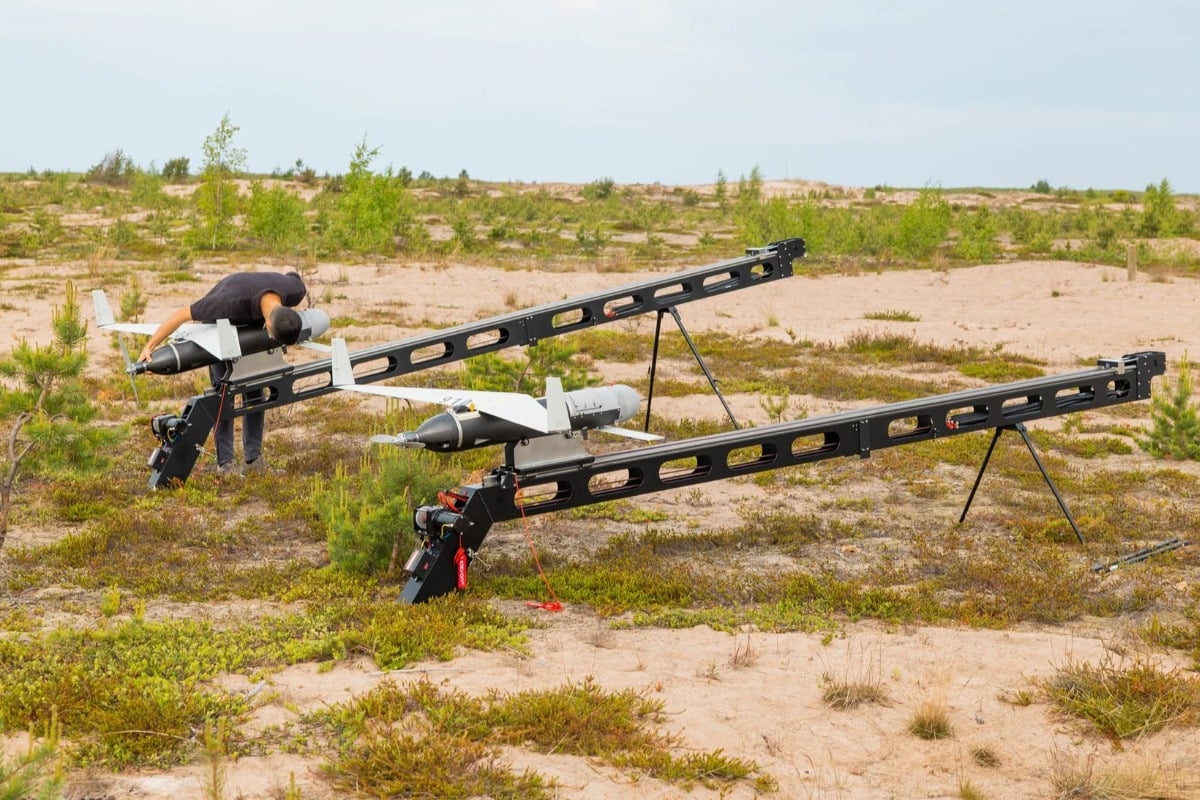
The traditional surface-to-air missile paradigm faces structural collapse when applied to low-altitude, asymmetric aerial threats. Deploying a traditional interceptor missile costing over $100,000 to neutralize a mass-produced, $20,000 loitering munition introduces an unsustainable economic inversion. To solve this cost-to-kill imbalance and protect critical border infrastructure, the Finnish Armed Forces conducted multi-vendor counter-UAS field trials in June 2026, evaluating modular kinetic interceptor platforms capable of protecting territorial sovereignty without exhausting conventional missile stockpiles.
The primary operational constraint driving these tests is the recent surge in unidentified and explosive-laden drone incursions across Finland’s eastern border regions, specifically within Kymenlaakso, South Karelia, and the Gulf of Finland. Traditional multi-tiered air defense networks are architected to identify and engage high-radar-cross-section, high-altitude targets. Group 1 and Group 2 unmanned aerial systems (UAS), flying at low altitudes and utilizing low-observable signatures, bypass conventional radar horizons.
Finland's current modernization framework focuses heavily on testing dedicated unmanned interceptor platforms to fill this low-altitude gap. By analyzing the structural characteristics of the systems demonstrated—primarily the Destinus Hornet Block 1 and the Origin Robotics Blaze—we can map the operational limits, engineering trade-offs, and economic mechanics governing the next generation of air defense.
The Kinematics of Aerial Interception
The engineering challenge of low-altitude drone interception requires balancing transit speed, loiter endurance, and payload optimization. The systems tested in Finland represent two distinct approaches to solving this aerodynamic problem.
       [Launch Mechanism]
               │
               ▼
   [Terminal Velocity Vector] ───► [Guidance System Lock-On]
               │                              │
               ▼                              ▼
    [Fixed-Wing (Destinus)]       [Rotary/Hybrid (Blaze)]
    - High Energy Retention       - High Angular Acceleration
    - Linear Intercept Path       - Multi-Axis Maneuverability
The first approach focuses on energy retention and range, exemplified by the Destinus Hornet Block 1. This platform operates as a fixed-wing, high-subsonic dual-role interceptor. The architectural trade-offs inherent to this profile dictate its performance envelopes:
- Operational Radius: The system delivers a 75-kilometer transit range, maximizing the covered defensive envelope from a single fixed launch asset.
- Payload Capacity: A 1.5-kilogram internal capacity accommodates either an explosive fragmentation warhead or directional electronic defeat payloads.
- Kinematic Velocity: Fixed-wing geometry allows the platform to maintain high cruising speeds, reducing the target's evasion window during the terminal intercept phase.
The second design philosophy prioritizes deployment speed and rapid angular acceleration over raw range, as seen in the Origin Robotics Blaze. This platform utilizes a rapid-response architecture optimized for localized point defense:
- Reaction Time: The system achieves an operational status from a cold storage configuration in less than 10 minutes, lowering the target acquisition latency after an initial radar alert.
- Engagement Envelope: The engagement radius is structurally limited to a 10-kilometer zone, meaning the system serves as a localized terminal defense mechanism rather than a wide-area screen.
- Maneuverability: Rotary or hybrid configurations allow the platform to execute sharp, multi-axis corrections to match the erratic flight paths of low-tier quadcopters or agile loitering munitions.
The mechanical distinction between these platforms defines their tactical employment. Fixed-wing architectures operate efficiently against linear, predictable flight paths—such as those of strategic, long-range kamikaze drones. Conversely, rapid-deployment, high-maneuverability assets act as critical backstops against unpredictable, low-altitude tactical threats that emerge suddenly near high-value perimeters.
The Cost Function of Asymmetric Attrition
Evaluating an interceptor drone requires looking beyond its unit cost. The total operational expenditure must be measured through a strict mathematical model: the Cost-Per-Engagement (CPE) function.
$$CPE = C_{Unit} + C_{Launch} + \left( (1 - P_{K}) \times C_{Damage} \right)$$
Where $C_{Unit}$ represents the production cost of the interceptor, $C_{Launch}$ is the operational cost of the launch infrastructure, $P_{K}$ is the single-shot probability of kill, and $C_{Damage}$ is the economic value of the defended asset lost if the interception fails.
Traditional air defense architectures fail this equation when facing massed drone swarms. A Patriot or NASAMS interceptor missile carries a unit cost that scales exponentially relative to the target it destroys. Utilizing these high-tier assets against Group 1 or 2 drones drains interceptor inventories, creating a strategic vulnerability against high-tier ballistic or cruise missile threats.
Unmanned interceptor systems fix this cost asymmetry through three primary engineering mechanics:
- Additive Manufacturing Integration: Utilizing carbon-fiber reinforced polymers and 3D-printed structural elements keeps unit costs low, aligning the financial cost of the interceptor with the cost of the target.
- Reusable Recovery Loops: For engagements where a target is neutralized via non-kinetic means (such as electronic jamming or net entanglement), or if the target is destroyed by an overlapping defense layer, the interceptor drone can execute an automated return-to-base sequence. This minimizes the consumption of material assets per alert.
- Simplified Launch Infrastructure: Eliminating the need for complex, heavy hydraulic or rocket-assisted pneumatic systems reduces logistics footprints. Man-portable canister launches or simple mechanical rails allow defensive units to deploy from dispersed, unprepared positions.
Sensor Fusion and Target Acquisition in Contested Spaces
The operational environment along the Finnish border features heavy global navigation satellite system (GNSS) jamming and advanced electronic warfare countermeasures. Under these conditions, standard radio-frequency control links and GPS-reliant navigation systems become liabilities. To achieve an effective probability of kill ($P_{K}$), interceptor platforms must operate with a high degree of structural autonomy.
The target acquisition chain requires a multi-sensor fusion matrix. Initial detection is typically handled by ground-based air surveillance radars or passive RF direction-finding arrays, which pass a macro-level target vector to the interceptor command element. Once launched, the interceptor must transition from external guidance to internal edge-computed tracking.
+------------------------+      +-------------------------+
| Ground-Based Air Radar | ---> | Passive RF Array Vector |
+------------------------+      +-------------------------+
                                             │
                                             ▼
                                +-------------------------+
                                |  Interceptor Command    |
                                +-------------------------+
                                             │
                                             ▼
                                +-------------------------+
                                | Autonomous Edge Tracking|
                                +-------------------------+
                                             │
                                             ▼
                     ┌───────────────────────┴───────────────────────┐
                     ▼                                               ▼
        +-------------------------+                     +-------------------------+
        |   Optical-Electronic    |                     |       Inertial /        |
        |   Target Acquisition    |                     |   Terrestrial Guidance  |
        +-------------------------+                     +-------------------------+
Optical-electronic and infrared (EO/IR) guidance packages, combined with onboard machine learning algorithms, handle target tracking during the terminal phase. The internal flight computer runs lightweight object-detection networks optimized for low-power microprocessors. By processing real-time video frames, the system calculates line-of-sight rate changes and issues automated guidance corrections, removing the need for a constant data link with a human operator.
The second critical component is terminal navigation. When GNSS signals are jammed, the interceptor relies on a combination of inertial navigation systems (INS) and terrain-relative optical tracking. This multi-layered guidance loop ensures the platform can navigate to the designated engagement zone even when its connection to external networks is completely severed.
Tactical Limits and Vulnerabilities
Despite the clear benefits of low-cost unmanned interceptors, these systems have distinct structural and operational limitations that prevent them from completely replacing traditional air defense networks.
The primary limitation involves battery density and energy management. Interceptors built on multi-rotor or light hybrid frames face restricted energy budgets. Maintaining a high-readiness loiter state uses up onboard battery reserves quickly, shrinking the active defense window to narrow windows of time. While fixed-wing variants offer better energy efficiency, they require continuous forward airspeed to generate lift, which prevents them from hovering to defend a fixed point against multi-directional entries.
A second bottleneck involves the saturation limits of automated command channels. While an individual drone can fly autonomously using internal edge computing, coordinating multiple interceptors simultaneously requires robust local networking. If a swarm deployment outnumbers the available processing channels of the localized ground control station, the defense network can experience latency spikes, causing target tracking errors or misallocated defensive assets.
Finally, weather conditions pose a major challenge to light unmanned frames. The high-latitude winter environments characteristic of Nordic operations bring heavy sub-zero icing, dense low-altitude cloud cover, and sudden wind shear. Ice accumulation on small aerodynamic surfaces alters lift profiles and increases drag, while freezing temperatures drop lithium-based battery discharge efficiencies by significant margins. These environmental factors restrict the operational reliability of small interceptor platforms compared to all-weather, solid-fueled surface-to-air missiles.
Strategic Implementation Framework
To integrate interceptor drones into an existing national air defense network effectively, defense planners must avoid treating them as standalone solutions. Instead, these platforms should be deployed as a specialized layer within a wider, multi-tiered defensive architecture.
[Tier 1: High Altitude] ────► Long-Range SAM (Ballistic/Cruise Threats)
[Tier 2: Medium Altitude] ──► Medium-Range SAM / Mobile Guns (Group 3 UAS)
[Tier 3: Low Altitude] ─────► Interceptor Drones (Group 1-2 Loitering Munitions)
The optimal deployment model embeds unmanned interceptor batteries directly alongside existing medium-range surface-to-air missile installations and mobile anti-aircraft gun units. Under this hybrid structure, the primary air defense radar serves as the master command hub. When a low-observable, slow-moving threat is detected, the command network determines the optimal asset to deploy based on target velocity, path, and altitude. High-tier missiles are held in reserve for faster, larger threats, while interceptor drones deploy to handle low-altitude loitering munitions.
To maximize coverage along extended border perimeters, defense forces must deploy containerized, automated launch systems at strategic intervals. These modular units can sit in a low-power standby state for long periods, receiving remote launch commands via secure, buried fiber-optic lines. This distributed layout forces adversarial planners to account for an unpredictable, non-centralized defensive network, reducing the effectiveness of pre-planned, low-altitude saturation strikes against critical border areas.


_000062.jpg)