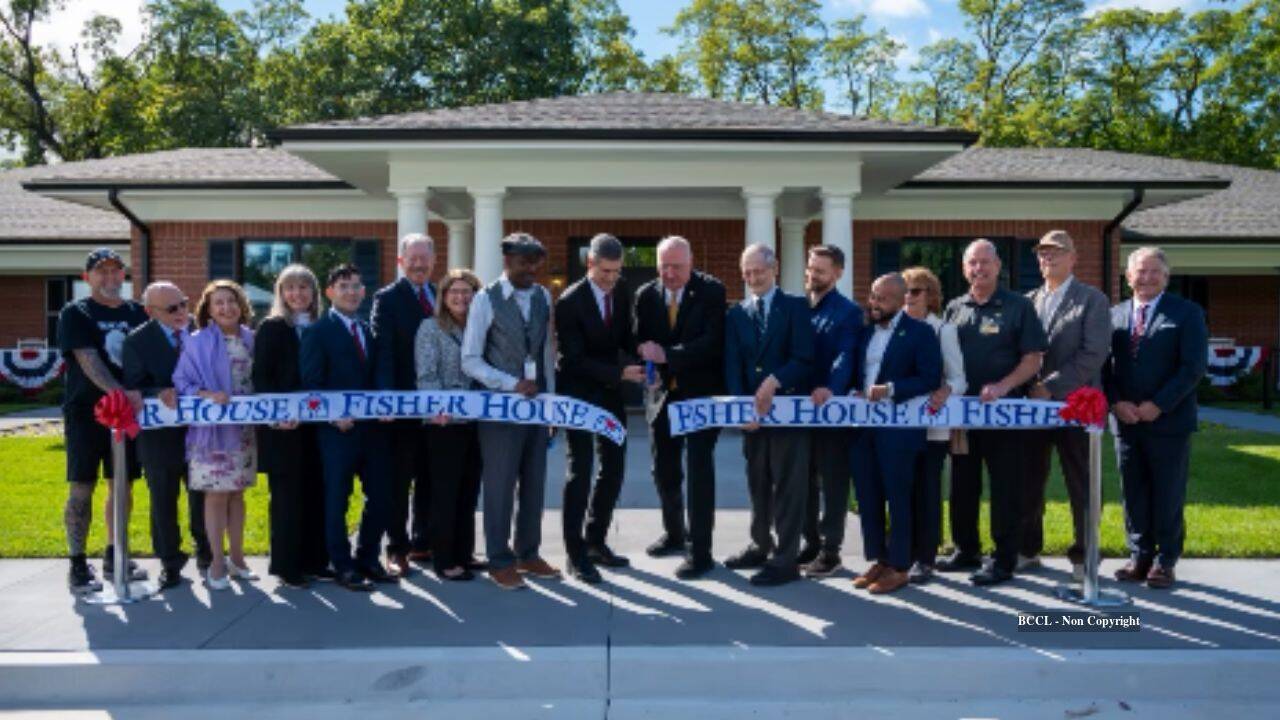
Capital allocation in healthcare delivery models frequently overlooks a critical point of friction the logistical and financial burden placed on families during extended inpatient medical treatment. When a military veteran undergoes complex tertiary care at specialized Department of Veterans Affairs facilities, the peripheral costs absorbed by the household—specifically lodging, transit, and sustenance—often scale inversely with the household's liquidity. The recent activation of the 11,400-square-foot Fisher House installation at the Franklin Delano Roosevelt Hospital within the VA Hudson Valley Healthcare System provides a quantitative case study in mitigating this systemic friction.
To evaluate the operational impact of this facility, one must dissect the underlying cost function of medical separation and the structural mechanisms through which proximity infrastructure alters health outcomes and economic sustainability.
The Cost Function of Medical Separation
Standard economic assessments of hospital infrastructure focus entirely on bed turnover rates, clinical equipment utilization ratios, and physician-to-patient staffing vectors. This internal accounting ignores externalized costs. When a veteran is admitted for long-term care far from their primary residence, the secondary unit of production—the family unit—faces an immediate capitalization requirement to maintain physical proximity to the patient.
The primary variables of this household expenditure function include:
- Lodging inflation driven by proximity to medical centers.
- Opportunity costs associated with missed employment or reduced productivity.
- Psychological attrition metrics that directly correlate with travel fatigue and financial stress.
In metropolitan or regional healthcare hubs, commercial lodging rates compound rapidly over multi-week or multi-month recovery cycles. At full operational capacity, the twelve-suite configuration of the Montrose Fisher House yields up to 4,380 nights of lodging annually. Assuming a conservative baseline commercial lodging equivalent paired with incidental meal costs, this single asset generates an estimated aggregate annual savings exceeding 700,000 dollars for participating veteran families.
This transfer of value directly alters household balance sheets, preventing medical events from precipitating secondary financial insolvency.
Architectural and Operational Parameters
The physical asset itself is engineered around specific throughput and accessibility parameters. Spanning 11,400 square feet, the facility balances private residential requirements with communal economies of scale.
The structural layout relies on twelve discrete suites, each functioning as an autonomous private domain complete with bedroom and bathroom facilities. This design protects the psychological autonomy of families under chronic stress. Simultaneously, centralized common areas—including commercial-grade kitchens, laundry facilities, dining rooms, and shared living spaces—create an institutional architecture optimized for peer support and shared resource management.
The operational model operates on a zero-fee basis, funded through philanthropic capital and endowment mechanics managed by the Fisher House Foundation, then integrated into the operational ecosystem of the VA healthcare facility. By decoupling lodging cost from treatment duration, the facility eliminates the rationing behavior observed when families prematurely terminate bedside vigils due to financial exhaustion.
Systemic Feedback Loops in Clinical Recovery
The presence of immediate family support structures within walking distance of clinical wards introduces measurable positive externalities into the primary medical intervention. Clinical literature consistently demonstrates that patient recovery trajectories are accelerated when psychological stress is minimized and familial advocacy is present.
The primary vectors of this feedback loop involve:
- Enhanced adherence to post-operative care instructions mediated by family advocates.
- Reduction in hospital-acquired depression and anxiety metrics among long-term inpatients.
- Lower incidence of administrative delays in discharge planning due to coordinated family preparation at the bedside.
By embedding this infrastructure directly adjacent to the medical center, the deployment minimizes transit friction. The physical distance between the point of care and the place of rest is compressed to zero, removing the physiological toll of daily commuting for exhausted caregivers.
Limitations and Capital Scarcity
Despite the clear efficacy of this model, structural limitations persist within the broader national healthcare deployment network. Philanthropically funded capital projects are constrained by initial site acquisition costs, regional zoning regulations, and the long-term maintenance liabilities transferred to institutional partners.
Furthermore, twelve suites represent a finite capacity vector. In high-density medical corridors, demand frequently exceeds supply, requiring triage protocols that prioritize patients based on distance traveled, clinical acuity, and projected length of stay. This scarcity highlights that while facilities like the Montrose Fisher House optimize the micro-economics of individual family recovery, they operate as targeted interventions rather than universal solutions to the broader systemic shortage of accessible family housing within national healthcare systems.
Strategic Deployment Forecast
The successful integration of the Montrose facility validates a replicable blueprint for public-private healthcare infrastructure development. Future expansion models must move beyond reactive site selection based solely on historical donor availability, pivoting instead toward predictive capacity mapping. By aligning capital deployment with epidemiological data regarding veteran population aging and regional specialization of VA medical centers, philanthropic foundations can maximize the marginal utility of each square foot constructed. The standard moving forward relies on treating family proximity not as an auxiliary amenity, but as a critical variable in the clinical and economic equation of patient recovery.